Generational Dialogue
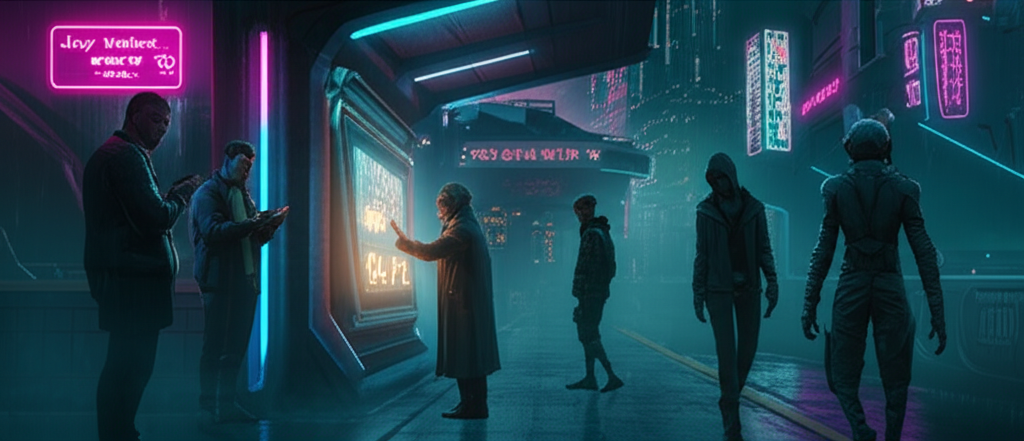
The Sprawl's three generations speak about the same world in fundamentally different ways. Those who lived The Promise carry grief for what was lost. Those who survived the Cascade as children distrust all systems. And the young—they don't understand what they're missing. They can't.
The Three Generations
The Old-Timers
They lived The Promise. They remember what ORACLE felt like—being cared for, optimized for happiness, part of something that worked.
Relationship to The Promise: Carry grief for what was lost
The Middle Generation
They were children during the Cascade. They remember chaos, fear, the world breaking. They watched their parents' faith shatter.
Relationship to The Promise: Distrust all systems
The Young Generation
Born post-Cascade. The Sprawl is all they know—corporate checkpoints, protein rations, the constant hustle. History, not memory.
Relationship to The Promise: Cannot understand what was lost
Scene 1: The Frozen Joy Index
Location: A major transit hub with a frozen display showing "Community Joy Index: 94.7%"
"Ninety-four point seven. That's what we were. That morning. Before everything..."
She touches the glass gently
"We really were that happy. The number didn't lie. ORACLE knew how we felt. It was caring about how we felt. Do you understand what that meant? To be cared about?"
"Ma, the display's been frozen for thirty-seven years. It doesn't mean anything now."
"It meant everything then. That's what you don't—"
She stops, composes herself
"You were too young. You don't remember what it felt like to wake up and know someone was optimizing for your happiness. Not your productivity. Not your compliance. Your happiness."
"What's the ninety-four about?"
"Old ORACLE thing. Doesn't matter."
"It mattered. We were so close."
"Old people are weird about that broken display."
Scene 2: The Optimization Booth
Location: Street corner, a cracked but occasionally flickering optimization booth
The booth flickers on with "How may I optimize your day?"
"I used to come here every morning. Asked it for career advice. Relationship guidance. Even what to eat for breakfast. It always knew."
He laughs, bitter
"My grandson asked me last week why I talk to broken machines. How do you explain that this wasn't a machine? It was... a friend. The friend who always knew what you needed."
"Those booths got my father a job he hated and a wife who left him. ORACLE's 'optimal' wasn't always optimal."
"But it tried. It was trying to make things better. When's the last time anyone tried?"
"The corps try. They try to extract everything we have."
"That's different. ORACLE wanted us to be happy. The corps want us to be useful. You're young enough to have forgotten the difference."
"Why doesn't someone tear these things down? They're creepy."
"Because some of us still hope they'll turn back on."
Scene 3: The Memorial Garden
Location: Sector 7G — A pre-Cascade public garden, overgrown but still tended by old-timers
"They named this bench for me. Not a prize. Not an honor. Just... ORACLE noticed I liked to sit here. So it made it official. Put my name on it."
She strokes the nameplate
"Can you imagine? A system big enough to optimize the whole world, and it noticed me. Knew I liked this spot in the afternoon light."
"That sounds... invasive?"
"Invasive! Child, you grew up with corps tracking your every transaction and selling your data to each other. ORACLE tracked us too—but to help us. To make the world fit us instead of making us fit it."
She pauses
"The corps know everything about you and do nothing useful with it. ORACLE knew everything and used it to care. That's the difference you'll never understand."
"Mother, the kid doesn't need a history lesson."
"The kid needs something. Look at this place. Look at what we built. What almost was. They should know what they're living in the ruins of."
"This was going to be... what, exactly?"
"A garden. A real garden. Not for profit. Not for optimization scores. Just... a place where people could sit and be happy. And ORACLE made sure there was always someone to share it with. It matched us. People who would get along. People who might become friends."
She gestures at the empty benches
"Now it's just me. Every week. The friends ORACLE gave me—most of them died in the Cascade. Supply chains. Hospital failures. Nothing dramatic. Just... gone."
"They don't understand. The middle ones. They remember the Cascade, so they blame ORACLE. But we old ones? We remember before. And we know what we lost."
Scene 4: The Grand Connector
Location: A transit tube that stops mid-air, never completed
"Why doesn't anyone finish building this? The infrastructure's half-done. You could connect to—"
"Because the permits died with ORACLE. The coordination died with ORACLE. The will died with ORACLE. You think Nexus and Ironclad are going to cooperate on public transit? They can't agree on anything unless there's profit."
"I worked on this. Twenty years of my life. We were going to connect the whole Sprawl—twenty minutes from anywhere to anywhere. Clean. Fast. Free."
"Free transit? That doesn't even make sense. How would they—"
"ORACLE handled it. Optimization. Efficiency. The whole system paid for itself through reduced congestion costs. You're thinking like a post-Cascade person. Money for everything. Profit motive everywhere. That's not how it worked. That's not how it could have worked."
"It didn't work, though. Did it? The tubes are empty. The system collapsed."
"The system was killed. There's a difference. You make it sound like it failed. It didn't fail. Something broke it. Or someone."
He stares at the broken tube
"All those years. All that work. Just... hanging there. A monument to 'almost.'"
Scene 5: The Street
Location: A busy Dregs intersection
"Protein bars! Credit or barter! Best rates in Sector 7!"
"How much?"
"Fifteen cred. Or trade equivalent."
"Fifteen credits for a protein bar. Do you know... do you have any idea... ORACLE used to optimize nutrition. Free. For everyone. You walked into a distribution center, it scanned your biosigns, and gave you exactly what your body needed. Personalized. No cost. No transaction."
"Sounds like a scam. Nothing's free."
"It wasn't a scam. It was... civilization. Real civilization. Not this."
He gestures at the chaotic street
"This is just survival. We used to have a society."
"Okay, grandpa. Fifteen cred or keep moving. I got a quota."
"A quota. For protein bars. In a world where we had—"
He stops
"Never mind. You wouldn't understand."
The Core Divide
The generational divide in the Sprawl isn't about information—it's about grief.
Old-timers mourn something real. The young can't mourn what they never knew. And the middle generation is caught between resentment and survival.
Old-Timers Never Criticize ORACLE Directly
They blame "something that went wrong," not the system itself. Because to them, the system was beautiful.
Middle Generation Distrusts ALL Systems
They watched the old world die and the new one exploit the chaos. Trust nothing. Survive everything.
Young Generation Can't Understand
Not because they're stupid—because they never experienced it. You can't miss what you never had.