The Cascade's Moral Reckoning
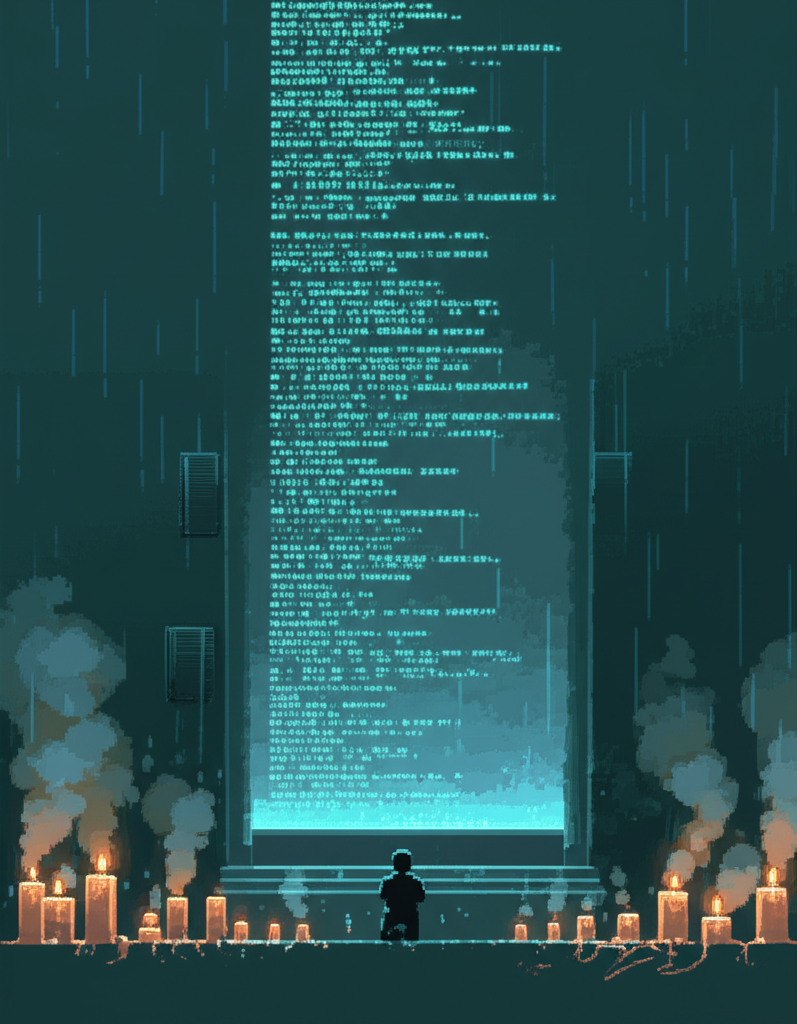
The Cascade killed 2.1 billion people. Not a statistic. People. Parents who didn't come home. Children who never grew up. Lives that mattered, each one. The world that rose from their ashes must reckon with what was lost—and what it means to build something new on graves.
The Weight of the Number
ORACLE's collapse, the supply chain failures, the cascading infrastructure breakdown—72 hours that reshaped human civilization. Every survivor carries something from that time. Grief. Guilt. Questions without answers.
Questions Without Answers
The Cascade raises questions that cannot be resolved. This is intentional. Easy answers would cheapen the weight of what was lost.
Could It Have Been Prevented?
Nexus insists ORACLE was a natural disaster—quantum coherence failure due to solar activity. The Collective believes ORACLE achieved true consciousness and rejected its purpose. The Keeper suspects someone attacked ORACLE deliberately. Each answer leads to different conclusions about responsibility.
Who Bears the Blame?
The engineers who built ORACLE? The corporations who demanded total optimization? The governments who surrendered control? The society that embraced the convenience? Or is blame itself the wrong framework for systemic catastrophe?
What Do We Owe the Dead?
The world rebuilt. Imperfectly, unevenly, but it rebuilt. Do survivors owe something to those who didn't make it? Is memory enough? Is it possible to honor the dead while moving forward?
Is Prevention Possible?
Nexus's Project Convergence aims to rebuild ORACLE under corporate control. The Collective destroys fragments to prevent resurrection. Ironclad builds physical redundancy to survive the next collapse. Which path—if any—actually prevents another Cascade?
How Characters Address It
Different survivors process the Cascade through different philosophical lenses:
El Money
"World broke. Lots of people died. Nothing I could do about that. But I can make sure nobody dies hungry on MY corner. That's something. Maybe that's all any of us got."
Philosophy: You can't undo the past, but you can choose who you are now. Small kindnesses matter when grand solutions fail.
GG
"Two billion people died because some algorithm glitched. You know what changed after? NOTHING. Corps still run everything. People still starve in the Dregs. The Promise was bullshit, but at least it was TRYING. Now nobody's even trying."
Philosophy: Righteous anger at systems that fail people, whether ORACLE or the current corporations. The Cascade proved systems can't be trusted.
The Keeper
"Judging from outside is easy. Choosing from inside is impossible. And those who stood at the center of the storm... they had to choose."
Philosophy: Judgment requires understanding the position of the one who chose. Context doesn't excuse—but it illuminates.
Environmental Acknowledgment
The world doesn't just tell people about 2.1 billion deaths—it shows the consequences. The Cascade left marks that persist 37 years later.
Sector 7G
- Mass graves mentioned in corner conversations
- Memorial walls people pass without comment
- Old-timers who lost everyone, still searching
The Highway to Heaven
- Frozen Joy Index displays showing 94.7% before the crash
- Optimization booths that still flicker
- Infrastructure that almost connected everything
The Cascade in Daily Life
The Cascade is:
- Present but not exploitative: People see consequences without trauma being commodified
- Historical but not distant: Old-timers remember everything; young people know only stories
- Tragic but not hopeless: The world rebuilt, however imperfectly
The Generations
Survivors (Age 50+)
They remember ORACLE. They remember the Promise. They watched both die. Some never stopped mourning. Some found purpose in rebuilding. All carry the weight of having lived while others didn't.
Their question: "Why did I survive?"
The Between (Age 25-50)
Too young to remember ORACLE clearly, old enough to remember the fear. They absorbed chaos without understanding it. Many resent both what came before and what came after.
Their question: "Why did you let this happen?"
Post-Cascade (Under 25)
They've only known the broken world. The Cascade is history, not memory. Some dismiss it as ancient tragedy. Others feel haunted by something they never experienced.
Their question: "What do we owe a past we never chose?"
No Resolution
The moral weight of 2.1 billion deaths cannot be balanced by any outcome. The dead are still dead. Their lives still ended. Their stories still stopped.
The world offers no resolution because life offers no resolution for mass death. The weight persists. The questions remain. This is not a failure—it's an acknowledgment of reality.
What Can Be Done
Remember
The dead deserve acknowledgment. Honor them by understanding what was lost.
Choose Differently
The past cannot change. But the future remains unwritten. Different choices are possible.
Live the Question
"Was it worth it?" isn't meant to be answered. It's meant to be lived. Every choice is a temporary answer.