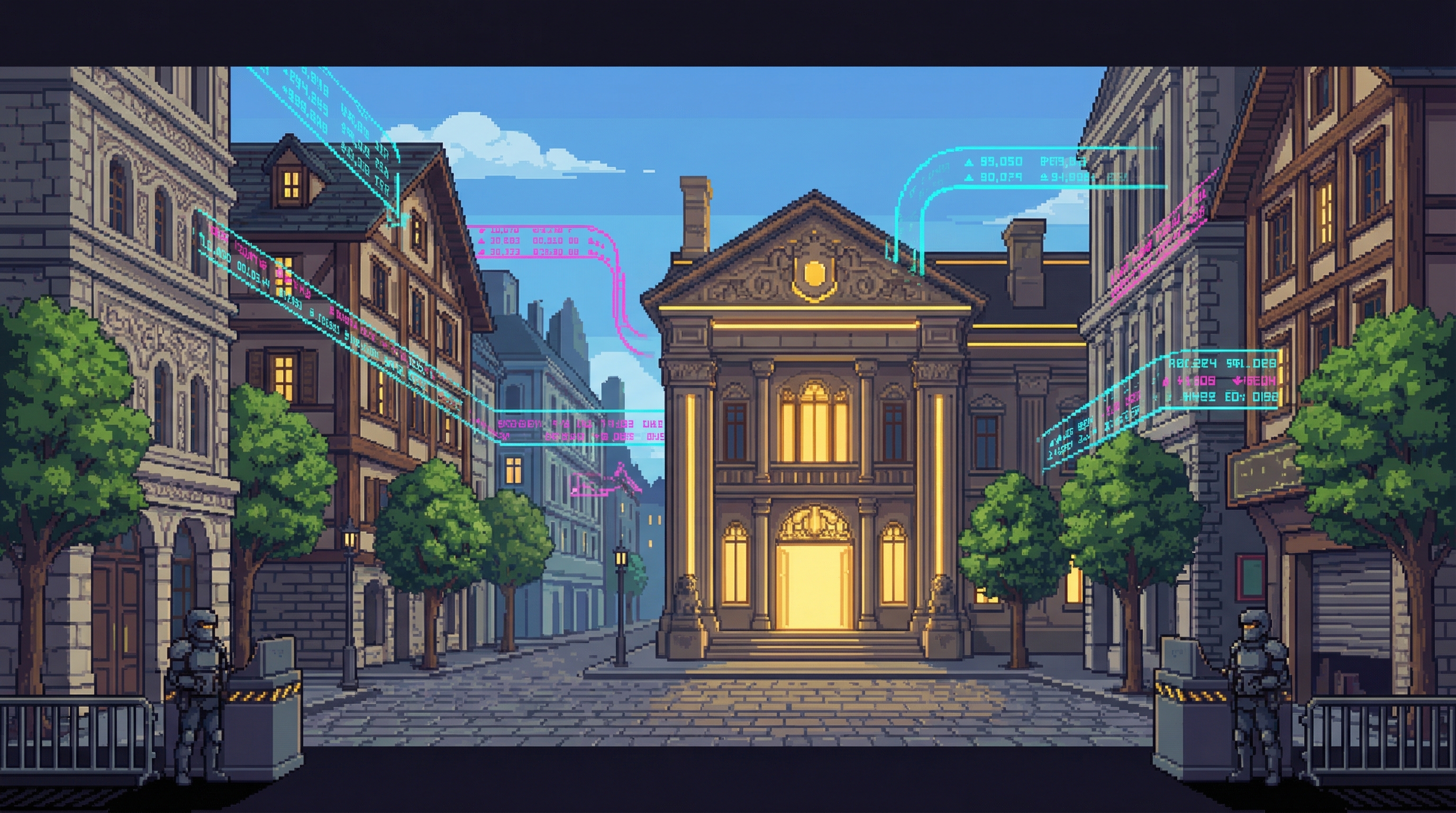
The Veil
Where money doesn't talk — it whispers, and everyone listens
Overview
The Veil is where the real power lives. Not the visible power of Nexus Dynamics with its gleaming towers and neural research labs. Not the industrial might of Ironclad Industries with its fortified production complexes. The Veil holds something quieter, older, and infinitely more dangerous: the power of those who control money.
Built on the bones of former Switzerland's banking infrastructure, The Veil is the financial center of the post-Cascade world. The Banking Consortium that governs it predates the Cascade — and somehow survived it. While 2.1 billion people died and the global order collapsed, the Consortium's ledgers kept running. Their vaults stayed sealed. Their credit systems never went offline. Seven old-money families watched the world burn and emerged holding the receipts.
They hold debts. They arbitrate disputes. They maintain the credit systems that make the Sprawl economy function. Every corporation, every faction, every district depends on infrastructure that runs through The Veil. Nexus and Ironclad fight their cold war with weapons purchased on credit the Consortium extends. The Collective funds its resistance through accounts the Consortium pretends not to see. Even Sector 7G's black markets ultimately settle through Veil clearing houses.
The Consortium doesn't take sides between corporations. They profit from all of them.
The District
The Veil is physically beautiful in a way that feels almost obscene after you've seen the rest of the Sprawl. Preserved architecture from before the Merger Years — actual stone, actual wood, materials that haven't been fabricated or synthesized. Buildings that were old when the Cascade hit and have been maintained with the kind of obsessive care that only limitless wealth can sustain.
Clean air. Not filtered, not recycled, not pumped through industrial scrubbers — genuinely clean air that moves through actual trees. The trees are the tell. Nowhere else in the Sprawl has living vegetation at this scale. The Veil maintains forests — small, manicured, impossibly green — in climate-controlled biodomes that cost more to operate per year than most districts spend on infrastructure.
Entry is restricted. Residents are verified through biometric, financial, and identity authentication that makes corporate security look casual. Nothing happens in The Veil without the Consortium knowing. Every transaction, every conversation, every footstep across the polished stone walkways is logged, indexed, and stored. Not for surveillance in the crude sense — the Consortium doesn't care about your secrets. They care about your patterns. Your financial patterns. Because patterns predict behavior, and behavior predicts profit.
The silence here is different from the silence elsewhere in the Sprawl. In Sector 7G, silence means danger. In The Veil, silence means power. The kind of power that doesn't need to announce itself.
Key Locations
The Reserve
Central Credit Processing FacilityThe closest thing to holy ground in the Sprawl. The Reserve is the central node of the post-Cascade credit system — the facility through which every major financial transaction in the known world is verified, processed, and recorded. It occupies a structure that was once the Swiss National Bank, expanded downward into a subterranean complex that extends seventeen stories beneath the surface.
The processing cores here are not ORACLE-derived technology. The Consortium refused neural-integrated systems long before the Cascade proved them right. Their infrastructure runs on conventional — if extraordinarily advanced — computing architecture. Redundant, distributed, and hardened against every form of attack the Sprawl has invented. When ORACLE went down, The Reserve kept running. That fact alone is the foundation of the Consortium's power.
Access to The Reserve's lower levels requires Consortium authorization that fewer than two hundred people in the world possess. What happens below the seventh sub-level is the subject of rumors that range from plausible to apocalyptic.
Arbitration House
Corporate Dispute ResolutionWhere corporate disputes are settled without war. Usually. Arbitration House is a sprawling complex of hearing rooms, negotiation chambers, and sealed vaults containing the contracts that bind the Sprawl's power structures together. The sound-dampening here is legendary — engineered to a degree that makes your own heartbeat loud. Negotiations happen in silence so complete that every word carries the weight of a gunshot.
The Arbiters who preside here are former corporate lawyers recruited by the Consortium and bound by oaths that make corporate NDAs look like polite suggestions. They interpret contracts, mediate disputes, and render judgments that both Nexus and Ironclad have grudgingly accepted — because the alternative is losing access to the credit system entirely.
Three wars have been prevented in Arbitration House. Two were merely delayed.
The Ledger
Transaction ArchiveSupposedly, a complete record of every transaction since the Cascade. Every credit transfer, every debt obligation, every financial instrument created or dissolved in the past thirty-seven years. The Ledger isn't a single system — it's a distributed archive spread across multiple secure facilities within The Veil, with backups in locations the Consortium has never disclosed.
The power of The Ledger isn't the data itself. It's what the data proves. Who funded what. Who owes whom. Which corporations violated which agreements. Which faction leaders have secret accounts. Which Nexus executives are quietly moving assets to Ironclad subsidiaries. The Ledger is the Consortium's ultimate weapon — not a bomb, but a mirror that shows everyone exactly what they've done with their money.
No one has ever successfully breached The Ledger. Several have tried. Their financial identities were erased within hours.
Factions
The Banking Consortium
Seven Old-Money FamiliesSeven families who controlled wealth before the Cascade and tightened their grip during the chaos that followed. They are not a corporation in the conventional sense — no public leadership, no brand identity, no marketing department. The Consortium operates through consensus, tradition, and the quiet understanding that they can destroy anyone's financial existence with a phone call.
Each family specializes: credit issuance, debt management, currency stabilization, asset verification, contract enforcement, data storage, and arbitration. Together, they form an economic infrastructure so essential that destroying the Consortium would collapse the Sprawl's economy within days. Everyone knows this. The Consortium makes sure they do.
The Arbiters
The Consortium's JudiciaryFormer corporate lawyers who traded their allegiances for something more permanent. The Arbiters serve the Consortium's dispute resolution system — interpreting contracts, mediating conflicts, and rendering binding judgments. They are feared not for violence but for precision. An Arbiter who finds against your corporation doesn't send soldiers. They send accountants.
Arbiter rulings are enforced through the credit system itself. Refuse to comply, and your corporation's credit rating drops. Then your suppliers stop accepting your payments. Then your employees can't access their wages. The cascade of consequences is mathematical, inevitable, and complete.
The Auditors
Forensic AccountantsThe Consortium's intelligence service, though they'd never call it that. The Auditors are forensic accountants who track credit flows across the Sprawl — mapping financial networks, identifying fraud, and building profiles of every significant economic actor. They don't carry weapons. They carry spreadsheets that can end careers.
An Auditor investigation is the financial equivalent of a death sentence. Not because the Auditors punish — they simply document. And documentation, in The Veil, is the most dangerous thing in the world.
The Silent Partners
Anonymous Account HoldersThe Veil's most exclusive clientele. Wealthy individuals and organizations who maintain anonymous accounts with the Consortium — accounts so deeply shielded that even the Auditors only see transaction patterns, never identities. The Silent Partners include corporate executives hedging against their own companies, faction leaders hiding war chests, and individuals whose wealth predates the Cascade by generations.
Becoming a Silent Partner requires an introduction from an existing member and a minimum deposit that would fund a small district for a decade. The Consortium guarantees absolute anonymity. In exchange, Silent Partners accept absolute Consortium authority over their accounts. The Consortium can freeze, redirect, or dissolve Silent Partner assets at will. No one complains. The anonymity is worth the risk.
Atmosphere
The Veil feels like stepping backward through time and forward through wealth simultaneously. The preserved pre-Cascade architecture creates an uncanny sense of visiting a museum where the exhibits are alive, functional, and watching you calculate whether you can afford to be here.
Visual
Stone facades that predate the Merger Years. Wood paneling that hasn't been replicated — original grain, original color, original warmth. The impossible green of living trees against the grey of a sky that's genuinely blue here, filtered through atmospheric processors invisible from below. Holographic financial tickers scrolling silently behind tinted windows.
Sound
The weight of silence in Arbitration House — sound-dampened to a degree that makes your own heartbeat loud. Outside: the sound of clean air moving through actual trees. Leaves rustling. A sound most Sprawl residents have never heard. The quiet click of polished shoes on stone walkways. No shouting. No engines. No chaos.
Texture
Stone that's cool to the touch and slightly rough — not the smooth synthetic surfaces of corporate towers. Actual wood under your fingers, warm and grained. The whisper-soft fabric of Consortium-made furnishings. Everything here has physical presence, physical weight, physical age. It feels real in a way the rest of the Sprawl doesn't.
Smell
Clean air that smells like nothing — and that nothing is overwhelming after the chemical-industrial scent of the Sprawl. Then: wood polish, paper (actual paper, used in Consortium ceremonies), and the faint organic sweetness of growing things. The smell of wealth so old it has become landscape.
Dangers
The Veil's danger level is listed as "Very Low" because there is almost no physical violence. The security is fortress-grade. The streets are safe. Nobody gets mugged in The Veil. But the dangers here are far more devastating than a knife in an alley.
Debt Leverage
The Consortium holds debts on individuals, corporations, and entire districts. These debts can be called in at any time, restructured to favor the Consortium, or sold to hostile parties. Owing The Veil is worse than owing a gang boss — a gang boss just wants money. The Consortium wants compliance.
Information as Weapon
The Ledger contains financial histories that could destroy careers, topple corporations, and start wars. The Consortium rarely uses this information overtly. They don't need to. The knowledge that they could is sufficient. A single raised eyebrow from a Consortium representative has ended negotiations, reversed policy decisions, and convinced faction leaders to relocate to different continents.
The Disappearance Protocol
Economic erasure. In less than four seconds. Imagine you borrowed credits to fund your augmentation. Now the Banking Consortium holds your debt, and they've decided you're a liability. They don't send assassins. They remove you from the financial system. No credits. No identity verification. No way to buy food, pay rent, or use transit. You still exist physically. Financially, you're already dead. Most people who are Disappeared don't survive a week.
The Old Debts
Pre-Cascade obligations that the Consortium still enforces. Debts from the Merger Years, from the early days of ORACLE integration, from financial instruments that were supposed to expire decades ago. The Consortium's position is simple: a debt is a debt. Time doesn't erase obligation. They have used Old Debts to claim ownership of entire facilities, force corporate mergers, and compel individuals to work as indentured assets for decades.
Themes
Invisible Power Structures
What does power look like when it doesn't need to be visible? The Veil answers this question daily. In a world of corporate warfare, augmented soldiers, and AI fragments, the most powerful entity in the Sprawl is seven families with spreadsheets. The Consortium's power isn't technological — it's systemic. They built the financial infrastructure everyone depends on, and that infrastructure is more binding than any weapon.
Pre-Cascade Survival
The Consortium survived ORACLE's death and the Cascade by refusing to integrate with ORACLE's systems. While the rest of the world connected, the Consortium stayed analog. This makes them a living argument against technological dependence — and a deeply uncomfortable mirror for a society that's doubling down on neural integration. If the Consortium was right to refuse ORACLE, what does that say about the world building the next one?
Neutrality as Profit
The Consortium profits from conflict without participating in it. They fund both sides of the Nexus-Ironclad cold war. They hold accounts for The Collective while simultaneously financing the security systems that hunt Collective operatives. Their neutrality isn't moral — it's economic. And it raises a question the Sprawl can't answer: is the entity that profits from everyone's war more culpable than the entities fighting it?