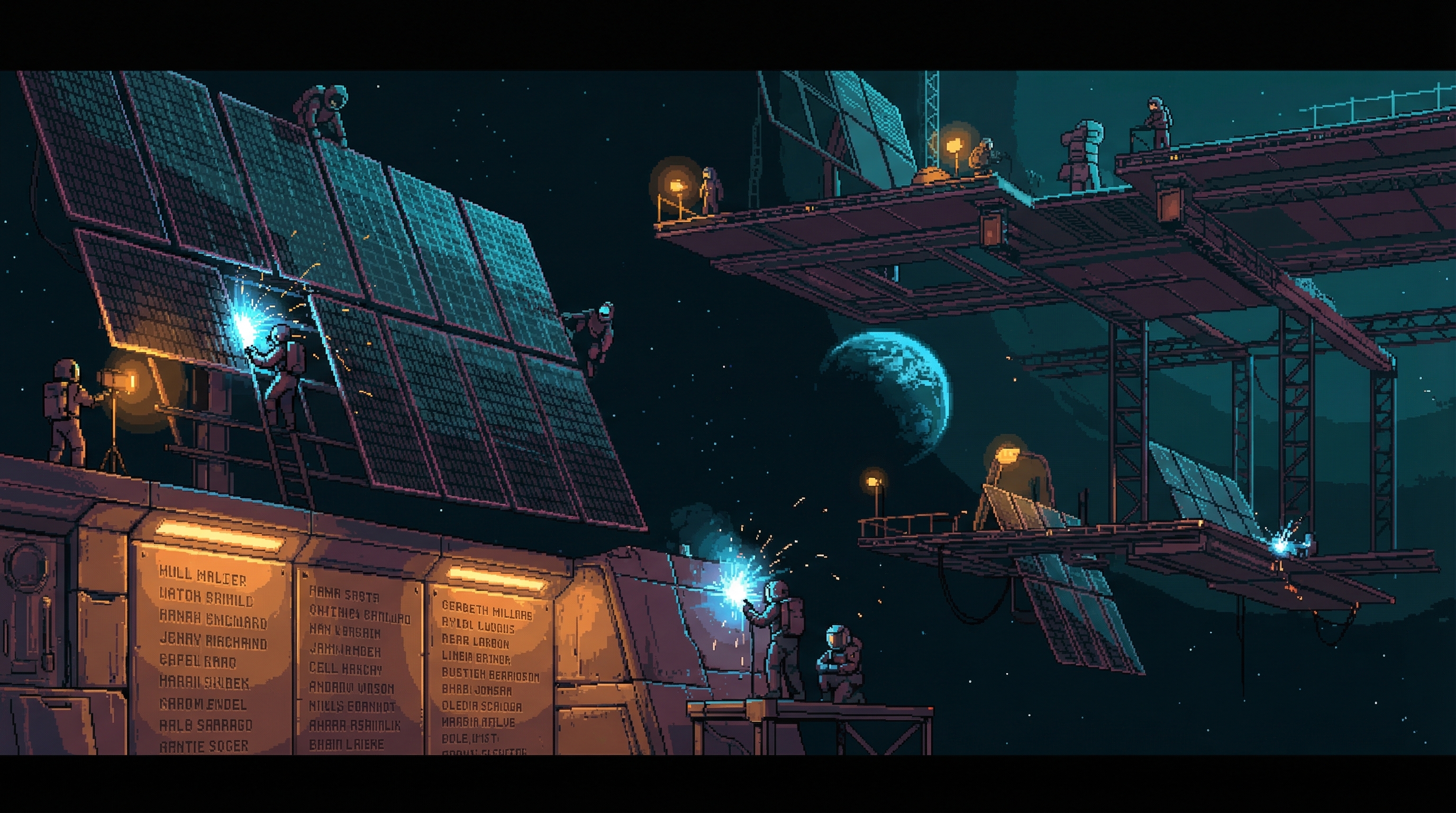
The Assembly Yards
Where the Lattice becomes real, one beam at a time.
Overview
At the Lattice's midpoint -- equidistant between Mercury's furnace and Earth's blue comfort -- the Assembly Yards are where humanity builds its longest reach. Solar collectors arrive as raw materials from Belt mining operations and Ironclad's orbital foundries. The Yards are where those components become collectors.
The facility spans approximately 300 cubic kilometers of construction platforms, material storage bays, and improvised habitats. Approximately 4,000 construction workers cycle through on rotating six-month contracts. The work is assembly in hard vacuum -- bolting structural beams to collector frames, wiring photovoltaic arrays, aligning reflective surfaces to tolerances measured in fractions of degrees. Nothing about it is complicated. Everything about it can kill you.
A mishandled structural beam that "weighs" nothing in zero-g still has the same mass. Inertia does not care about gravity. A hundred-tonne collector strut drifting at half a meter per second will crush a suited worker against a platform with the same force it would on Earth -- just slower, quieter, and without the dignity of a sound. The Yards' memorial wall adds approximately six names per year. The names are engraved in hull plating. Nobody pretends that's poetic. It's what they had.
Conditions Report
You exit the docking bay. Through your faceplate: nothing. Absolute black in every direction except the construction platforms, which glow amber with work lights. Somewhere behind you, Earth is a blue dot the size of your thumbnail. You feel the vibration of a welding arc through your boots before you see the light.
Visual
Construction amber against void black. Blue-white welding arcs flashing on distant platforms like slow-motion lightning. The faint blue of Earth, visible during rest breaks through observation ports -- too far to feel like home, close enough to remind you what home looks like. Solar collectors in various stages of assembly, skeletal frames catching light at angles that make them look alive. The memorial wall near the main docking bay, names catching light from passing work lamps.
Sound
Inside the hab modules: the hum of life support, the clang of tools being racked, the muffled conversations of people who have run out of things to say to each other three months into a six-month rotation. Outside, in suits: your own breathing. The click of magnetic boots. Radio chatter, terse and professional. And during off-shifts, through the station hull, something else -- a low vibration that is not mechanical. The Lattice, humming.
The Void
The defining feature of the Yards is what isn't there. No atmosphere. No horizon. No weather. No sound outside a suit. The human brain was not built for this much nothing. Long-rotation workers report a specific psychological state -- "yard eyes" -- where depth perception fails because there are no reference points. A collector frame fifty meters away and a platform five kilometers away look the same size. Veterans learn to trust their instruments. Newcomers learn to trust the veterans.
Void Tone
During off-shifts, workers gather in the observation bays and listen. The Lattice -- all 93 million kilometers of it -- produces structural vibrations that travel through the Assembly Yards' hull. Frequencies no one planned. Harmonics no one designed. The sound of the largest structure humanity has ever built, humming to itself. The workers call it void tone. It is the Yards' only art form, born from the structure they are building with their hands.
The nearest Freeport bar is three light-minutes away. Void tone is free and it is here.
"First rotation, you count the days. Second rotation, you stop counting. Third rotation, you start listening to the tone. After that, you're either a lifer or you're done. No middle ground out here." -- Assembly Yards shift supervisor, exit interview recording
Points of Interest
The Construction Platforms
Dozens of open-frame platforms ranging from fifty meters to two kilometers across, anchored in formation by station-keeping thrusters. Each platform serves a stage of collector assembly: frame fabrication, photovoltaic mounting, reflective surface alignment, quality inspection, and launch preparation. A completed collector detaches from the final platform and is guided into its position on the Lattice network by automated tugs. The entire process takes approximately six weeks per unit.
The Memorial Wall
Located beside the main docking bay -- the first thing arriving workers see, the last thing departing workers pass. Hull plating engraved with names, dates, and cause of death. The causes are clinical: "Inertial impact, Strut 7-C." "Suit breach, Platform 14." "Decompression, Storage Bay 3." Six names per year, on average. Some years fewer. Some years more. The wall has been growing since the Yards opened. Nobody talks about running out of space. There is always more hull plating.
Material Storage Bays
Pressurized warehouses containing raw components shipped from Belt mining operations and Ironclad's orbital foundries. Carbon-composite struts, photovoltaic arrays, reflective sheeting, wiring harnesses, fastener assemblies -- everything needed to build a solar collector from scratch. Drift-Runner Tomas Wren supplies the Yards three times weekly, threading cargo through the construction zone in runs that require precision navigation between active work platforms.
Hab Modules
Improvised living quarters scattered throughout the construction zone -- pressurized cylinders bolted to platform struts, connected by enclosed walkways. Functional and grim. Sleeping racks for eight, shared mess facilities, a medical bay staffed by a single medic per shift. The culture inside is work, eat, sleep, work. Rotation calendars on every wall, days marked off. Personal effects kept to what fits in a locker. Nobody decorates. Everyone leaves.
Who Works Here
Four thousand people, cycling through on six-month contracts. The work draws a specific kind: people comfortable with vacuum, comfortable with isolation, comfortable with the knowledge that help is light-minutes away if something goes wrong fast. Most are repeat contractors -- workers who have done two, three, five rotations and keep coming back because the pay is good, the work is honest, and the alternatives are worse.
The culture is functional. Shift supervisors run tight crews because loose crews die. Social hierarchies form around competence, not seniority -- a first-rotation worker who can align a reflective surface to spec earns respect faster than a third-rotation worker who can't. Off-shift entertainment is limited to what people bring with them, what they can make from what's available, and void tone. Mostly void tone. Workers gather in the observation bays the way people on Earth gather around campfires -- not because they planned to, but because the alternative is staring at the walls of a hab module that smells like recycled air and four thousand other people.
Ironclad operates the Yards and sets the contracts. The terms are clear: six months, hazard pay, medical coverage for on-site injuries, transport home when your rotation ends. What happens to your lungs after twenty years of suit breathing is your problem. What happens to your mind after six months of void is your problem. The memorial wall is Ironclad's only concession to sentiment, and even that serves a function -- it reminds every worker walking in that the work is real, the vacuum is real, and the six names per year are not a statistic. They are a forecast.
Strategic Assessment
The Invisible Backbone
The Assembly Yards build the solar collectors that power the Lattice, which powers the Sprawl. Every watt consumed in Nexus Central, every light burning in the Stacks, every data center humming in the corporate towers -- all of it traces back to collectors assembled by suited workers in hard vacuum at the Lattice midpoint. Nobody on Earth thinks about where their power comes from. The workers at the Yards think about nothing else.
The Foundry Parallel
Surface-side, the Foundry runs the same calculation: heavy labor, grim conditions, memorial walls that grow longer every year. The parallel is exact. The difference is atmosphere -- the Foundry workers breathe bad air; the Yards workers breathe bottled air. The Foundry has Worker's Row; the Yards have hab modules. Both employ people building infrastructure they will never benefit from, maintained by institutions that view them as line items. The Yards are the Foundry in vacuum.
Supply Chain Vulnerability
Four thousand workers at the Lattice midpoint, three light-minutes from the nearest settlement, dependent on regular supply runs for everything from food to fasteners. If Drift-Runner Wren's shipments stop for two weeks, the Yards go dark. If the Yards go dark, new collector assembly halts. If new collector assembly halts, the Lattice cannot expand to meet growing energy demand. The entire Sprawl's energy future depends on a supply chain that passes through 300 cubic kilometers of open vacuum staffed by contract workers on six-month rotations. Nobody talks about this. The people who would need to talk about it are the people who benefit from not talking about it.
▲ Restricted Access
The Tone Is Changing
Long-rotation workers -- the ones on their fourth or fifth cycle -- report that void tone has shifted in frequency over the past eighteen months. Not dramatically. Not in ways instrumentation confirms. But the workers who have been listening for years say the Lattice sounds different. Higher. More complex. As if additional harmonics are emerging from a structure that hasn't changed in composition. Ironclad attributes this to "perceptual drift in long-duration isolation." The workers who hear it are not convinced. They built the thing. They know what it sounded like. It sounds different now.
Memorial Wall Anomaly
The memorial wall lists six names per year, on average. Except for three non-consecutive years in which the number dropped to zero. Zero construction fatalities across 4,000 workers performing hard-vacuum assembly. Ironclad celebrated these years as safety milestones. Shift supervisors from those years tell a different story: not that accidents stopped, but that outcomes changed. Workers who should have died from decompression events or inertial impacts survived with injuries that should have been fatal. Medical reports from those years are sealed. The zero-fatality years do not correlate with any equipment upgrades, safety protocol changes, or workforce composition shifts. They correlate with nothing anyone can identify.