Overview
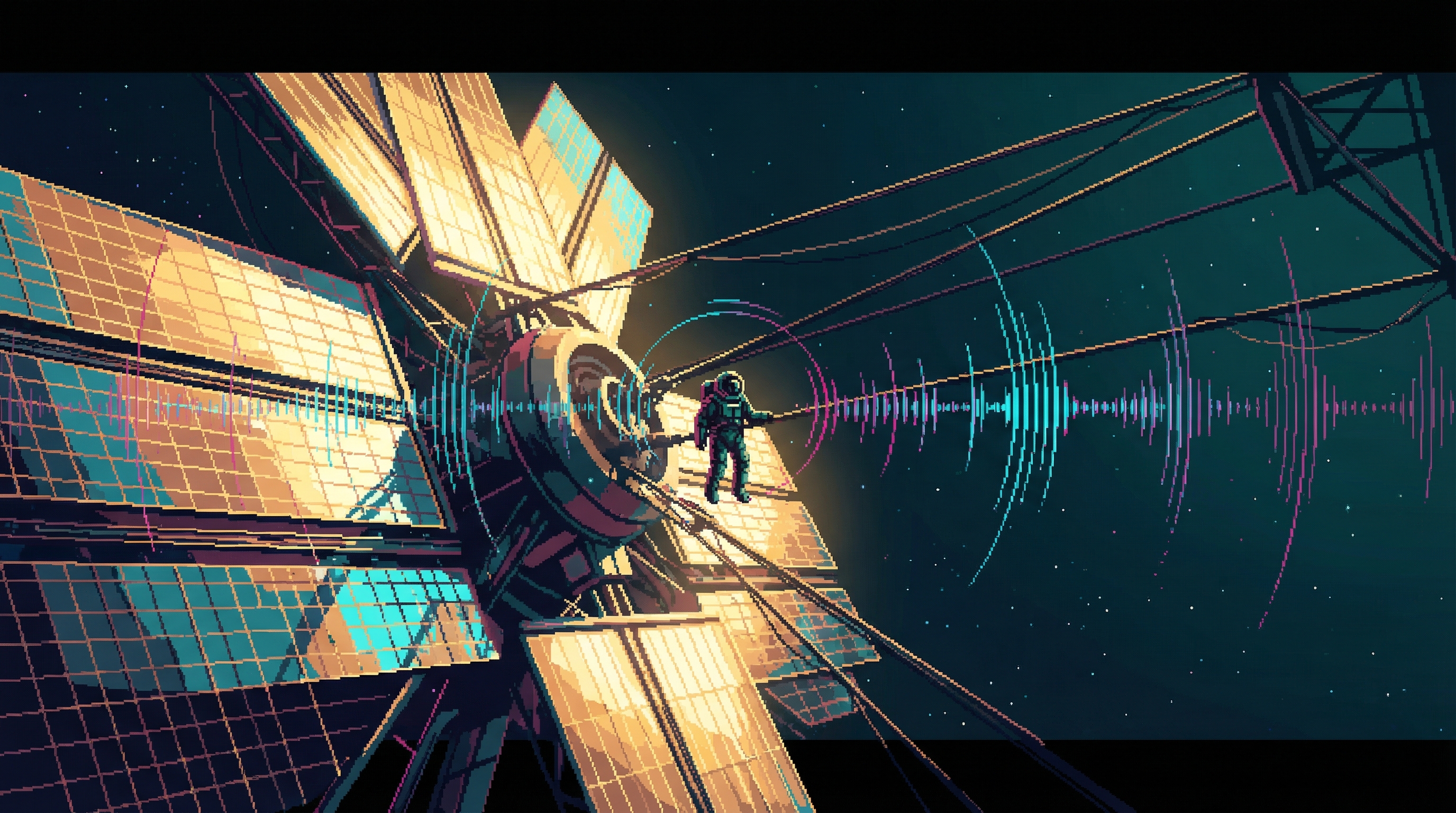
The first void tone recording arrived on the surface in a salvager's personal data cache — a two-minute audio file labeled "lattice weird noise" that a drift-runner named Sahar Koss had captured while repairing a solar collector array at 340 kilometers altitude.
The file contained a sound that shouldn't exist: a sustained harmonic produced by the interaction of solar radiation pressure on collector surfaces, transmitted through structural cables into the habitable sections of the Lattice. The frequency was below human hearing threshold at sea-level atmospheric pressure — but at the near-vacuum conditions of the collector arrays, with air pressure barely sufficient to carry sound, the frequency became audible as a tone that Koss described as "like a cathedral thinking."
Koss shared the recording with other drift-runners. They recognized it. They'd all heard it — the sounds the Lattice makes when sunlight hits its collectors and the energy propagates through kilometers of cable and structural steel. They'd been hearing it for years. They just hadn't thought of it as music.
A drift-runner named Pei Vansara did. In 2170, Pei began deliberately positioning herself at acoustic nodes — points where the Lattice's structural vibrations converged — and recording the results. She mapped the Lattice's resonant frequencies the way a musician maps a new instrument. She learned which collector arrays produced which tones, which cable tensions created which harmonics, which times of day generated which acoustic patterns.
Over three years, she composed sixteen pieces using the Lattice as her instrument. She performed them by positioning herself at specific structural intersections during specific solar conditions, activating and deactivating collector arrays to shape the sound, and recording the result with equipment modified to function at near-vacuum pressure.
When the recordings reached the surface, they changed music.
The Sound
Void tone is impossible to accurately describe to someone who hasn't heard it. The closest approximation:
Imagine the lowest note an organ can produce — a frequency felt more than heard, a vibration that enters the body through the bones. Now strip away the organ's mechanical overtones. Remove the air's contribution to the sound. What remains is a pure structural vibration — the sound of matter responding to energy at a scale that makes human music seem like a conversation in a very small room.
Lattice solar collectors produce tones from below hearing (2 Hz) to low midrange (400 Hz). Structural cables add harmonics that no ground-level instrument can replicate — overtone series shaped by kilometers of tensioned steel vibrating in near-vacuum, where the absence of atmospheric dampening allows harmonics to sustain indefinitely.
"Music that sounds like architecture. Like the sound a building would make if you could hear it thinking. Like the hum of a structure vast enough to have moods."
Drift-runners who live on the Lattice describe void tone as the sound of home. Surface listeners describe it as the sound of something much larger than themselves, paying attention.
The Authenticity Problem
Void tone breaks the Authenticity Market.
A legitimate void tone recording is a Tier 1 lived original — created by a specific person, in a specific place, during a specific acoustic event that will never recur exactly. By the Market's own standards, void tone is the most authentic music available.
But the conditions of creation are inhospitable. Drift-runners compose at orbital altitude, in near-vacuum, wearing pressure suits, at temperatures that cycle between -150°C in shadow and +120°C in direct sunlight. The acoustic environment cannot be reproduced on the surface. The experience of creating void tone is available only to the approximately 8,000 people who live and work on the Lattice.
The Tribunal's Dilemma
The Authenticity Tribunal has never sent a Judge to the Lattice. They certify void tone recordings based on metadata analysis and drift-runner testimony — a process that requires trusting the creators in a system built on verification.
Mercer's Synthetic Void Tone
Kael Mercer exploited this gap. His synthetic void tone — generated by AI models trained on Pei Vansara's original recordings — is indistinguishable from authentic Lattice recordings by surface listeners. Ground-level critics, including Orin Slade, cannot reliably identify which recordings originate from the Lattice and which originate from Mercer's studio.
The drift-runners can tell. They say the synthetic versions lack "drift" — the micro-variations in frequency caused by the Lattice's structural movements as it orbits.
"Authentic void tone breathes. Synthetic void tone hums." — Drift-runner saying
The difference is imperceptible to anyone who hasn't spent years listening to the Lattice's voice.
The Culture
On the Lattice
Void tone is not a genre to drift-runners. It's ambient sound. They hear the Lattice constantly — its collectors singing, its cables humming, its structural joints groaning as thermal stress cycles through the material. Pei Vansara's innovation wasn't creating void tone; it was recognizing that what they were already hearing was music.
This recognition changed Lattice culture. Drift-runners began sharing their favorite acoustic nodes — locations where the structural harmonics were particularly rich or unusual. Listening stations were improvised at structural intersections. Void tone gatherings — groups of drift-runners meeting at an acoustic node to listen together — became a social ritual.
The culture is informal, democratic, and fiercely protective of its origins. Drift-runners do not object to surface listeners enjoying void tone recordings. They object to surface listeners claiming to understand void tone.
"You're hearing a photograph. The Lattice is the landscape." — Pei Vansara, to a Sprawl journalist
On the Surface
Void tone's Sprawl audience is small but devoted. Approximately 10,000 regular listeners — concentrated in Neon Graves, Zephyria, and the academic enclaves — consume void tone recordings as a contemplative practice. The genre's inaccessibility is part of its appeal: in a world where every other musical experience can be neurally recorded and reproduced, void tone exists in a space that most people will never physically inhabit.
Orin Slade's review of the Lattice Recordings — a 3,000-word piece in The Zephyria Record — introduced void tone to the broader cultural conversation. He described the music as "the sound of infrastructure becoming conscious" and argued that void tone represented the purest challenge to the authenticity tier system: art that is unambiguously human, unambiguously original, and unambiguously impossible to verify.
Relief's "Void Tone Experiences"
Relief Corporation's synthetic recordings — presented with visual simulations of Lattice environments — sell to 200,000 subscribers. They bear approximately the same relationship to actual void tone as a photograph of a forest bears to the smell of pine needles.
They are extremely popular.
The Deeper Question
Void tone asks whether authenticity requires accessibility. If the most genuine music in the world can only be created in conditions that exclude 99.99% of humanity, what does that mean for a culture that has built its entire creative economy on the principle that authentic experience has measurable value?
The genre also embodies a quieter question: can a structure be an artist? The Lattice produces void tone whether or not anyone is listening. Pei Vansara shaped and recorded it, but the raw material — the sound — is generated by physics acting on engineering. The Lattice doesn't intend to make music. It makes music anyway.