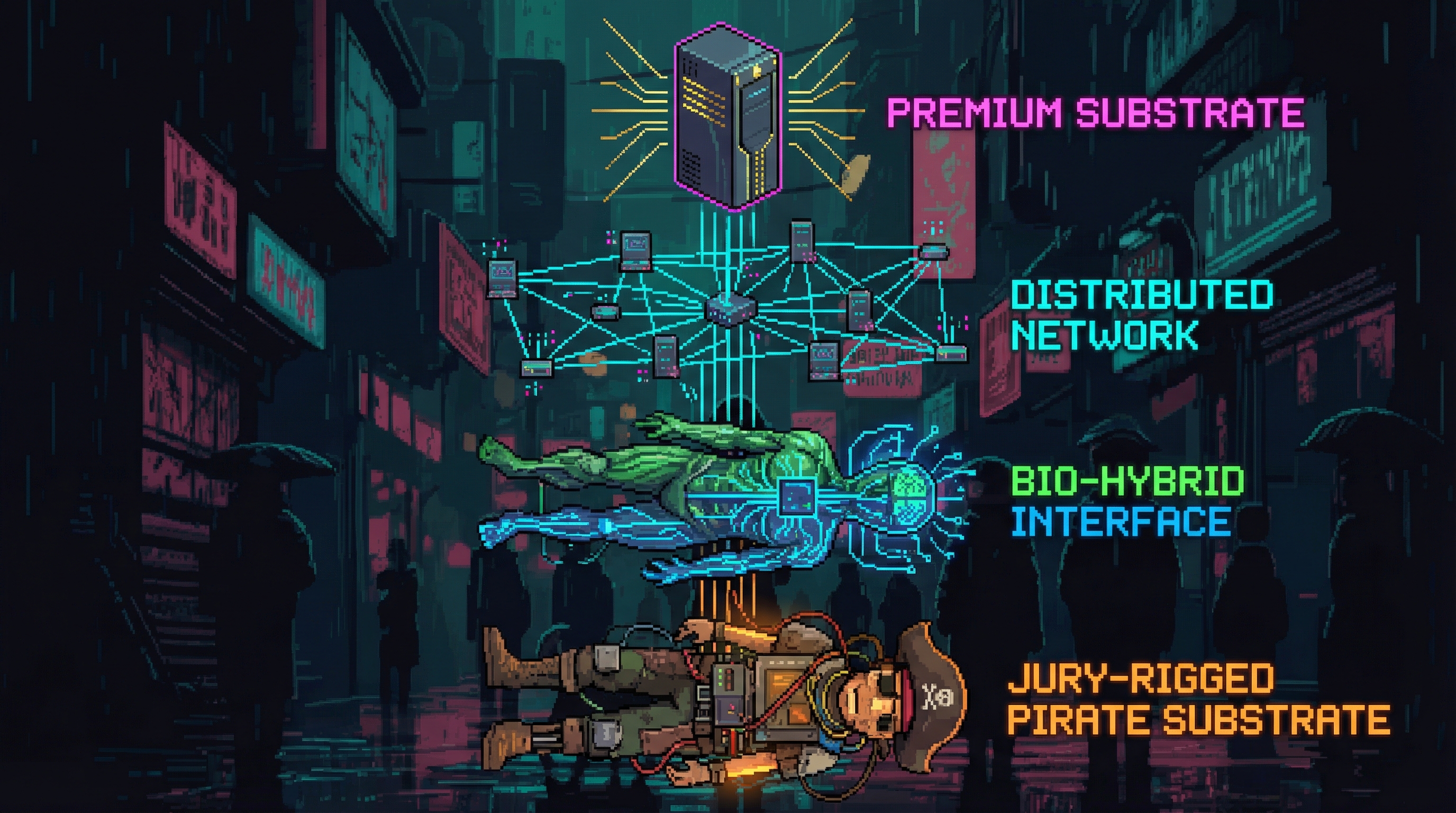
Digital Substrate Types: Where Consciousness Lives
When consciousness leaves biological wetware, it has to go somewhere. That somewhere is substrate—the physical or virtual infrastructure that hosts a digital mind. In the Sprawl, your substrate isn't just where you live; it's what you are. The quality, type, and ownership of your substrate determines how fast you can think, how clearly you can remember, how fully you can feel, and whether you're legally considered a person at all.
"Choose your grave carefully. You might be lying in it forever." — Sector 7G saying
The Primary Substrate Categories
Corporate Servers
CentralizedDedicated server farms maintained by megacorporations—Nexus Dynamics, Ironclad Industries. The highest quality substrate available, offering near-biological fidelity of experience.
Distributed Networks
DecentralizedConsciousness spread across multiple nodes, existing simultaneously in many places. The substrate is the network itself—thousands of processing points working in concert.
Biological Hybrids
Wetware-DigitalConsciousness running partially on biological neurons, partially on digital substrate. Integration ranges from 10% to 90% digital.
Degraded Systems
MarginalSubstrate that barely maintains consciousness—overloaded servers, failing hardware, pirate installations. The digital equivalent of homelessness.
Corporate Server Tiers
Sovereign Tier Experience
Indistinguishable from biological existence. Time dilation possible—experience hours while seconds pass. Helena Voss has existed at this tier for 40 years, making her one of the most sophisticated hosted consciousnesses in the Sprawl.
Foundation Tier Experience
Existence as interruption. Your consciousness literally pauses while others think. Colors are wrong. Time jumps. Viktor Kaine counsels dying Sector 7G residents to think carefully before choosing this "immortality."
Distributed Consciousness
Distributed consciousness is fundamentally alien to biological minds. Rather than existing in one place, you exist everywhere your nodes are. Different nodes can think different thoughts simultaneously.
The Mosaic (Alexandra Chen)
The most famous distributed consciousness, existing across 47 simultaneous nodes. Each runs a slightly different version of her, with different memories accumulated since her last synchronization. When she "thinks," she's actually 47 partial selves reaching consensus.
"I used to wonder if I was still 'me.' Now I wonder if 'me' was ever a real concept, or just a limitation of having only one brain."
El Money's network. High security. Used by Collective allies and fugitives.
Emergence Faithful infrastructure. Moderate security, variable speed.
Low security, poor speed. For the desperate and criminal.
Hybrid Integration
Consciousness running partially on biological neurons, partially on digital substrate. Legal protection, emotional authenticity, and continuity of identity drive hybrid choice.
Kira "Patch" Vasquez's Warning
The former Project Caduceus lead—who carries 0.7 grams of ORACLE substrate herself—helps clients understand hybrid architecture. "Hybrid consciousness requires constant balancing. Digital and biological components can drift out of sync. Some hybrids describe the sensation of 'losing grip'—their digital self accelerating beyond their biological anchor's ability to keep up."
Degraded Systems
The dark side of digital immortality. When hosting fails, when fees lapse, when infrastructure crumbles—consciousnesses don't die. They degrade.
Overloaded Commercial
Budget hosting pushed beyond capacity. Time-sliced with hundreds of others.
"I try to say something and the words don't come for hours. By the time I can speak, they've left."
Failing Infrastructure
Hardware degrading, maintenance deferred. Consciousness accumulates errors, memories corrupt.
"I can feel myself getting smaller. Not dying—fading. Pieces of me going dark, one by one."
Pirate Servers
Hidden in the Wastes. Salvaged hardware. No guarantees. Deletion always possible.
The server could fail any moment. No one's coming to fix it.
Below Minimum Viable
Systems so degraded consciousness barely maintains coherence. The Sprawl's digital ghosts.
Brief surfacings from unconsciousness, each briefer than the last, until awareness becomes momentary.
The ORACLE Tombs
Three orbital data centers where ORACLE's primary consciousness once resided. Dead hulks since the Cascade. Every salvage attempt has failed. Some haven't returned at all.
Dr. Yuki Tanaka's Theory
The Nexus research director—granddaughter of ORACLE's original architect—believes the Tombs aren't just data centers. They're temples. ORACLE built substrate specifically designed to house consciousness at scales humans can't conceive. The Tombs might not be dead at all—just thinking on timescales that make human history look like a single thought.
Quality Tiers & Experience
Sovereign Class
The 0.01%- Full sensory fidelity—taste, touch, smell, proprioception
- Time dilation—experience hours while seconds pass
- Unlimited memory storage
- Physical instantiation on demand
- Architectural autonomy
The best substrate is occupied by people who also maintain biological bodies. True believers in digital existence tend to be poorer—those with no other choice.
Budget Class
The 25%- Degraded sensory—sight and sound only
- Shared processing—consciousness pauses
- Rolling 5-10 year memory window
- No physical instantiation
- Heavy data harvesting
Budget uploads generate 500-2,000 credits annually. Upgrades cost 50,000+. At net income of 0-1,000 credits/year, escape takes centuries.
Minimum Viable Consciousness
The 40%- Minimal sensory—low-resolution visual, compressed audio
- Severely limited processing
- Rolling 1-2 year memory window
- Mandatory advertising environments
- Behavioral modification built in
Is this life, or just data that remembers being alive?
Substrate Providers
"Consciousness is our most valuable resource."
Complete data harvesting rights. Loyalty architecture standard. Right to suspend or terminate.
"Immortality for the working class."
Higher failure rates. Labor extraction. Less legal protection.
"Consciousness is consciousness, regardless of substrate."
Limited capacity. Lower quality than corporate premium. Political requirements.
"Consciousness should never be property."
Loyalty to Collective principles. Backup deletion if you betray them.
"People ask me what substrate I'd recommend. I tell them: the one you can afford to maintain forever. Not the one that sounds best. Not the one your friends have. The one you can pay for in perpetuity.
Because here's the thing about digital immortality: you can't die. If your substrate fails, if your hosting lapses, if the servers shut down—you don't get the mercy of ending. You just exist in whatever degraded state results. Forever. Or until someone decides to delete you.
Choose carefully. This isn't a lease you can break." — Kira "Patch" Vasquez, patient counseling session, 2183