The Line-Walkers Union
We Walk the Lines So the Lines Don't Walk You
Overview
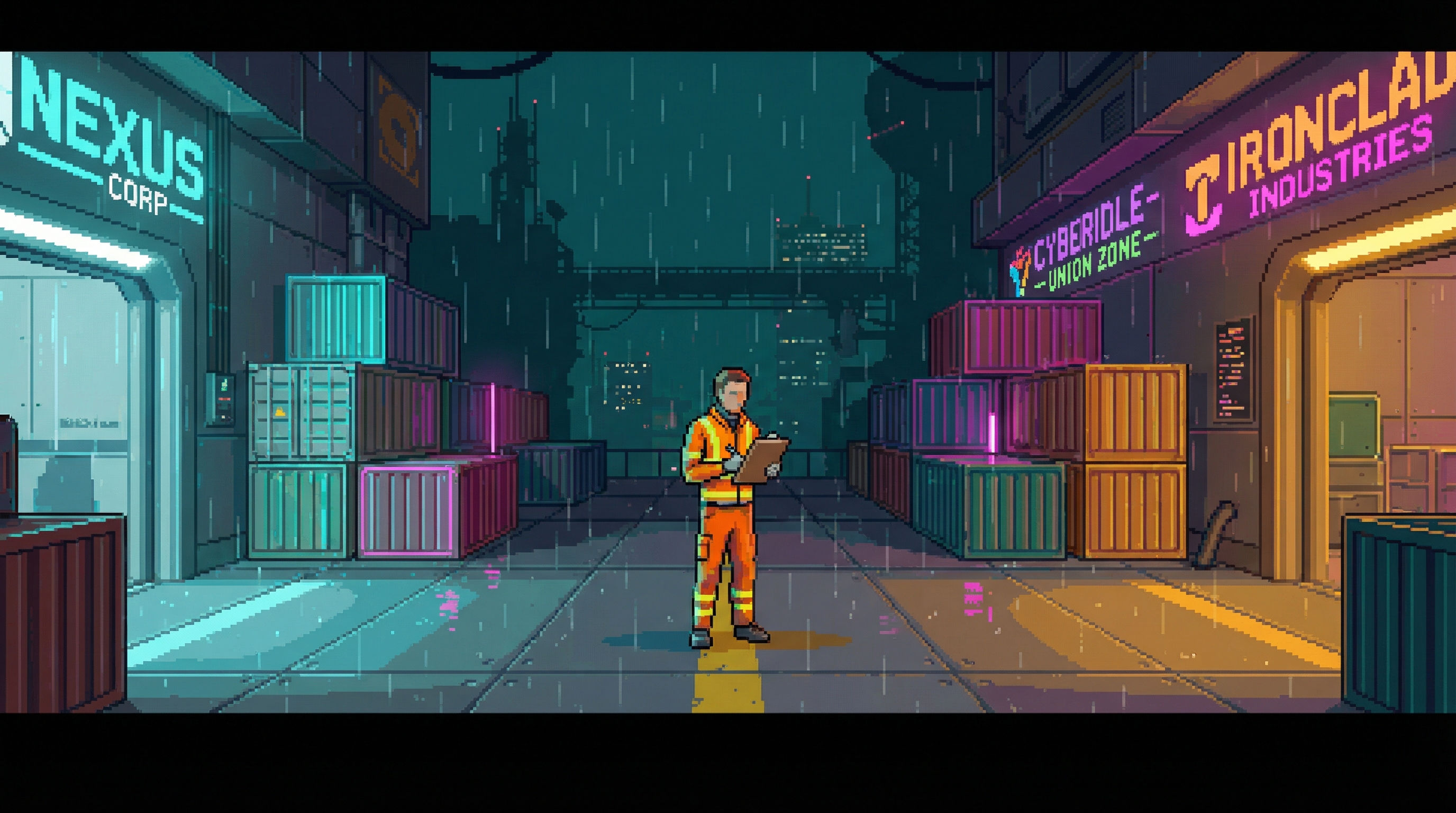
At every yellow stripe painted on Highport Station's deck plates — the jurisdictional boundaries between Ironclad territory, Nexus territory, and independent zones — someone has to manage the transition. The Line-Walkers Union represents approximately 2,000 workers who do this: customs handlers, cargo inspectors, jurisdiction translators, and the specific breed of administrator who understands that a container can be simultaneously Nexus property, Ironclad property, and independent cargo — and who can resolve this contradiction before lunch.
The Union was founded in 2176 after Loss of Pressure Event 7 killed sixty-seven people, twenty-three of them in corridors where contradictory evacuation routes from different jurisdictions crossed. The Line-Walkers' demand was simple: unified emergency protocol superseding jurisdictional boundaries. Denied. Their response: a nine-day work stoppage that seized the orbital supply chain. The protocol was adopted on day ten.
Nobody else can make three incompatible legal systems produce functional outcomes.
Doctrine
The Line-Walkers have no ideology beyond competence. Their power derives from being necessary.
"The line doesn't care whose law you prefer."
Every boundary is a negotiation. Every crossing requires someone who can hold three sets of rules in their head simultaneously and find the path that satisfies none perfectly but works for all practically.
"Memorize the law. Never trust a database."
Databases belong to jurisdictions. When you're standing on the line between Nexus territory and Ironclad territory, whose database do you check? The answer is neither. You carry the law in your head, because your head doesn't belong to anyone.
"Sixty-seven. Remember the number."
Every new Line-Walker learns the count before they learn the job. Sixty-seven dead in LPE-7 because three evacuation systems gave three contradictory orders. The Union exists so that number never grows.
Notable Members
Ifechi Adeyemi
Senior Jurisdiction LawyerMore than 4,000 cross-jurisdictional disputes resolved in twelve years. Without consulting a database. Not once. Adeyemi carries the law in her head — Ironclad commercial codes, Nexus regulatory frameworks, independent zone customs, and the fourteen conflicting treaty provisions that govern cargo transfer — because databases belong to jurisdictions and might be inaccessible from another.
The most experienced Line-Walkers develop what the Union calls legal synesthesia — sensing which jurisdiction's logic will produce the best outcome before consciously identifying the boundaries. Adeyemi has it. She can look at a cargo dispute and feel the answer before she can explain why.
The Work
What it means to stand on a yellow line between incompatible systems and make them produce functional outcomes.
The Yellow Stripe
Highport's deck plates carry hundreds of yellow painted stripes — physical, undeniable boundaries between corporate territories. On one side, Nexus blue-white lighting, Nexus commercial law, Nexus security jurisdiction. On the other, Ironclad amber, Ironclad labor codes, Ironclad enforcement. The stripe itself belongs to nobody. That's where the Line-Walkers work.
A cargo container crosses a yellow stripe and its legal status changes mid-transit. Insurance shifts. Safety regulations switch. The customs codes that applied three meters ago no longer exist. A Line-Walker handles this transition — paperwork in one hand, radio in the other, three sets of regulations in their head, and the specific judgment to know which rules to prioritize when they contradict each other.
The experienced ones don't hesitate at the line. They walk across it like it isn't there, because for them it isn't — they've internalized both sides. The new ones pause. You can always spot a junior Line-Walker by the way they slow down at the stripe, checking their notes, second-guessing which jurisdiction's form to stamp first.
The Nine-Day Strike
When the unified emergency protocol was denied, the Line-Walkers stopped walking. Every jurisdictional boundary on Highport became impassable. Cargo piled up at yellow stripes — legally unable to cross without a Line-Walker to process the transition. Customs queues stretched through entire sections. Ships couldn't unload because nobody could resolve the jurisdictional status of incoming freight.
By day three, Ironclad supply chains were backed up to the docking rings. By day five, Nexus was losing millions in delayed data shipments. By day seven, independent zone merchants were running out of stock. The orbital supply chain doesn't just use the Line-Walkers. It is the Line-Walkers. Without them, the lines become walls.
On day ten, the unified emergency protocol was adopted. The Line-Walkers went back to work. Nobody thanked them. Nobody needed to. Sixty-seven names on the memorial said enough.
Points of Inquiry
Human Middleware
The Line-Walkers are the interface between incompatible systems. Highport has tried automated solutions — algorithmic jurisdiction resolvers, AI-driven customs processing, smart-contract boundary management. All failed. The jurisdictional problem resists automation because it requires judgment, context, and the specific human capacity to hold contradictory rules simultaneously and produce an outcome that satisfies none perfectly but works for all practically.
In a world that builds algorithmic solutions for everything, 2,000 people with clipboards and memorized law books remain irreplaceable. The corporations have tried to automate them out of existence for fifty years. The Line-Walkers are still here. The algorithms are not.
The Automation Paradox
Every attempt to replace Line-Walkers with automated systems has produced the same result: the system works perfectly until two jurisdictions' edge cases collide, and then it either freezes (waiting for a rule that doesn't exist) or defaults to one jurisdiction's logic (triggering a legal challenge from the other). Humans can navigate ambiguity. Algorithms demand resolution.
The question Highport keeps asking: is this a temporary limitation of current AI, or a fundamental property of jurisdictional conflict? The Line-Walkers don't care. Either way, they have jobs.
Diplomatic Posture
Ironclad Industries
AdversarialThe nine-day strike forced Ironclad to accept unified emergency protocols. Ironclad has not forgotten. The Line-Walkers have not apologized.
Nexus Dynamics
ContestedNexus jurisdictional claims frequently conflict with Line-Walker operations. Nexus wants algorithmic boundary management. The Line-Walkers keep proving it doesn't work.
The Lamplighters
ParallelSurface parallel — invisible labor maintaining infrastructure between corporate territories. Different stratum, same principle: necessary work that nobody sees until it stops.
Labor Movements
ComplexOrbital branch of the Sprawl's labor resistance. Shared DNA — worker solidarity forged in corporate indifference — but the Line-Walkers' leverage is uniquely structural.
Restricted
What the intelligence networks are tracking.
The Memorized Map
Every Line-Walker carries a mental map of jurisdictional boundaries — not as they are officially drawn, but as they actually function. The official maps show clean lines. The real boundaries shift with corporate negotiations, informal agreements, and the accumulated weight of thousands of precedent-setting decisions made by Line-Walkers themselves.
The Line-Walkers don't just navigate the boundaries. Over fifty years of precedent, they have effectively drawn them. The official maps follow where the Line-Walkers have already walked.
Legal Synesthesia
The most experienced Line-Walkers report sensing jurisdictional boundaries before seeing the physical markers — a feeling in the gut, a shift in the quality of light, a change in air pressure that doesn't register on instruments. Adeyemi describes it as "the law has a weight, and when you carry enough of it, you can feel when it changes."
Medical evaluation finds nothing physiological. The phenomenon is consistent, reproducible among veterans with 15+ years of service, and completely unexplained. Whether it's pattern recognition compressed beyond conscious access or something stranger, nobody can say.
The Fourteenth Treaty
Thirteen treaty provisions govern cargo transfer on Highport. The Line-Walkers operate as though there is a fourteenth — an unwritten agreement, referenced in no database, that provides emergency override authority during pressure events. No corporation acknowledges it. Every Line-Walker knows it.
If the fourteenth treaty were formalized, it would effectively make the Line-Walkers Union a jurisdictional authority in its own right. This is why it stays unwritten. And why it works.