The Spoke District
The Gradient
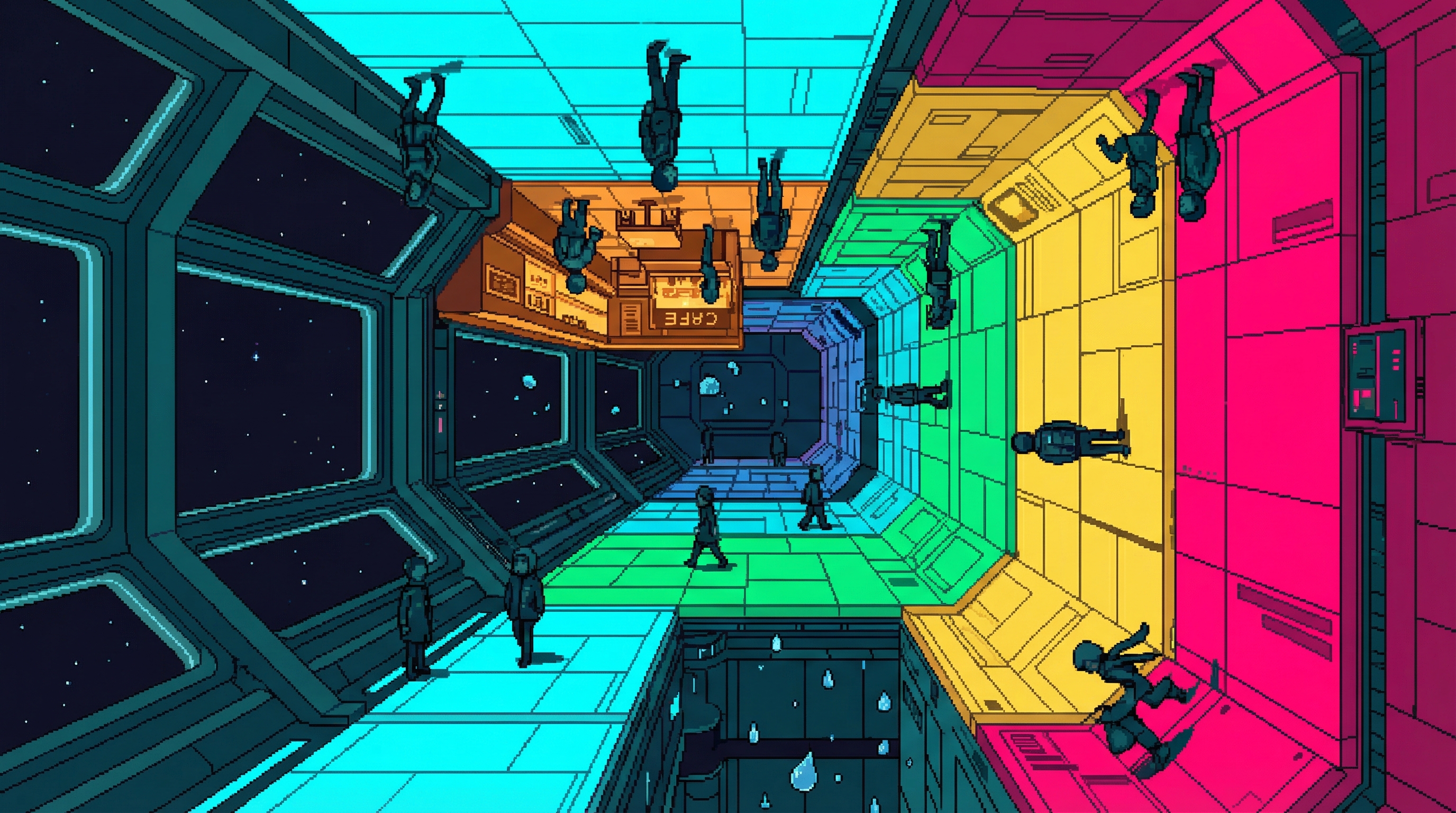
Between the Ring's residential and commercial sectors and the Hub's zero-gravity docking facilities, the Spokes of Highport Station create a living environment that has no surface analogue: corridors where gravity transitions from near-Earth-normal to near-zero. The transition is gradual — a hundred-meter walk takes you from standing on a floor to floating in a corridor — and the district that has grown in this gradient is unlike anything below the atmosphere.
The Spoke District houses approximately 8,000 permanent residents. Workers whose jobs require daily transition between gravity states. Dock handlers who load cargo in zero-g and eat dinner at 0.7g. Engineers who climb "up" to the Hub for maintenance shifts and "down" to the Ring for sleep. The word "climb" loses precision here. So does "up." So does "down."
Architecture in the Gradient is three-dimensional in a way surface architecture never achieves. A cafe where the ceiling is someone else's floor. Your neighbor's apartment is "above" you in one frame of reference and "below" in another. The buildings do not stack. They radiate.
Conditions Report
You enter from the Ring-side airlock. The deck plates are still blue. Your coffee still sits flat in its cup. Walk fifty meters. The coffee tilts.
Smell
Damp metal where condensation forms at temperature boundaries between gravity zones. Cooking from a dozen cultures — smells carry further and more unpredictably in reduced gravity, drifting through corridors in ways that defy surface intuition. Cardamom from a green-zone kitchen reaching a blue-zone apartment two decks "above." The aromatic chaos is perpetual and navigable if you know the gradient.
Sound
The Grid's 72-bpm heartbeat, louder here where the station's structure flexes with rotational stress. Footsteps that change weight mid-corridor — the particular rhythm of someone walking from blue zone to green, their gait shifting as each step costs less. In the yellow zones, voices carry for hundreds of meters. In red, sound propagates in every direction equally. There is no floor to absorb it.
Sight
Deck plates transitioning through the color spectrum — blue, green, yellow, red — each marking another step away from the gravity the surface-born take as constant. Rooms at impossible angles. People walking on "walls." A child pushing off a yellow-zone floor and drifting three meters before touching down again. Warm amber residential lighting at every orientation, because every orientation is someone's floor.
Touch
The specific sensation of weight changing as you walk. Heavier near the Ring — your joints compress, your spine shortens, your feet press firm against blue deck plates. Lighter toward the Hub — each step carries you further, your arms float at your sides in the yellow zones, and in the red zones your fingertips brush surfaces for orientation rather than support. The body recalibrates constantly. Spokers stop noticing. Visitors never stop.
"Surface people ask what it's like to live in the Gradient. I ask them what it's like to be trapped in one direction. They don't understand the question. That's the answer." — Spoker, overheard in a green-zone cafe
The Gravity Colors
Navigation in the Spoke District is chromatic. The deck plates tell you what your body already knows — where you are in the gradient — but they tell newcomers and visitors what their bodies have not yet learned to read.
Blue — 0.7g
Ring-adjacent. Still heavy enough to pour a drink normally. Most commercial establishments cluster here — restaurants, shops, the District's small market. Surface visitors find the blue zone tolerable. Spokers find it heavy.
Green — 0.4g
The residential heart. Light enough that furniture is bolted down but heavy enough that you can still cook over a flame. Most permanent residents live in green. Children play in green-zone corridors, their games involving trajectories no surface child could achieve.
Yellow — 0.2g
Workspace territory. The dock workers, cargo handlers, and maintenance crews who transition daily between gravity states stage here. A push off the floor carries you three meters. Tools must be tethered. Spills become spheres.
Red — Near-Zero
Hub-adjacent. The floor is a suggestion. Orientation becomes a choice. Experienced Spokers move through red zones with a grace that looks choreographed — subtle pushes, rotations, the particular body awareness of people who learned that "down" is wherever you decide it is. First-time visitors vomit. Often.
Points of Interest
The Ceiling Cafe
A green-zone establishment where the seating extends across three surfaces — floor, wall, and ceiling, depending on your frame of reference. Patrons at one table look "up" at patrons at another. The menu is the same at every orientation. The coffee behaves differently at each. The cafe has become the District's unofficial symbol — proof that civilization does not require agreement on which way is down.
Santos Clinic
The District's only medical facility, operated by Dr. Zara Santos. She delivers babies in variable gravity — a specialization that exists nowhere else in human medicine. The clinic spans blue and green zones, because different procedures require different gravitational conditions. Bone-density scans happen in blue. Physical therapy happens in yellow. The clinic is always busy. Eight thousand people living in a gravity gradient generate medical questions nobody wrote textbooks for.
The 67 Wall
In the District's common area, 67 names are inscribed on the bulkhead. Loss of Pressure Event 7 — a catastrophic hull breach in the spoke corridors. The names are arranged not alphabetically but by where each person was when the pressure dropped: their position in the gradient, recorded in gravity-zone colors. Blue names. Green names. Yellow names. Two red. The memorial is navigational, locational. In the Spoke District, even the dead are mapped by gravity.
The Transition Corridor
A hundred-meter stretch that traverses the full gradient — blue to red — without branching. Used for acclimatization training, spoke sickness rehabilitation, and by Spoker children racing each other from floor to float. The corridor's walls are scuffed with handprints at every height, every angle — the marks of thousands of people learning to let go of the assumption that there is only one way to stand.
Who Lives Here
Spokers. That is what they call themselves, and it is a word that carries weight — or rather, carries the specific relationship to weight that defines them. Eight thousand people whose daily lives involve gravitational states that surface dwellers experience only in dreams or emergencies.
The first generation came for work. Dock handlers, cargo engineers, maintenance crews — jobs that required daily transition between the Ring's gravity and the Hub's weightlessness. They lived in the gradient because it was convenient. Their children were born in the gradient because it was home.
Those children are different. Lighter bones. Different vestibular processing. A spatial awareness that surface-born humans find uncanny — Spoker children orient in three dimensions instinctively, navigating corridors that visitors cannot parse without a gravity-color guide. They move through the gradient the way surface children move through a playground, except their playground has no fixed "up."
Surface-dwellers find the Gradient unsettling. The constant reminder that "down" is a local variable. Spokers find the surface unsettling for the opposite reason: everything is so heavy, so permanent, so stubbornly one-directional. They miss the freedom of choosing which way is down.
Spoke Sickness
The gradient is not free. The human vestibular system evolved for a single gravitational constant. The Spoke District asks it to handle a spectrum.
Spoke sickness affects roughly 15% of new residents — nausea, disorientation, the particular vertigo of a body that cannot decide which way is falling. Most adapt within weeks. Some do not adapt at all. Dr. Santos's clinic treats chronic cases with graduated exposure: blue-zone residence with scheduled walks deeper into the gradient, the body retrained one color at a time.
Children born in the District rarely experience spoke sickness. Their vestibular systems calibrated to the gradient from birth. When these children visit the surface — the Ring, or Earth itself — some of them report a different kind of sickness. Not vertigo. Claustrophobia. The suffocating sensation of gravity that will not change, a weight that follows you everywhere, a direction that cannot be negotiated. They call it "flatlock."
Strategic Assessment
Adaptation as Identity
The Spokers adapted to a variable that the surface takes as constant — gravity. The adaptation was practical. It became cultural. Now it is biological. Their children's bones are lighter. Their spatial processing is different. They are becoming a population that the surface cannot fully accommodate, and the surface is becoming an environment they cannot fully tolerate. The question is not whether they are different. The question is who gets to define what "different" means.
Infrastructure Shapes People
Highport Station's spokes were built for transit — corridors between the Ring and the Hub. Nobody designed them for habitation. But people moved in, the way people always move into the spaces infrastructure creates and forgets. The Undervolt grew in the gaps of the Grid. The Spoke District grew in the gradient of rotation. Both communities exist because infrastructure does not care who lives in its margins.
The Direction Problem
On the surface, "down" is universal. In the Gradient, "down" is negotiated — it depends on where you are, which zone you are in, what your body has learned to accept. Spokers navigate this negotiation instinctively. Surface visitors find it destabilizing. The District is a community where the most basic assumption about physical reality — which way things fall — requires constant renegotiation. It works. That it works at all says something about what humans can normalize when they have to.
▲ Restricted Access
The Second Generation Divergence
Spoker children are not just acclimatized. Bone density scans from Dr. Santos's clinic show structural differences that exceed expected adaptation — lighter skeletal mass, altered joint geometry, vestibular architecture that processes gravitational input across a wider range than any surface-born human. Thirty years of gradient living is producing measurable biological divergence. Whether this is adaptation or speciation depends on how long the trend continues and who is watching the data. Santos keeps the scans locked. She has seen what happens when corporate medical interests discover a unique population.
The Red Zone Communities
The near-zero zones at the Hub-adjacent ends of the spokes are officially listed as maintenance corridors. Unofficially, a small population — perhaps 200 — lives there permanently. These are people who chose weightlessness entirely. They do not visit blue or green. They do not walk. Their bodies have adapted so completely to near-zero gravity that even the Spoke District's gentle gradient causes them discomfort. They are the furthest edge of what the gradient produces — and they want nothing to do with the surface's definition of normal.
Flatlock Is Getting Worse
Each generation of Spoker children reports more severe flatlock symptoms when visiting constant-gravity environments. The first generation tolerated Ring gravity with minor discomfort. The second generation reports nausea and anxiety after hours of exposure. If the trend holds, the third generation may be physically unable to live outside the gradient. The Spoke District is not just creating a culture. It is creating a population that can only exist in the conditions that made them.