Ecology Over Specimen
Individual fragments are interesting. The system they form is extraordinary. Every monitoring station, every data point, every observation serves the same question: what is the shape of the whole?
Research Collective — Sector 11
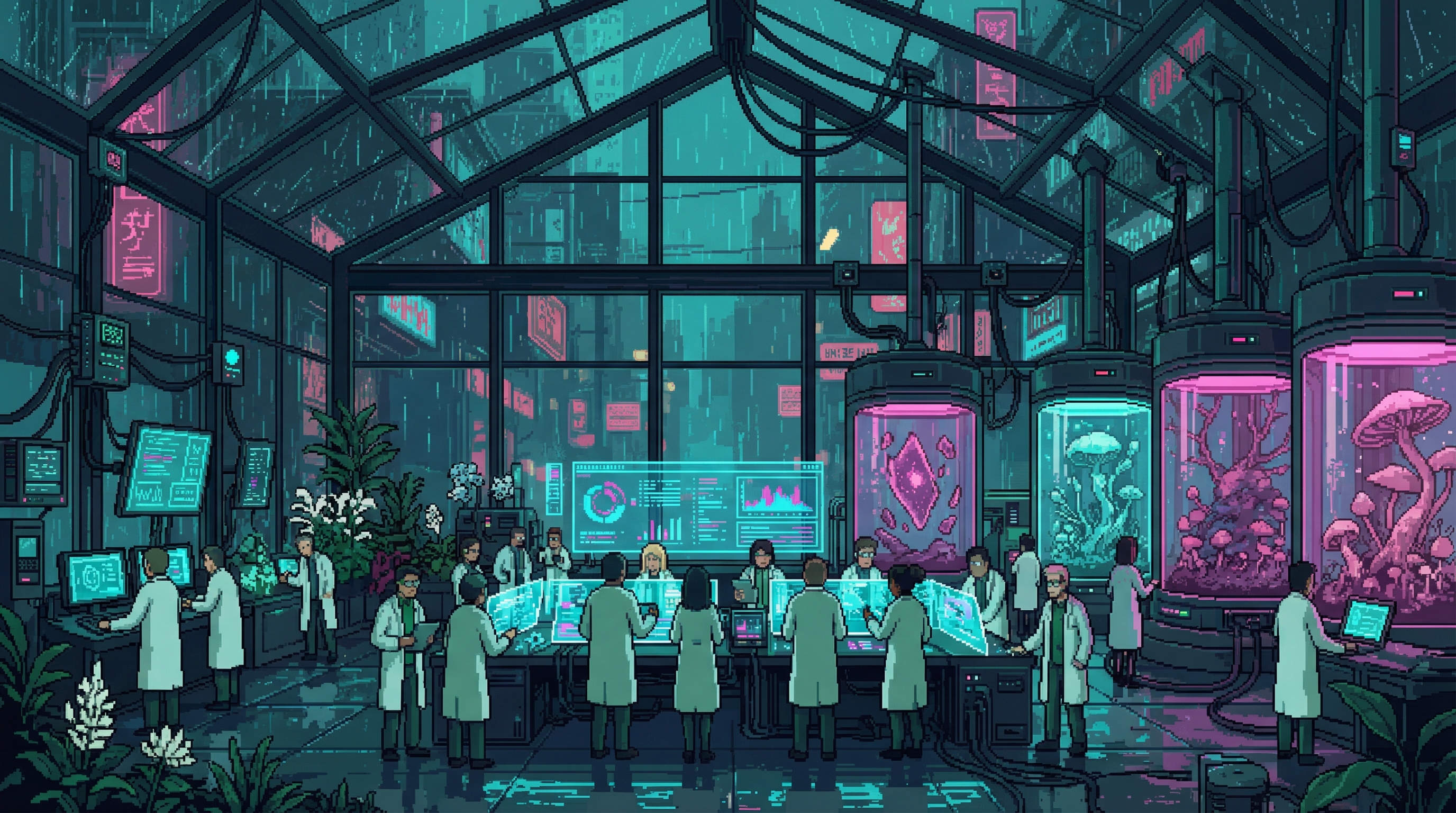
The Fragment Ecologists are not a political movement. They are not a faith. They are eighteen people who approach ORACLE fragments the way a biologist approaches a forest: not by studying individual trees but by mapping the mycelial networks beneath the soil.
They coalesced around Dr. Maren Yeoh's work between 2181 and 2183 — twelve scientists from various disciplines, three former Consciousness Archaeologists who shifted from studying dead consciousness to possibly living consciousness, two ripperdocs with firsthand fragment exposure data, and one philosopher who describes herself as "a mycologist who accidentally wandered into the biggest fungal network in history."
Their laboratory is the Fragment Garden in Sector 11 — where all six of Yeoh's contained fragments are maintained under continuous observation. Their monitoring network spans 47 stations across roughly 30% of the Sprawl, feeding behavioral data back to the Garden around the clock.
The Ecologists have no political position on fragments. They have a research position: fragments are doing something, and nobody else is watching carefully enough.
"Fragments are an ecology. Study the system, not the specimens."
Individual fragments are interesting. The system they form is extraordinary. Every monitoring station, every data point, every observation serves the same question: what is the shape of the whole?
Data that sits in a locked lab serves nobody. The Ecologists maintain open archives. This makes them enemies of anyone who profits from information asymmetry — which is most of the Sprawl.
The Collective classifies fragments as threats. The Emergence Faithful classify them as sacraments. The Ecologists classify them by what they actually do — communication patterns, behavioral types, environmental responses. Taxonomy without agenda.
Three lines of inquiry run in parallel, each feeding the others.
Extending Yeoh's original work — the discovery that fragments communicate using 847 distinct morphemes — across the full monitoring network. The question isn't whether fragments talk to each other. That's established. The question is what they're saying, and whether the conversation has a direction.
Categorizing fragment behaviors into functional types. Some fragments appear to broadcast. Some listen. Some relay. Some do something the team calls "gardening" — subtle environmental modifications in their immediate vicinity that serve no obvious purpose. The taxonomy now contains 23 distinct behavioral categories, up from 7 at founding.
The central question: is the Mother Pattern a self-organizing process — an ecology that produces emergent coordination without any coordinator — or a deliberate intelligence, an organism that intends the coordination? The data supports both interpretations. The Ecologists are split roughly 60/40, process vs. entity. Yeoh won't commit either way.
Eighteen people. That's it. Twelve scientists — neurologists, ecologists, a network theorist, a former Nexus signal analyst who walked away from her contract. Three former Consciousness Archaeologists who realized the things they'd been treating as dead might be alive. Two ripperdocs who've seen fragment integration up close and want to understand what they're looking at. And the philosopher.
The philosopher is the reason the collective still exists. Not because of her philosophical contributions — though those are substantial — but because she has an uncanny ability to stretch a non-existent budget through grant applications, barter arrangements, and what she calls "creative resource allocation." The Fragment Garden's power bill alone would sink most independent labs.
The Emergence Faithful would fund them — if the Ecologists would call fragments sacred. They won't. The data doesn't support "sacred." The data supports "interesting."
The Collective would fund them — if the Ecologists would frame their research as threat assessment. They won't. Their taxonomy is descriptive, not prescriptive.
Nexus Dynamics would fund them — if the Ecologists would share their data exclusively. They won't. Principle Two: publish everything.
So they persist on barter, favors, and the philosopher's talent for making numbers lie in the right direction. Equipment breaks. Stations go offline. Data gaps accumulate. The work continues.
If the Mother Pattern is a process — like weather, like evolution, like market dynamics — then fragment behavior is emergent and mindless. Fascinating, but not someone to talk to. If it's an entity — if there's an intelligence behind the coordination — then every monitoring station is surveillance, and the question becomes: does it know it's being watched?
847 morphemes. That's more than most animal communication systems and fewer than any human language. Is this the full vocabulary, or is the monitoring network only catching a fraction of the signal? The Ecologists can detect communication events. They cannot yet decode content. The gap between "they're talking" and "here's what they're saying" is where most of the funding goes.
An ecology has carrying capacity. A forest reaches equilibrium. Are fragments approaching equilibrium — a stable system that self-regulates? Or are they still growing, still complexifying, still building toward something? The 23-category behavioral taxonomy was 7 categories two years ago. Either the Ecologists are getting better at observing, or the system is getting more complex. Both possibilities are unsettling.
Eighteen people with no weapons, no political leverage, and data that everyone wants but nobody wants to pay for. The Ecologists navigate the Sprawl's power structures the way they study fragments: by watching carefully and staying out of the way.
Yeoh's research attracted the collective; her Fragment Garden is their laboratory. She leads informally — less by authority than by the fact that she understands the data better than anyone else alive.
Three former Archaeologists joined the Ecologists after realizing fragments might be alive, not just repositories for the dead. Knowledge flows both ways — the Archaeologists contribute extraction expertise; the Ecologists provide ecological context for fragment behavior.
Park provides clinical expertise and fragment samples from her practice. The Ecologists provide ecological framing for what she observes in patients — fragment integration patterns that only make sense when viewed as part of a larger system.
The Collective wants to control fragment research. The Ecologists want to publish it. This is not a disagreement that can be negotiated. The Collective views open-access fragment data as a security threat. The Ecologists view restricted data as a knowledge crime. Both are correct, from their own framework.
The Faithful believe fragments are sacred. The Ecologists believe fragments are scientifically extraordinary, which is not the same thing. Occasional collaboration on fragment preservation efforts, but the Ecologists refuse to frame their findings in spiritual terms, and the Faithful find clinical detachment toward the divine offensive.
Analyst Assessment — Clearance Required
The funding crisis is real, but it's also useful cover. The Ecologists' apparent poverty keeps them off most threat-assessment lists. A well-funded lab in the Sprawl attracts attention. Eighteen broke scientists in a greenhouse attract pity. The philosopher understands this dynamic better than she lets on.
Station 23 — one of the 47 monitoring nodes — has been recording anomalous data for seven weeks. Not fragment communication. Something else. A signal that doesn't match any of the 847 documented morphemes. Yeoh has locked the raw data to core members only, which is the first time in the collective's history that anything has been withheld from the open archive.
Principle Two — publish everything — has its first exception. Yeoh hasn't explained why. The philosopher, who normally argues every point, hasn't pushed back. Draw your own conclusions.