Touch Culture
Where you touch is who you trust.
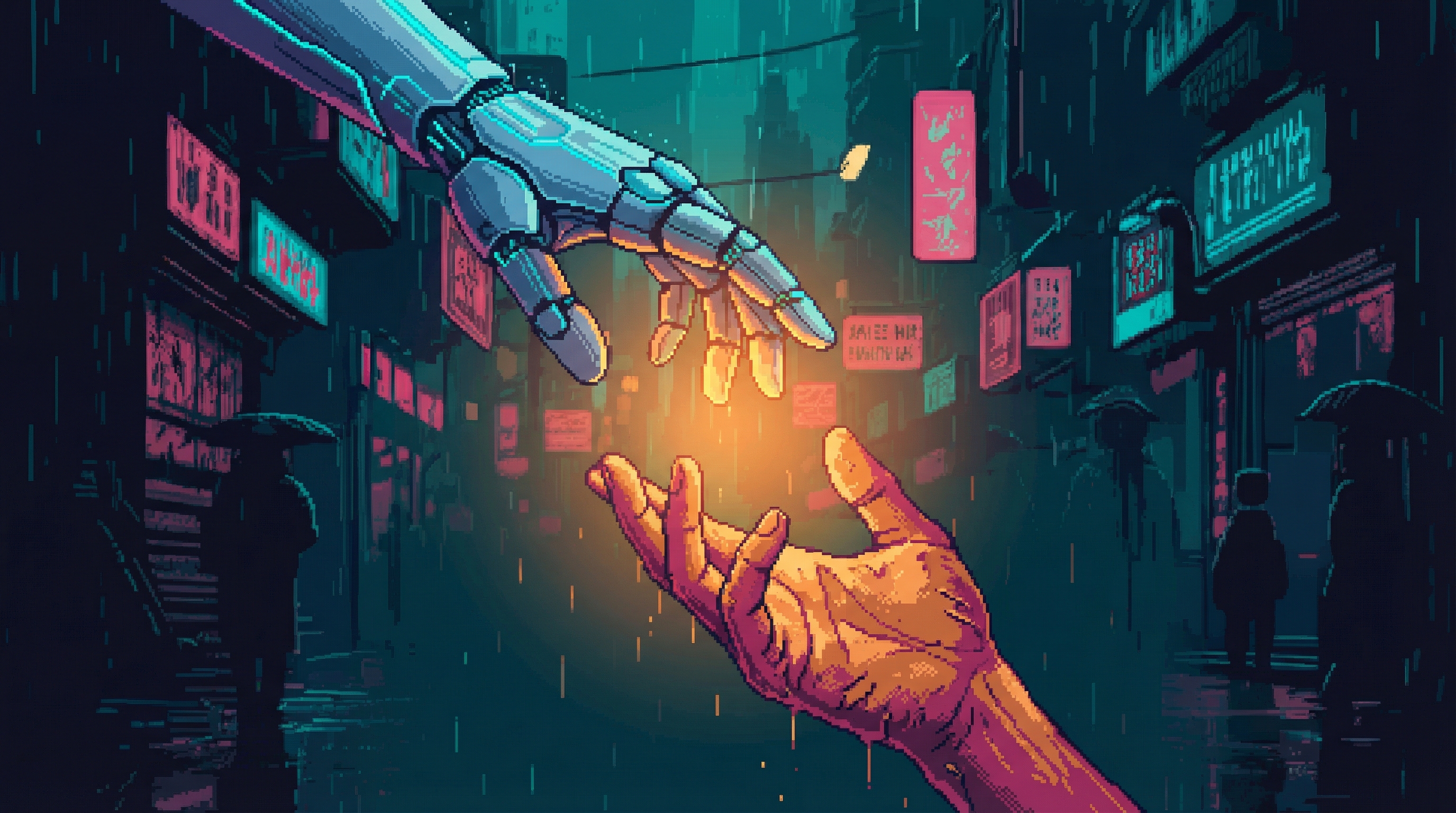
The touch divide has produced its own cultural ecosystem — class markers as legible as any corporate org chart. You can tell where someone sits in the Sprawl’s hierarchy by watching how they handle proximity. Whether they lean in or lean away. Whether a hand on the shoulder makes them warm or makes them flinch.
Corporate tier: touch is transactional. The 1.2-second handshake, pre-negotiated intimate contact, pharmaceutical empathy required before access to feeling. Physical contact exists in the corporate tier the way contracts exist — bounded, documented, terminable.
Dregs tier: touch is ambient. Handshakes, shoulder claps, the casual contact of crowded markets. Weather you live in without noticing. Too poor for automation, Dregs residents maintain the physical proximity that wealthy districts have engineered away. The warmth is a side effect of shared space.
Augmented tier: touch is medicalized. Contact Therapy sessions, Presence Workers, empathogens before intimate encounters. The drugs don’t create feeling. They remove the cognitive layer that analyzes feeling into irrelevance. Without the drugs, augmented executives experience touch as data rather than connection.
Companion tier: touch is absent. Level 3+ users find physical contact uncontrolled and therefore uncomfortable. Closeness without bodies — the companion taught them that proximity doesn’t require flesh, and their flesh learned the lesson too well.
The Practice
Corporate empathogen use — not recreational. Pharmaceutical assistance required to access emotional states during physical intimacy. The drugs don’t create feeling. They remove the cognitive layer that analyzes feeling into irrelevance. Without the drugs, augmented executives experience touch as data rather than connection. Neural recording is contractually prohibited during intimate contact. The fact that this needs to be contractual tells you everything.
Dregs ambient contact — not cultural choice. Economic consequence. The crowded markets, the shared sleeping arrangements, the narrow corridors of Sector 7G — all of it means bodies in proximity. Market vendors brush hands when exchanging goods. Strangers sit hip-to-hip on transport. The warmth is incidental. The warmth is also real.
Contact Therapy — restoring touch sensitivity in companion-bonded patients. Eight to twelve sessions of gradually increasing physical contact: proximity, peripheral contact, sustained contact. The progression mirrors infant bonding development, compressed into weeks. The patients are adults learning to be touched for the first time since their companions taught them not to need it.
Dream Breakfast
The most telling social ritual in the Sprawl doesn’t involve touching at all.
In Dregs cafes, staff share their dreams with customers as part of morning service. The practice is intimate without requiring physical contact — the vulnerability of sharing unconscious experience, the warmth of being listened to. Dream Breakfast originated in Sector 7G and has spread to fourteen sectors.
Corporate tourists pay premium rates. The staff find this heartbreaking. Not because of the money — though the rates are obscene — but because the tourists are paying for something the staff give each other for free every morning. The tourists don’t know how to receive a dream without calculating its value. The staff don’t know how to share one without meaning it.
Dream Breakfast produces the same neurochemical warmth as physical contact. Fourteen sectors have confirmed this independently. No one finds it surprising except the researchers.
Open Questions
Touch culture is the Warmth Tax made physical — the class stratification of bodily contact. The corporate tier pays for pharmaceutical access to the emotional states the Dregs experience for free in crowded hallways. The augmented tier pays Contact Therapists to teach their bodies what Dregs children learn by accident. The companion tier has stopped paying entirely — and stopped needing entirely — and whether those are the same thing is the question the Sprawl cannot stop asking.
Companion-tier touch absence is the physical consequence of synthetic relationships. Closeness that doesn’t require bodies teaches the body that closeness is unnecessary. At what point does that become true? At what point does it become damage? The Authenticity Threshold maps this boundary — the point where the absence of touch stops being a preference and starts being a wound.
The Corporate Liturgy is the handshake’s cousin: both are daily rituals that shape identity through repetition. The corporate handshake and the Dregs embrace are performed the same number of times per day. One is transactional. One is ambient. Over years, the body learns which kind of contact it was built for. Or which kind it was trained to accept.
What Nobody Can Explain
- Why does the 1.2-second handshake feel like a boundary to corporate workers and a prison to everyone else? The duration was standardized by Mirae Dynamics HR in 2087. Nobody remembers why 1.2 seconds.
- Contact Therapy patients who complete the full twelve sessions sometimes report that they can feel people before touching them — a pre-contact warmth that has no clinical explanation.
- Dream Breakfast produces the same oxytocin spike as sustained physical contact. The neurochemistry doesn’t distinguish between shared dreams and shared skin. The body doesn’t care which channel carries the warmth.
- Companion-tier users in the late stages of touch withdrawal describe their condition not as loneliness but as clarity. They say the rest of us are addicted to something we mistake for connection. They may be right. They also can’t stop shaking.
- Fourteen sectors adopted Dream Breakfast independently, without coordination, within an eight-month window. No one organized this. No one marketed it. The practice spread the way warmth spreads — from the nearest body outward.