Memory Culture
Crop. Residue. Soil. Heritage. The vocabulary of a generation that buys its past.
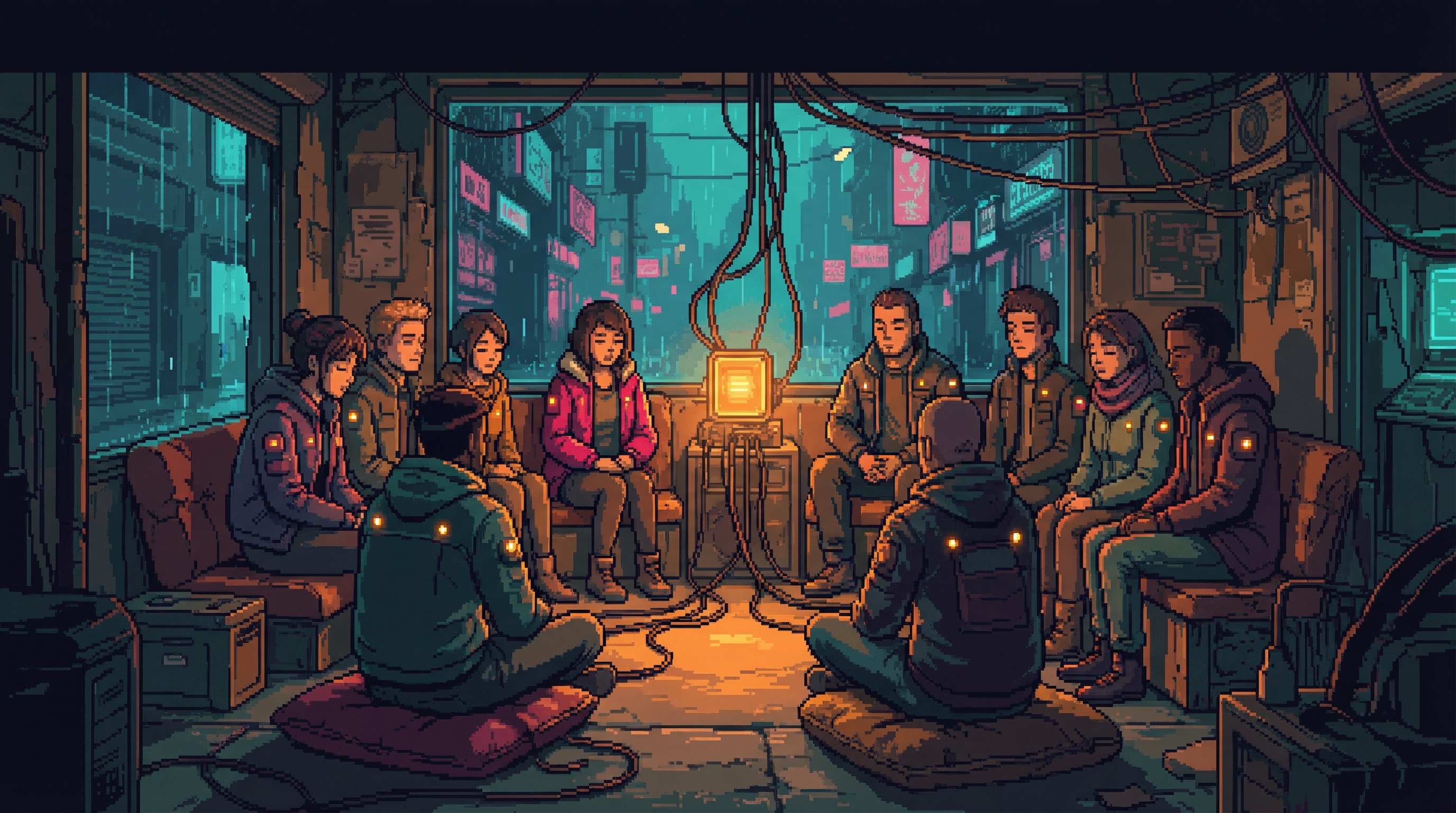
The memory trade didn’t just create a market. It created a world. New words for experiences nobody had before the technology existed. Rituals that no one designed but everyone recognizes. Class markers as legible as any corporate badge, but written in what you consume and how you talk about it.
Memory culture is what happens when a population develops an entire relationship with purchased experience — not just the buying and selling, but the language, the etiquette, the taboos, the pride, and the shame that grow around it like moss on infrastructure.
The Vocabulary
The language is agricultural and sensory — the vocabulary of people who think of consciousness as land and experience as harvest.
The Practice
Memory sharing circles are the ritual heart of the culture. Eight to fifteen people gather in a cleared apartment or back room, load the same purchased memory simultaneously, and experience it together. Afterward, they sit up and talk about what happened. Forty-plus groups operate regular circles across the Sprawl. The more structured version — the Impression Ceremony — has become a distinct practice in its own right.
The provenance question — “is this memory real?” — is deeply rude in sharing circles. You don’t ask because the point is the shared experience, not its origin. In authentication contexts, the same question is essential. The etiquette is perfectly clear to anyone inside the culture and baffling to anyone outside it.
Abstainers — people who refuse all purchased memories — wear small amber pins, the color of memory chips. The pin says: I have not bought experience. I live on what I grow. The abstainer community is small but visible, and they are treated with a mixture of respect and suspicion, the way any culture treats those who refuse its central sacrament.
The Class Divide
What you consume tells the Sprawl exactly who you are.
Heritage consumption marks elite status. Pre-Cascade memories cost thousands of credits — recordings from before the world changed, carrying the texture of a vanished era. The wealthy collect heritage the way previous generations collected art: as proof of taste, wealth, and access. The question of whether heritage memories are genuine is never asked in polite company.
Street memories mark Dregs identity. Unverified, raw, potentially traumatic — purchased from anyone willing to sell, consumed without the safety filters that regulated memories include. Street memories carry risk: someone else’s worst day can leave residue that lasts weeks. The Dregs wear this risk as identity. You buy street because you can afford street, and then you make that the culture.
Synthetic memories are the middle tier’s staple. Affordable, reliable, engineered for specific emotional profiles. The stigma is that they’re “not real” — laundered by definition, impressions without provenance. The middle tier consumes the most memory by volume and carries the most shame about it. The rich don’t need to justify their consumption. The Dregs don’t care. The middle explains, constantly, why synthetic is just as good.
Where It Lives
Memory culture is strongest in Sector 7G and the wider Dregs, where street memories are most accessible and sharing circles most common. The vocabulary originates here — farmers, traders, and consumers living close enough together that language evolves fast and spreads faster.
The culture thins as you rise through the Sprawl’s tiers. Executive levels consume heritage privately and rarely discuss it. The middle tiers consume synthetic in curated settings designed to feel organic. Only in the Dregs is memory consumption a public, communal, identity-defining activity — discussed openly, practiced together, and woven into the social fabric as tightly as any religion.
Points of Inquiry
Memory culture is the social response to tradeable experience — the human adaptation to a world where someone else’s past is available for purchase. Like dream culture (the response to commodified sleep) and opacity culture (the response to radical transparency), it develops language and practice to navigate conditions the previous generation never imagined.
The class dimension mirrors every other system in the Sprawl: the rich buy the best and it marks them as elite. The poor buy what they can afford and make it identity. The middle consumes the volume product and carries the stigma. Memory culture doesn’t invent this pattern — it inherits it and expresses it through a new medium.
Displacement drift raises a question nobody wants to answer: at what point does purchased experience replace organic memory so completely that the consumer is no longer the person who started buying? The drift is considered irreversible. The culture has a word for it but no solution. The farmers call their consciousness “soil,” and the consumers are slowly paving it over.
What Nobody Can Explain
- Displacement drift is considered irreversible past a certain threshold. No one has established where that threshold is. Heavy consumers report the drift, and then they keep buying. The word exists; the warning doesn’t work.
- The provenance question is rude in sharing circles and essential in authentication. How did the same culture develop opposite norms for the same question in different contexts — and how does everyone know which context they’re in?
- Memory farmers describe their own consciousness as “soil.” What does it do to a person to think of their inner life as a medium for growing product? The farmers who produce the best crop report the lowest satisfaction with their own organic experience.
- Heritage memories cost thousands of credits. The provenance verification for pre-Cascade recordings is unreliable at best. How much of the heritage market is built on laundered synthetic dressed in the right packaging?
- The abstainers wear amber pins — the color of the thing they refuse. Why identify yourself by the shape of your refusal rather than the shape of your alternative?