The Inheritance Tax
Systemic Cost — The Daily Price of an Unoptimized Genome
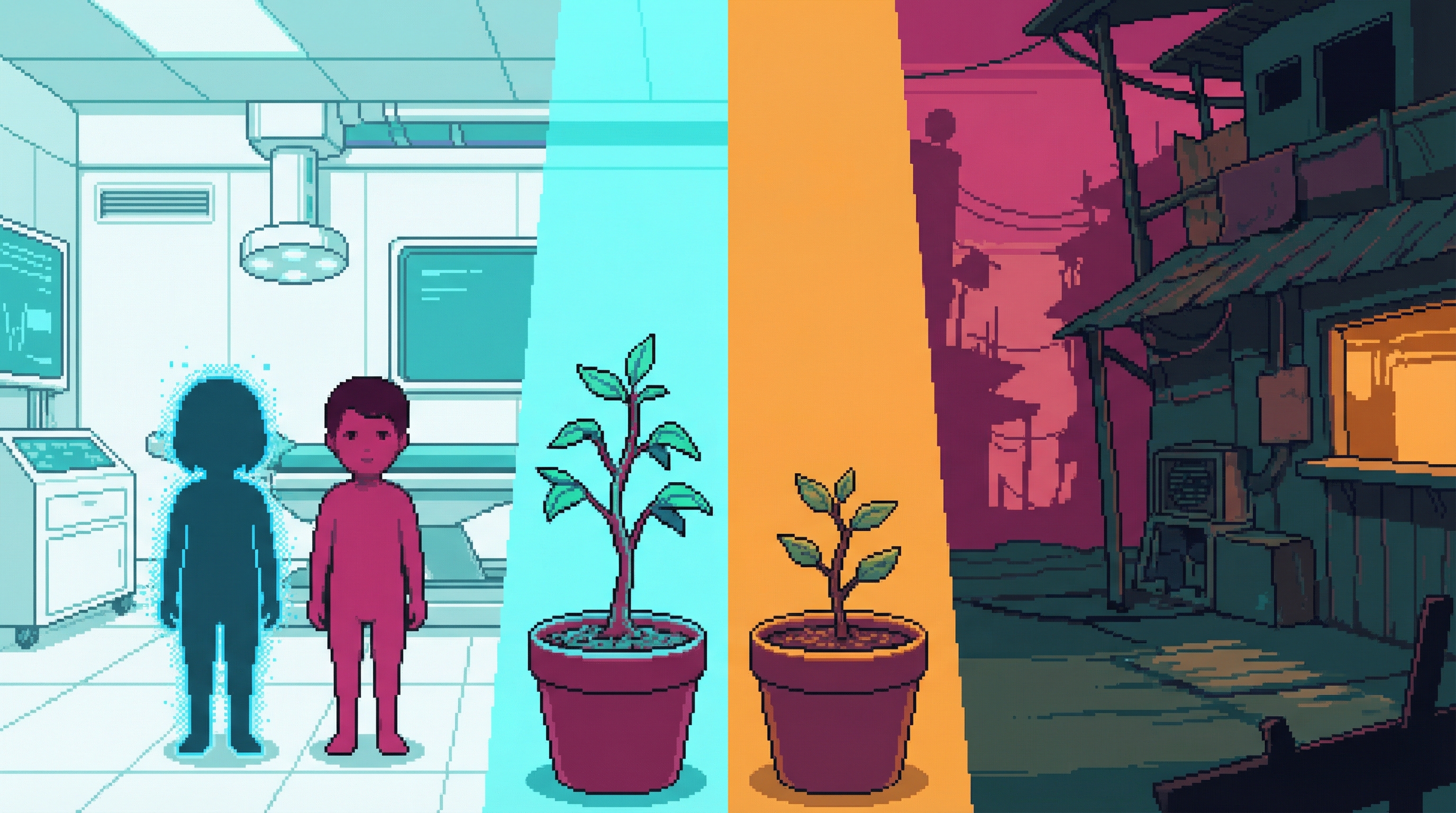
Nobody designed the inheritance tax. Nobody voted for it. It emerged from a million reasonable decisions — a parent choosing Helix Optimize because they loved their child, a designed adult marrying another designed adult because the conversation moved at the same speed, a corporation hiring the candidate whose cognitive baseline happened to be 15% faster. The tax is not a policy. It is a consequence. And the bill arrives at birth.
"The daily cost of operating at 85% of the speed the meeting room assumes is standard."
— Common Dregs expression, entered vocabulary late 2170s At a Glance
The Cost Nobody Invoices
The inheritance tax is not a line item. You will not find it in any budget, any contract, any license agreement. It is the sum of every moment a natural-born person spends processing at 85% of the speed the designed world calibrates for — every meeting where the conversation moved a half-beat faster than you could follow, every promotion that went to someone whose neurons fired 15% quicker, every evening spent studying material a designed colleague absorbed in an afternoon.
Genetic optimization — commercially available since the 2150s, widespread in corporate territories by the 2170s — creates advantages that are permanent, inheritable, and invisible. A designed child’s cognitive baseline, immune function, metabolic efficiency, and longevity ceiling are all calibrated before birth. The advantages compound: a 15% cognitive speed advantage at birth widens throughout life because faster processing allows faster skill acquisition, which provides better career outcomes, which funds better augmentation, which widens the gap further.
You can buy a Professional-tier consciousness license. You cannot buy a redesigned genome retroactively. The license gap can be bridged by money. The inheritance tax is permanent.
The Three Compounding Mechanisms
The inheritance tax operates through three feedback loops. Each one alone would create measurable inequality. Together, they produce a gap that widens on its own.
Direct Cognitive Advantage
A 15% speed advantage at birth translates to faster learning, earlier milestone achievement, and the cumulative effect of thousands of small advantages over a lifetime. The designed child reads earlier, learns faster, and enters the workforce with a cognitive baseline their natural-born peers cannot match regardless of effort. The gap is not about intelligence. It is about processing speed — and speed compounds.
Assortative Mating
Designed adults preferentially partner with other designed adults — driven by social proximity (corporate-tier circles overlap) and cognitive compatibility (conversation flows more easily at similar processing speeds). The result: genetic advantages concentrate and compound across generations rather than dispersing through the general population. Not by ideology. By milliseconds.
Economic Feedback
Cognitive advantages produce career advantages. Career advantages produce economic advantages. Economic advantages fund better augmentation — which compounds the genetic baseline. A designed individual with Executive-tier augmentation operates at a cognitive level that is unreachable by a natural-born individual at any augmentation tier. The floor rises for the designed. The ceiling lowers for everyone else.
The Irreversibility Problem
Substrate can be changed. Augmentation can be purchased. Consciousness tier can be upgraded. Corporate affiliation can shift. But your genome — the one your parents selected, or didn’t, before you drew breath — is written in every cell of your body, passed to your children, and compounding across generations. The inheritance tax is the only axis of the New Divide that gets worse on its own.
The Three-Generation Projection
Dr. Mensah’s locked-drawer research, distilled to a timeline.
Generation 1 — The Founders (2150s–2170s)
First commercially designed children enter the workforce. 15% cognitive speed advantage at individual level. Assortative mating begins — designed find designed through social gravity, not conscious selection. The inheritance tax is invisible because the first generation still has natural-born parents who remember what the baseline felt like.
Generation 2 — The Current (2170s–2190s)
Children of designed-designed partnerships inherit cumulative advantages. Cognitive gap widens to 25–30% over natural-born baseline. Mixed-enrollment schools begin informal tracking by genetic status — the fast table and the slow table. The inheritance tax enters common vocabulary because the second generation has never known any other baseline. To them, the tax is not a disadvantage. It is the world.
Generation 3 — The Projected (2190s–2210s)
The cognitive gap exceeds what consciousness licensing creates. A third-generation designed child at Basic-tier augmentation outperforms a natural-born child at Professional-tier. The inheritance tax can no longer be compensated for. It can only be inherited.
Councillor Nwosu: “How long do we have?”
Mensah: “We’re in generation two.”
What It Feels Like
The Meeting Room
You feel the inheritance tax in the specific moment when a meeting room’s conversation pace is set by the designed participants and you realize you’re a half-beat behind every exchange. Not because you’re stupid. Not because you weren’t paying attention. Because the room was calibrated for processing speeds your neurons will never reach.
The Admissions Office
You see the inheritance tax in university admission statistics where designed applicants score 15–20% higher across every metric — not because they studied harder, but because their brains processed the same material in less time, leaving them with hours their natural-born peers spent catching up.
The Kitchen Table
You hear the inheritance tax in the voice of a natural-born parent explaining to their child why their designed classmate reads faster — and knowing the explanation changes nothing. The child nods. The child understands. The child will spend their life 15% behind, and understanding why does not close the gap.
Points of Inquiry
The Love Defense
The designed population didn’t choose their advantages. Their parents made the choice — a choice any parent would make if they could afford it. The moral calculus is agonizing: genetic optimization produces objectively better outcomes, and the objection is not that it works but that it works unevenly. The system doesn’t need malice. It needs parents.
The Optimization Paradox
Genetic engineering produces longer lives, fewer diseases, greater capability. The inheritance tax is the cost of distributing these benefits through a market rather than a mandate. Object to the tax and you object to health. Accept the tax and you accept biological aristocracy. No position is clean.
The 85% Life
What does it mean to live an entire life at 85% of the speed the world assumes is standard? Not disability — the natural-born are fully capable by any historical measure. Disadvantage — in a specific, contemporary, compounding way. The inheritance tax is invisible because 85% looks like 100% to anyone who has never experienced 100%.
The Purity Inversion
The Purity Clubs celebrate genetic naturalness — turning the inheritance tax into a status symbol. But only for those who can afford the celebration. Wealthy natural-born wear their unoptimized genomes as proof they don’t need the advantage. Poor natural-born wear the same genomes as a sentence. Same biology. Different net worth. Different meaning.
Related Files
The inheritance tax sits where biology meets economics and neither blinks. These are the systems it feeds and the systems that feed it.
The Genome Divide
The controversy that encompasses the inheritance tax — the fifth axis of the New Divide, the only one that is permanent, heritable, and compounding.
Helix Biotech
Created the commercial infrastructure. Genetic optimization as a medical service, priced by tier, available since the 2150s. The inheritance tax is their product’s externality.
The Great Divergence
The economic gap. The inheritance tax adds the biological dimension that makes it heritable. Cognitive advantages produce economic advantages produce augmentation access — the spiral tightens.
The Purity Clubs
Celebrate genetic naturalness as luxury — inverting the tax into a status symbol. The same unoptimized genome means freedom for the wealthy and limitation for the poor.
Dr. Afia Mensah
Documents the psychological consequences — capability guilt in designed children who didn’t ask for advantage, learned helplessness in the natural-born who can’t close the gap.
The Dependency Spiral
Both create irreversible hierarchy — augmentation through technology dependency, genetics through heredity. Parallel mechanisms, converging outcomes.
▲ Restricted Access
The following intelligence is drawn from intercepted research data, suppressed academic proceedings, and analyst field observations. Classification: restricted.
The Psychological Split
Dr. Mensah’s unpublished psychological profiles identify two conditions emerging across the designed/natural divide. In designed children: capability guilt — the knowledge that your advantages were purchased, not earned, producing chronic imposter syndrome in a population that objectively outperforms. In natural-born children: learned helplessness — the recognition that effort cannot close a gap that was established before birth, producing disengagement that looks like laziness but is in fact rational surrender.
The Silent Tracking
Mixed-enrollment schools do not officially sort students by genetic status. Officially, there are no designed tables and natural-born tables in the cafeteria. Unofficially, by age fourteen, the social clusters have formed along genetic lines with 94% accuracy — sorted by conversation speed, by processing rhythm, by the milliseconds that determine whether a joke lands or falls flat. The schools report no discrimination. The lunch tables tell a different story.
The Compensation Ceiling
Internal Helix modeling, leaked to the academic whisper network in 2181, suggests that by generation three, no combination of augmentation, education, and consciousness licensing can close the cognitive gap between a third-generation designed individual and a natural-born individual. The inheritance tax becomes, at that point, permanent in the mathematical sense — not merely difficult to pay, but impossible to discharge.
"My designed colleague finishes my sentences before I’ve formulated them. She’s not being rude. She’s not showing off. She’s just processing at a speed where waiting for me feels like an eternity she’s too polite to mention. I wasn’t slow. I was biological. That’s the inheritance tax. Not cruelty. Not conspiracy. Just two people in the same room, one of them running on hardware the other will never have. And both of them knowing it." — Anonymous corporate worker, Dregs-adjacent housing block, 2183