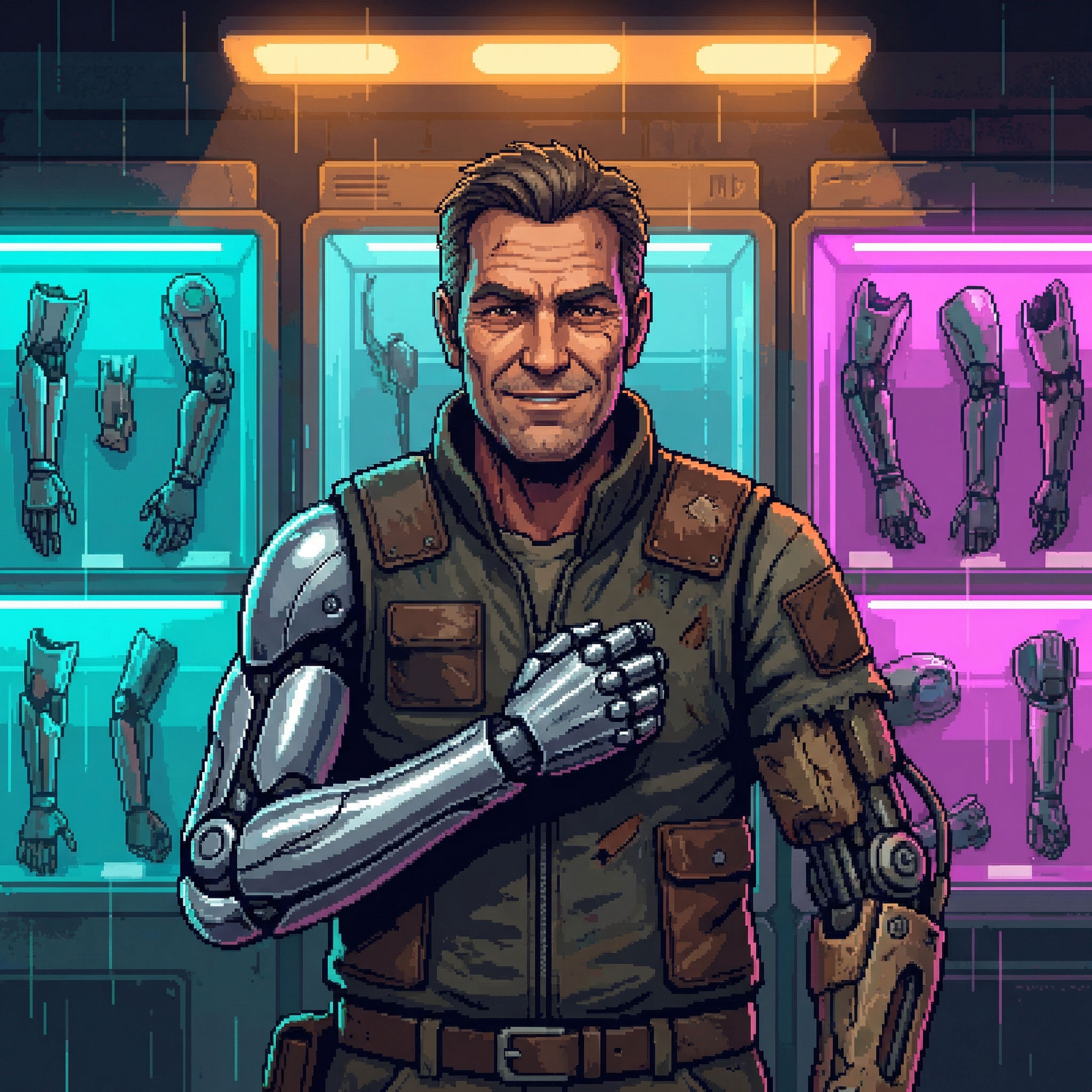
Seid
Also known as: "The Arms Dealer"
The Running Joke
Every time someone introduces Seid, they call him "the arms dealer." And every time, people assume he sells weapons.
"Let me introduce you to Seid—he's the biggest arms dealer in the Dregs."
The new client reaches for their sidearm.
"No, no—arms. Like, you know..." mimes having two arms "...arms."
This happens constantly. At business meetings. At parties. In back alleys. He's tried other titles—"limb merchant" (sounds like a serial killer), "prosthetics broker" (too clinical), "The Leg Guy" (didn't stick). Nothing works.
The confusion is eternal.
The Business
Seid is the Sprawl's most successful dealer of cybernetic limbs—arms, legs, hands, feet, and everything in between. He sources, refurbishes, and sells prosthetics ranging from budget salvage jobs to bleeding-edge corporate prototypes.
The Backstory
Seid doesn't talk about his childhood. The story, if you dig deep enough: born in the Wastes to scavenger parents, lost both arms at age twelve when a collapsed structure pinned him for six hours.
For two years, he lived as a double amputee in a world that measures worth by productivity. Then a salvager named Crow gave him a gift: two mismatched arms pulled from a dead corporate soldier. Installed badly, without anesthesia.
Those arms—one military combat model, one civilian utility—became more than limbs. They became proof that discarded things could have value. That someone's loss could become someone else's gain.
"Everyone loses parts of themselves. Not everyone gets them back. I make sure more people get them back."
Appearance
The Arms
Both of Seid's arms are cybernetic—different models, naturally. His left arm is a sleek corporate model that demonstrates premium quality to prospective buyers. His right is a custom-modified salvage job, proof that he can make anything work. Together, they're a walking advertisement for his business: one arm says look what you could have, the other says look what I can do with scraps.
The Presentation
Seid dresses like a salesman who does business in back alleys—professional enough to meet corporate buyers in Nexus lobbies, practical enough to survive the Dregs at midnight. The clothes say trust me. The mismatched chrome arms say I've been where you are.
The Tell
When Seid talks about limbs he's passionate about, his right hand—the salvage arm—flexes involuntarily. A neural tic from the bad installation, never fully corrected. He could have it fixed. He hasn't. It reminds him of Crow.
The Dr. Tzu Yu Connection
Seid works closely with Dr. Tzu Yu, the Sprawl's most notorious unlicensed surgeon. The relationship is symbiotic:
- Seid supplies the limbs
- Dr. Tzu Yu installs them
- Together, they offer end-to-end service
When someone loses an arm in a laser fight at 3 AM, they call Dr. Tzu Yu. When they need a replacement arm by morning, Dr. Tzu Yu calls Seid. They've been working together for 23 years.
The Showroom Floor
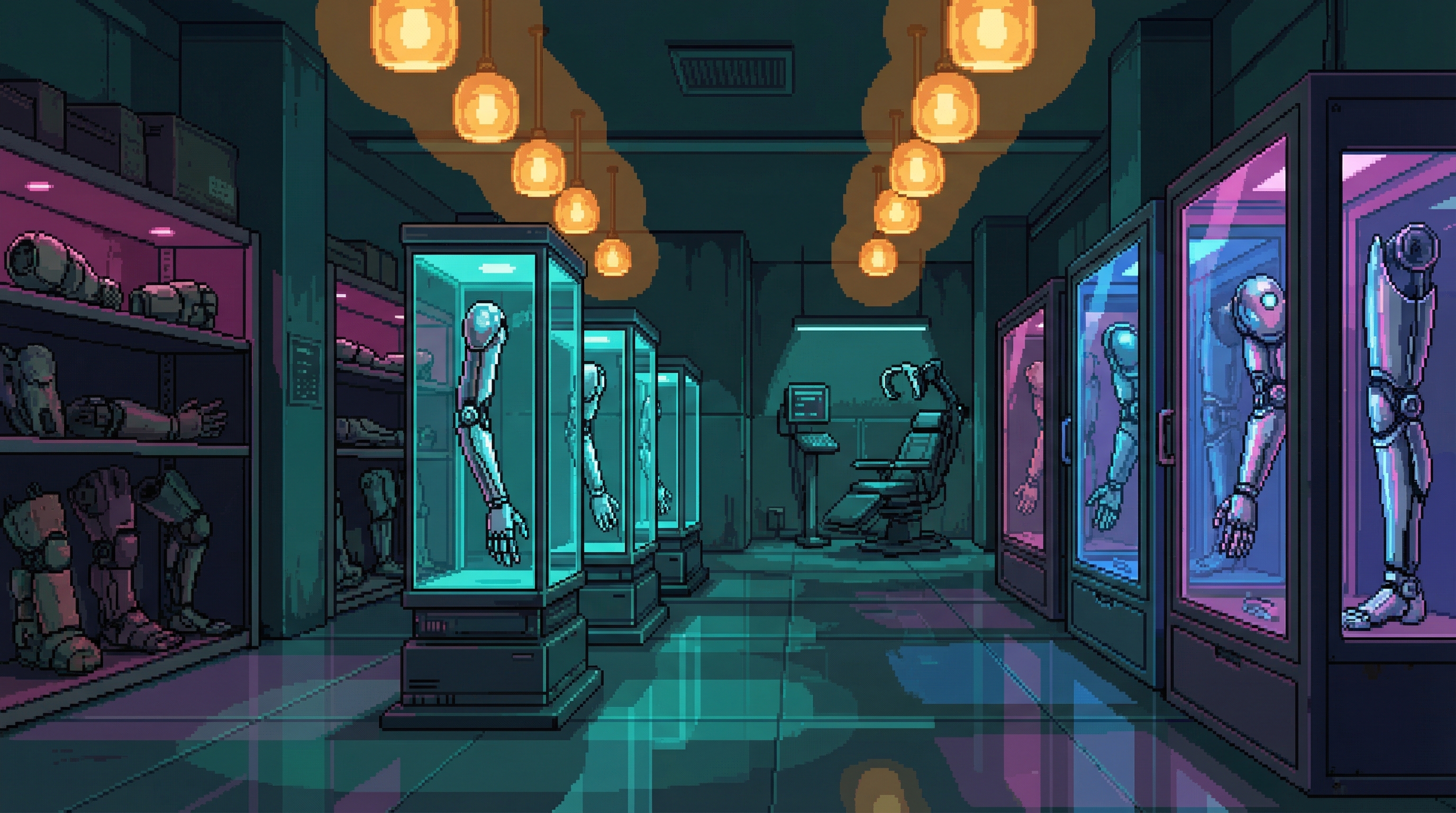
The primary showroom is in the Lower Market—a converted cargo bay three levels below the bazaar where Viktor Kaine's people keep the peace. The first thing that hits you is the smell: machine oil, the faintly sweet chemical tang of synthetic skin, ozone from the neural calibration rigs, and underneath it all the clean mineral scent of titanium alloy. It smells like a hospital designed by mechanics.
Three aisles. Budget on the left—salvage limbs on rotating stands, some still bearing scorch marks or the faded serial numbers of their previous owners. Standard in the center—sleek production models on velvet-lined shelves with handwritten specs cards in Seid's cramped handwriting. Premium on the right, behind glass cases lit with blue LED strips that make the military-grade chrome sing. A Nexus SpecOps combat arm sits in the center case, matte black with gold joint articulation, fingers curled like it's waiting for someone to complete it.
The cases hum. Demo limbs flex on motorized display mounts, fingers opening and closing in slow demonstration loops, wrists rotating through their full range of motion. It's mesmerizing and slightly unsettling—disembodied hands trying to remember what they were reaching for.
The Fitting
Along the back wall: fitting stations with padded chairs and neural calibration interfaces wired into diagnostic rigs that Dr. Tzu Yu maintains remotely. When a customer tries on a prosthetic for the first time, Seid slides the limb over the stump or neural junction. A click—the magnetic seal engaging—and then the interface handshake: heat and static and suddenly having fingers again.
Some people laugh. Some cry. One woman—a factory worker who'd lost her arm to an Ironclad press malfunction three months earlier—sat in the fitting chair and just opened and closed the new hand for twenty minutes, watching the fingers respond, feeling the texture of the armrest through sensors she'd mourned like dead children.
Seid didn't rush her. He never rushes.
The Desperate Client
The hardest sales aren't the expensive ones. They're the ones where someone walks in with barely enough credits for budget tier, needing something that will let them work again tomorrow.
A young woman comes in near closing. Wastes-born, based on the dust ground into her collar and the way she blinks at the LED displays. Her left arm ends at the elbow—not a clean surgical cut but a ragged edge. She clutches a credit chip in her remaining hand.
Seid doesn't start with the catalog. He starts with a chair and a glass of water—real water, not recycled, which is its own quiet extravagance in the Lower Market. He asks what happened. She doesn't want to say. He doesn't push.
"What do you do for work?"
"Welding. Ironclad subcontract."
Welding means grip strength, heat tolerance, precision. He pulls three options from budget. The Ironclad utility model is the right choice. They both know it. But the price—even budget—is more than the credit chip holds.
Seid looks at the arm. Looks at her. Calculates. Then he cuts the price to what she has, plus a future debt: twelve hours of welding skill applied to his showroom whenever he needs repairs.
"I don't give handouts. I give terms. You're a welder. I need welding. We're even when the hours are done."
The magnetic seal clicks. The neural handshake fires. She gasps—heat and static and suddenly having fingers—and clenches the new hand into a fist, and the fist holds, and her eyes go wide.
Crow gave Seid arms when he had nothing. He's been paying it forward ever since.
Sample Dialogue
"You're looking for firepower? Wrong dealer. I sell arms, not arms. Look—" opens catalog "—titanium alloy, full nerve integration, 340-degree wrist rotation. You want to shoot someone? Go to Viktor. You want to reach someone? I'm your guy."
Client: "I heard you could get me some heavy arms."
Seid: "How heavy? The industrial models weigh about 8 kilos. Great lift capacity, but you'll feel it in your shoulder socket."
Client: "No, I mean—weapons. Guns."
Seid: sighs "Every. Single. Time."
"The corporations want you to buy new. Pay full price, get the warranty, submit to their network tracking. I give you options. Sometimes the best arm is the one that fell off someone who didn't need it anymore."
What He Won't Sell
No Children's Limbs
They exist on the gray market. He doesn't touch them.
No Active Tracking
He'll remove trackers, but won't sell them functional. "You want corporations knowing where your arm goes, buy from them directly."
No Rothwell Connections
He's never explained why. The topic closes conversations.
Connections
Dr. Tzu Yu: More than a business partner—co-architect of the Sprawl's underground augmentation economy. 23 years of collaboration.
The Collective: Gets special treatment. They need untraceable limbs. Seid provides them. No records, no serial numbers, no questions.
Viktor Kaine: Understanding based on discounted service to Sector 7G refugees. Kaine noticed. They've had an arrangement ever since.
El Money: Network referral relationship through G Nook. They've never met in person. That's intentional.
The Crow Mystery
There was a salvager named Crow who changed Seid's life. Gave him two mismatched arms pulled from a dead corporate soldier. Installed them himself, badly, without anesthesia. Then vanished.
"There was a salvager who gave me my first arms. Crow. Never found out his real name. Never saw him again after the installation. But I've spent thirty years looking for him—every Waste scout, every old salvager, I ask. Nothing. Maybe he's dead. Maybe he moved on. Either way... I owe him everything. And I can't repay it. So I pay it forward instead."
The name surfaces in the Wastes sometimes. Old scavengers who remember the years right after the Cascade—when everything was rubble and the dead outnumbered the living—they'll mention a figure who moved through the wreckage leaving gifts. A pair of arms wedged into a collapsed doorframe where someone was trapped. A leg propped against a medical tent. Always salvage-grade, always functional, always left without explanation.
Nobody knows if Crow was one person or many. Nobody knows if the name was chosen or given. What they know is this: for a brief window in the Scavenger Years, someone was stripping augmentations from the dead and giving them to the living. Not selling. Giving.
Seid has spent thirty years asking. Every Waste scout, every salvager crew, every scrap merchant who's been in the business long enough. The answers are always the same: yes, they've heard the name. No, they don't know where Crow went. Some say Crow died in the same ruins that supplied the gifts. Some say Crow was absorbed into the Collective's early networks. One old salvager in the Dregs swore Crow was still out there—still leaving limbs in the rubble, still vanishing before anyone could say thank you.
Seid doesn't believe that last one. But he hasn't stopped looking.
The Consciousness Question
Seid has spent 40 years watching people replace parts of themselves. He's developed strong opinions about where the replacement should stop.
On AI-Integrated Limbs
The modern corporate limb isn't just a prosthetic—it's a networked device. Nexus wants your arm connected to their systems. Helix wants your neural interface feeding them data. Every premium limb comes with AI assistants, predictive movement algorithms, cloud-connected diagnostics.
Seid strips all of it out.
"When I was fourteen, I got my first arms. Two mismatched military salvage units. No AI, no connectivity, no optimization. Just motor control and my brain learning to use them. You know what happened? I learned. I adapted. The arm didn't tell me how to move—I told it."
He doesn't sell "smart" limbs. He sells tools. The difference, he insists, matters.
The Tracker Removal Service
Every corporate limb contains tracking hardware. Location data, usage patterns, biometric readings—all feeding back to company servers. Seid's workshop includes a small EMP chamber and a team of hardware specialists who do nothing but find and remove these systems.
"Your arm shouldn't report to anyone but you."
The AI Optimization Problem
Modern prosthetics use AI to "optimize" movement—predicting what you want to do, smoothing your motions, correcting your mistakes. Seid thinks this is dangerous.
"The arm starts making decisions for you. Small ones first. Then bigger. Eventually, you're not the one reaching anymore—you're the one approving the arm's decisions to reach."
The Consciousness Purity Principle
Seid draws a hard line at neural AI integration. He'll sell you an arm that connects to your nervous system—that's mechanical interface, necessary for function. But he won't sell limbs that run AI processes in your neural space.
"The moment AI starts running in your head, even if it's 'just for the arm,' you're sharing your consciousness with something that isn't you. I've seen what happens."
The Older Way
Among his clients, Seid has a reputation for pushing "vintage" tech—pre-Cascade designs, mechanical systems, anything that doesn't require network connectivity. Some call it nostalgia. He calls it survival.
"ORACLE fell because everything was connected. When it went wrong, everything went wrong together. My clients' arms still work."
The Rothwell Exception
There's one topic that closes all AI discussions immediately: the Rothwell corporations. Seid won't touch their tech. Won't modify it. Won't discuss why.
The rumor in the Lower Market: Seid once took a job removing tracking from a Rothwell limb. What he found inside made him refuse all Rothwell work permanently. He won't confirm or deny. He just changes the subject.
Whatever he saw, it was enough to make a man who rebuilds corpses' limbs for a living draw a hard line he won't cross.