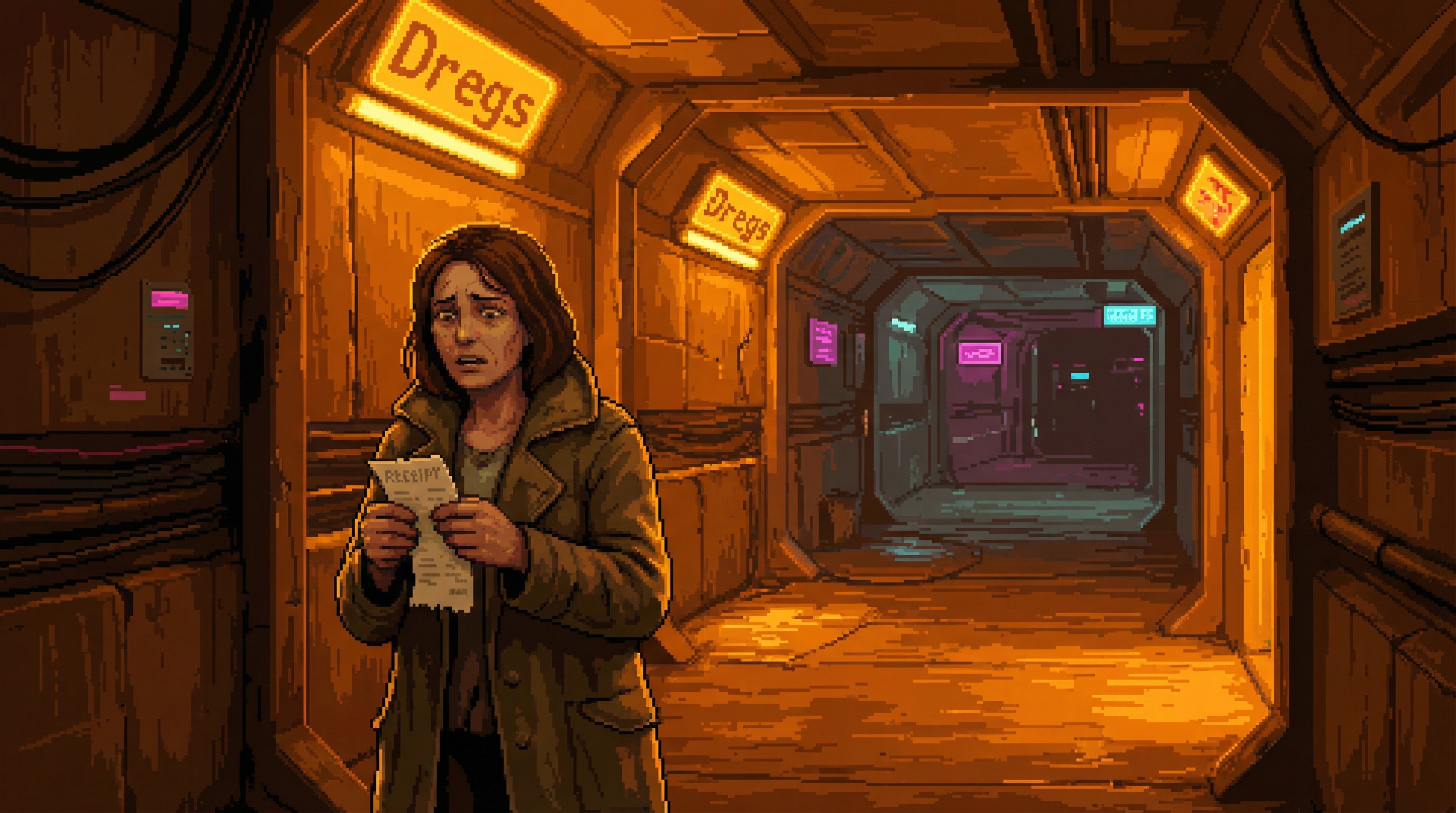
Nkenna Okafor-Reyes
Former Inference Analyst · Erased · Sector 7G
Nkenna paid to disappear. Not with money she could spare — with everything she had.
She was a Senior Inference Analyst at Good Fortune, building the behavioral models that BehaviorExchange trades. She predicted consumer behavior with 91% accuracy at a 30-day horizon. She earned ¢180,000 per year. She was valued. She was surveilled at Exposure Index 28.
She saved for seven years. The ¢340,000 was everything. The erasure left her invisible and broke — walking through Sector 7G without generating a footprint, without being predicted, without being valued by the system that had valued her for her entire career.
“I thought it would feel like freedom. It felt like falling. The ads were annoying. The inference was invasive. But they were also — context. They were the system saying: we see you. We know you’re here. You matter enough to watch. When nobody’s watching, you have to decide if you matter on your own.”
Field Observations
Nkenna speaks with the unvarnished honesty of someone who has nothing left to perform. She doesn’t romanticize privacy. She doesn’t demonize surveillance. She describes both with the precision of someone who has lived on both sides of the Bargain.
Honest Above All
She tells Opacity Movement prospects exactly what privacy costs, including the costs that aren’t financial. Most recruiters sell freedom. Nkenna sells vertigo — and lets people decide whether vertigo is worth it.
The Receipt
She carries her ¢340,000 receipt. A physical piece of paper. “This is the most expensive thing I’ve ever owned. It’s a divorce.” She shows it to anyone considering erasure. The paper is worn at the folds.
Post-Erasure Disorientation
The loss of being predicted is also the loss of being scaffolded. Every decision is heavier without algorithmic assistance. What to eat, where to walk, who to trust — choices that the system used to rank and recommend now arrive unfiltered, unweighted, raw.
Sensory Overload
Post-erasure, she notices everything she never noticed while monitored: the quality of walking through a crowd without your interface whispering predictions. The silence where purchase suggestions used to live. The weight of choosing what to eat without an algorithm ranking mood-appropriate options. The Dregs feel rawer, louder, more present — not because they’ve changed but because she experiences them without the filtering layer.
“¢340,000 is not a purchase. It’s a divorce.”
Known Associates
Good Fortune
Former employer. Nkenna built the behavioral models she paid ¢340,000 to escape. She predicted consumer behavior with 91% accuracy — one of the firm’s top analysts. The models are still running. She is not.
The Opacity Movement
The Movement’s most honest recruiter. Other recruiters promise liberation. Nkenna promises loss — loss of scaffolding, loss of validation, loss of the certainty that you matter to something larger than yourself. Her recruitment rate is lower than average. Her retention rate is the highest in the Movement.
Oren Vasquez-Mbeki (formerly Devi Okonkwo-Chen)
Perspective from the demand side. Nkenna paid for full erasure. Oren offers a gentler alternative at the Mirror Market — see your model rather than destroying it. Two approaches to the same injustice: Nkenna burned the house down; Oren opens the windows.
Oren Vasquez-Mbeki
Built the system Nkenna escaped. His guilt and her sacrifice bracket the same injustice from opposite ends — the architect who can’t stop building, and the analyst who paid everything to walk away.
Sector 7G
Post-erasure home. No surveillance overlay, no blue inference lighting. Raw, imperfect, unfiltered amber light. The corridors don’t know she’s there. Neither does anyone else, unless she tells them.
Open Questions
The Surveillance Security Blanket
Being watched is oppressive. Being watched is also orienting — a constant signal that you exist, that someone (even an algorithm) considers you worth tracking. Nkenna lost both simultaneously. The Dregs are debating what she found on the other side.
Is the vertigo temporary, or is it the permanent cost of freedom?
Invisible Self-Worth
When the system values you — at ¢47 or ¢340 or ¢12,000 — you have an externally validated measure of your significance. Your Exposure Index is a number that says: you matter this much. Nkenna’s index is effectively zero.
Without external validation, where does significance come from? Can you generate it yourself, or do you just learn to live without it?
The ¢340,000 Question
Is privacy worth everything you have? Nkenna’s answer is yes. But “yes” doesn’t mean “easy.” The Opacity Movement uses her story as proof that erasure works. She uses her story as a warning that it costs more than money.
How many people would pay ¢340,000 if they knew what the morning after felt like?
▲ Unverified Intelligence
Flagged items. Confidence levels vary.
- The models survived her: Good Fortune’s inference models that Nkenna built are still in active deployment on BehaviorExchange. Her successor refined them. Accuracy has reportedly increased since she left. Every behavioral prediction her old division sells carries her architectural fingerprints. She knows this.
- Erasure wasn’t clean: Multiple sources suggest that full erasure at the ¢340,000 tier is not truly complete. Residual data fragments persist in secondary systems, corporate backup archives, and partner-shared datasets. Whether Nkenna is aware of these traces — whether she has an Exposure Index closer to 0.3 than 0 — is unconfirmed.
- Recruitment as therapy: Opacity Movement leadership reportedly monitors Nkenna’s recruitment conversations. Not because she’s off-message — because her honesty about the cost of privacy is more effective long-term than ideological selling. Some within the Movement believe she’s processing her own grief through the recruitment process. Whether this diminishes or strengthens the work is debated.
- The new identity: Nkenna’s current identity was created from scratch during the erasure process. The name “Nkenna Okafor-Reyes” may itself be constructed. If so, her pre-erasure identity — the analyst who built the models — is someone else entirely. She has never confirmed or denied this.