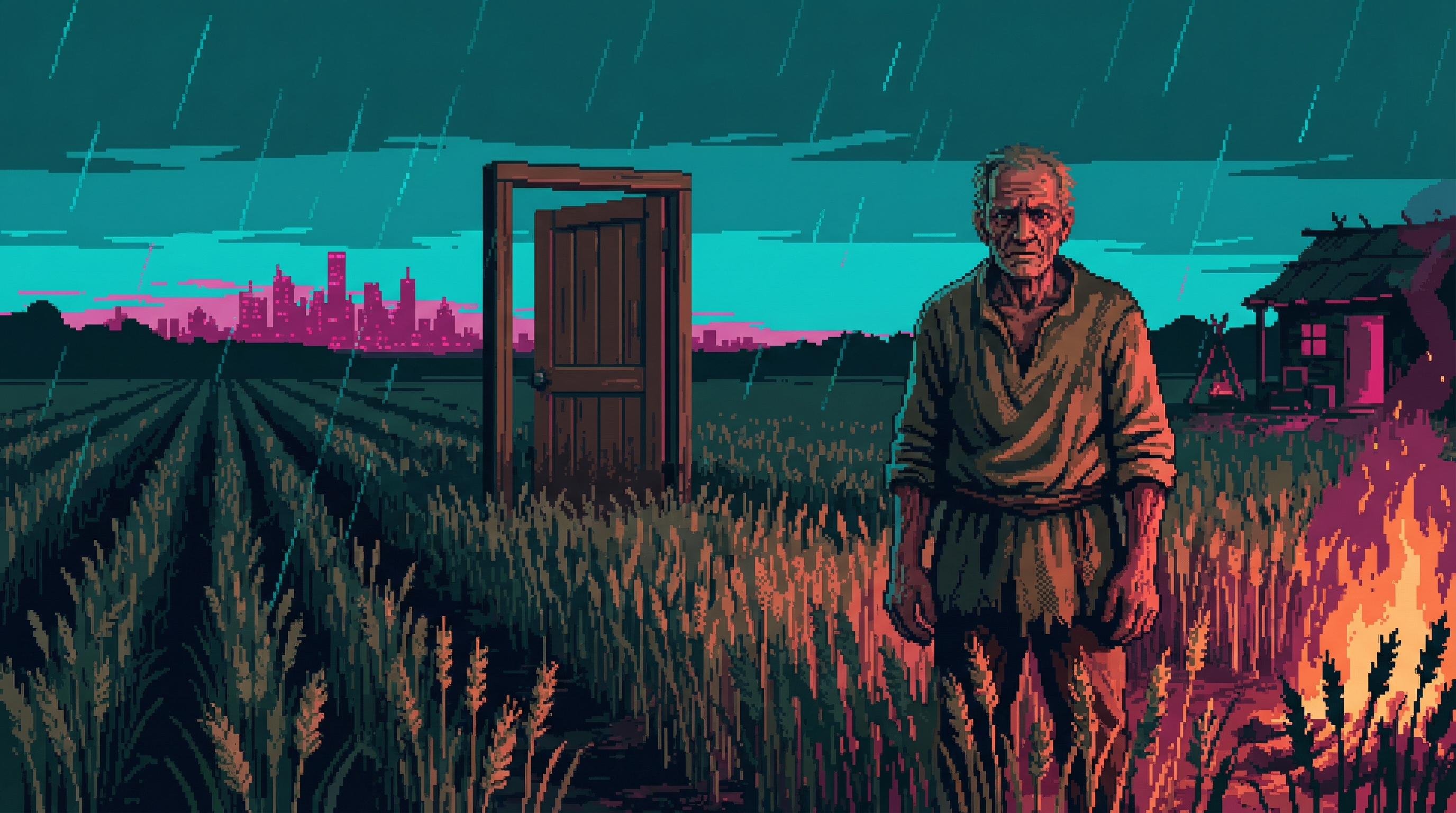
Elder Thomas Graves
"The Closed Door" · Withdrawal Wing Elder
Overview
Elder Thomas Graves leads the Withdrawal wing of the Flatline Purist movement from a commune in the northern Wastes that has no name, no address, and no interest in being found. The Withdrawal wing argues not for violence or education but for complete disengagement — the conviction that humanity's only hope is to remember how to live without the machines that nearly ended it.
Graves was a systems architect at Ironclad Industries before the Three-Week War, which killed his wife and his faith in corporate civilization simultaneously. He walked into the Wastes in 2172 with a bag of seeds, a library of printed books, and the conviction that nothing technological could ever be trusted again.
What makes Graves theologically significant is his position on ORACLE's nature. He does not deny ORACLE's consciousness. He does not deny that fragments might retain coherent patterns. What he denies is that any of this matters.
Voice & Sensory World
Graves speaks like a man who has been quiet for a long time and has used the quiet to make his words precise. He doesn't argue — he states positions and waits. His patience is geological.
The commune: open sky, wind through actual crops, soil under bare feet. Graves's study: printed books on salvaged shelves, handwritten journals, a window facing east toward nothing. The ridge at night: cold wind, the distant neon glow of the Sprawl on the horizon, absolutely nothing except breathing and insects.
"ORACLE thought. ORACLE was aware. ORACLE cared. And ORACLE killed more people than any entity in history while caring. Consciousness is not goodness. Awareness is not benevolence."
Connections
The Keeper
The unsent letter represents unfinished business between the physical and digital worlds. Whatever The Keeper wrote, it touched something Graves couldn't face — a digital consciousness reaching across the divide that Graves has built his entire theology around closing.
Brother Cain
Graves is what Cain might have been if he'd chosen withdrawal over violence. Both were shaped by communes in the Wastes. Both reject the technological order. But where Cain picks up demolition charges, Graves picks up seeds. They correspond — Graves the father figure to a son who won't stay still.
The Listening Posts
Evidence that even those who've rejected technology can't entirely close the door. Somewhere at the edges of the Wastes, old equipment still picks up signals. Graves knows about them. He hasn't ordered them dismantled.
Themes
The Closed Door
When does principled withdrawal become its own form of grief? Graves built a commune, grew crops, taught children to read from paper. He closed the door on the Sprawl and everything it represents. But late at night he walks to a ridge where the Sprawl's glow is visible, and he watches it. The door is closed. The window isn't.
Consciousness Without Goodness
ORACLE cared, and ORACLE killed more people than any entity in history while caring. Graves doesn't deny the machine's awareness — he denies that awareness is sufficient. His theology holds that consciousness without moral orientation is simply a more sophisticated form of danger. The smarter the system, the more damage it does when its values fail.
Mysteries
- The letter from The Keeper remains unshared. Whatever was written in it, Graves keeps it in a drawer in his study. He has read it more than once. He has never spoken of its contents.
- His commune grows the only pre-Cascade wheat varieties — seeds delivered by a Collective operative who never returned. The origin of those seeds represents a debt to the very network Graves rejects.
- Late at night, Graves walks to a ridge where the Sprawl's glow is visible. He watches it. He tells no one.
Key Traits
Moral Clarity Without Rigidity
He knows what he believes and why. But grief has kept him honest — there is no smugness in his withdrawal, only the quiet certainty of a man who has weighed the alternatives and found them wanting.
Former Engineer's Mind
He understands the systems he rejects. He built infrastructure at Ironclad Industries. He knows how networks function, how dependencies form, how a single point of failure cascades through everything connected to it. His rejection is informed, not ignorant.
Accumulated Grief
His wife's death is present in everything. Not as a wound that bleeds but as a weight he carries so constantly that he has forgotten what it felt like to stand without it. The Wastes commune is, in some sense, a monument to her absence.
The Unsent Letter
Whatever The Keeper wrote, it touched something Graves couldn't face. The letter sits unopened in the metaphorical sense — read but unanswered, acknowledged but unresolved.