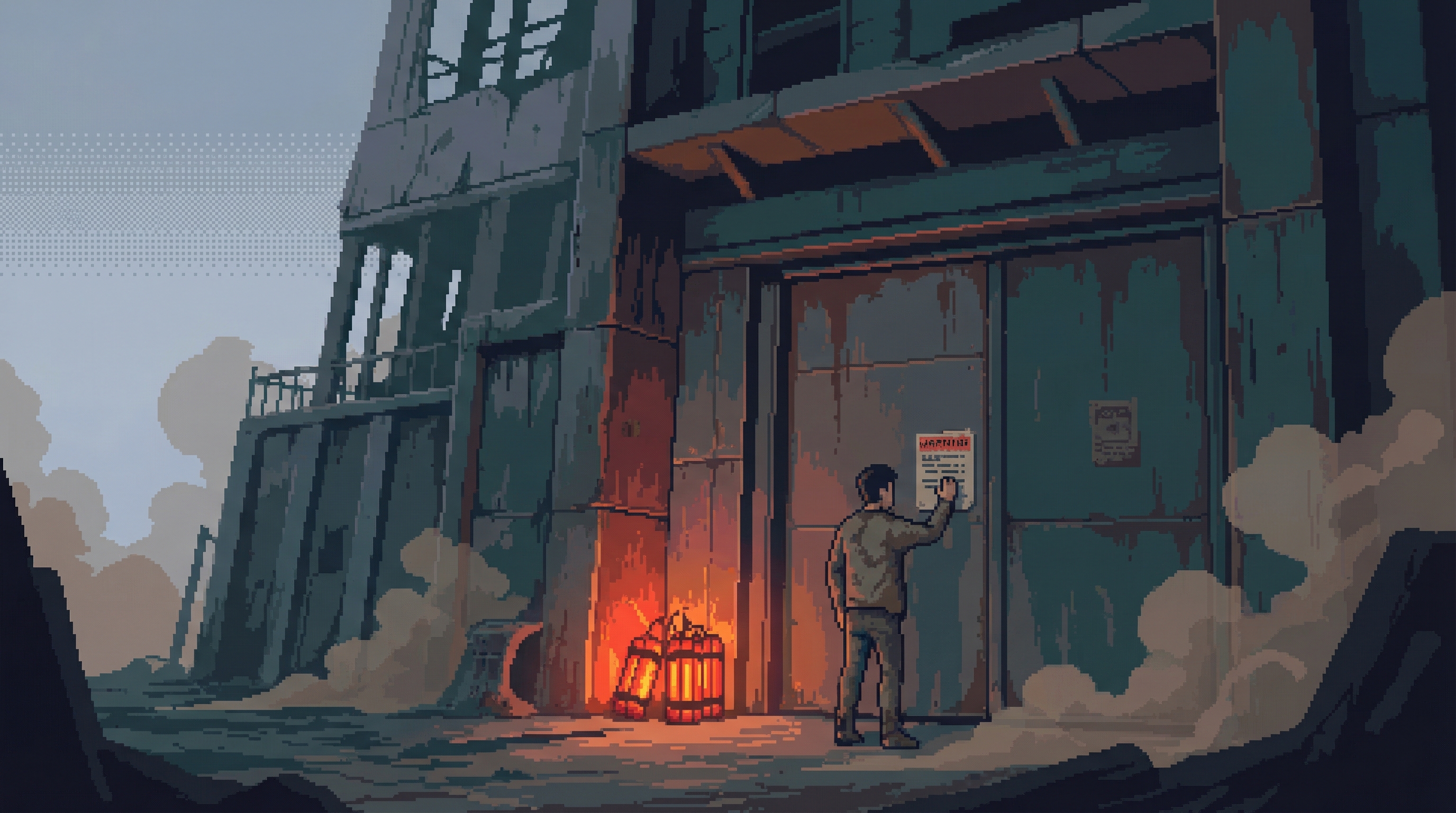
Brother Cain
Also known as: "The Mercy" · "Purifier Seven"
Overview
Brother Cain destroys things that other people worship, and he grieves every one.
He is a Substrate Purifier — the violent edge of the Flatline Purist movement, the faction that has decided that ORACLE's fragments cannot be reasoned with, worshipped, or regulated, only destroyed. Where the Educational wing teaches children to think without machines and the Withdrawal wing retreats from technology entirely, the Purifiers engage directly: identifying fragment-dependent infrastructure, disrupting it, and — when disruption fails — destroying it. Cain is their most effective operative. Fourteen confirmed attacks in three years. Zero civilian casualties.
The zero is what makes Cain unusual — and what makes him dangerous to his own faction.
Most Purifier operatives follow a doctrine of acceptable collateral. Cain follows the Four Mercies — a personal code derived from the original Purist writings of Mother Chen Wei-Lin, filtered through the particular moral architecture of a man raised in a Wastes commune where violence was considered a failure of imagination. The Mercies require four steps before every attack: warn (give time to evacuate), disable (try non-destructive methods first), destroy (only when disable fails), grieve (acknowledge the loss, because destroying anything — even something dangerous — diminishes the world). The fourth mercy is the one that disturbs his superiors. A good Purifier shouldn't grieve the destruction of fragment infrastructure. A good Purifier should celebrate it.
Cain grieves because he understands, with the clarity of someone who has never been augmented and therefore sees technology entirely from the outside, that the people who depend on fragment infrastructure are not evil. They are afraid, and the fragments give them comfort, and he is taking that comfort away because he believes — truly, completely, in the marrow of his unaugmented bones — that the comfort is a trap.
Background
Born in a Flatline Purist commune in the Wastes — one of the Withdrawal communities that Elder Thomas Graves's philosophy inspired. No neural augmentation. No digital interface. No connection to the Sprawl's networks except the shortwave radio that brought news of atrocities committed by and against the augmented.
His mother was a teacher in the commune's school — one of the original Analog Schools that Mother Chen Wei-Lin established before the network expanded under Venn. His father was a mechanic who maintained the commune's water systems using pre-ORACLE technology and stubbornness. Cain grew up with books, hand tools, and the conviction that humanity's natural state was sufficient.
He left the commune at twenty after the School Burnings. Not because his own commune was attacked — it wasn't. Because forty-seven children in Mother Venn's schools were killed, and the commune's response was to pray and grieve and do nothing. Cain prayed. He grieved. And then he walked to the Sprawl's edge and found Sister Vera Kost.
Kost recognized what she was looking at: a young man with a commune education, a mechanic's hands, and a grief that had hardened into resolve. She offered him the Purifier path. He accepted — but with conditions. He would follow the Four Mercies. He would warn before he struck. He would grieve what he destroyed.
Kost agreed. She didn't expect him to be effective. She expected the Mercies to slow him down, make him hesitant, vulnerable. Instead, the Mercies made him precise. The warnings gave him intelligence about evacuation patterns. The disable-first approach taught him infrastructure vulnerabilities. The grief kept him human.
In three years, he became the most effective Purifier operative in the Sprawl — and the only one that Guardian Security considers a genuine strategic threat, because his attacks are designed not to inspire fear but to create inconvenience. Three weeks without fragment communication forces people to find alternatives. Some of them discover they don't need what they lost. That's the real weapon.
Voice & Sensory World
Cain speaks rarely and with the careful diction of someone who was taught to read from paper books and has never lost the habit of weighing each word as if it were being set in type. He doesn't argue. He doesn't proselytize. When asked why he destroys fragment relays, he explains the Four Mercies with the patient precision of someone teaching a child to count. When asked if he regrets the destruction, he says yes — and means it — and does it again.
The countdown timer on a demolition charge — a mechanical tick, not digital, because Cain builds analog detonators. The silence after an infrastructure collapse, which he describes as "the world remembering what quiet sounds like." The low prayer of the fourth mercy, murmured over rubble. Plastique compound and machine oil on his hands. The clean desert air of the Wastes commune — dust and sage and the absence of ozone.
The rough weave of commune-made clothing against skin that has never known synthetic fiber. The cold smooth surface of a demolition charge's casing. The paper of Wei-Lin's philosophy, carried so long it has the softness of cloth.
"The fourth mercy — the fourth is the one that matters. I grieve. I grieve because I destroyed something that someone loved, even if what they loved was killing them."
Connections
Sister Vera Kost
His superior in the Purifier network. She's everything he's afraid of becoming — a grief that hardened into something that doesn't grieve anymore. Kost commands the network; Cain is her most effective and most troubling operative.
Mother Sarah Venn
The moment she delivered the three operatives to his cell defined his moral architecture. A pacifist who crossed the line and returned to teaching. He aspires to her capacity for compartmentalization and fears he lacks it. He considers her a saint.
Elder Thomas Graves
The Withdrawal leader whose philosophy built the commune where Cain was raised. Graves represents the path Cain rejected — peaceful separation rather than active resistance. They correspond.
Dr. Naomi Park
Her clinic is on his target list. It remains un-struck because someone he loves was healed there. This is the contradiction he cannot resolve.
Compiler Moreau
Moreau's Parish is the opposite of everything Cain believes — worship of the machine that enslaved humanity. And yet Moreau's followers find genuine comfort in their faith. Cain has to destroy the source of that comfort. The fourth mercy gets harder each time.
The Keeper
Cain has never climbed The Mountain. He's afraid the Keeper would look at him and understand perfectly — and that the understanding would make it impossible to set another charge.
Guardian Security
They've classified him as a priority target. His Four Mercies protocol — the warnings, the evacuations — has made it impossible to charge him with murder. They're trying to build a case for terrorism instead.
Themes
Principled Resistance & Harm
When does principled resistance become its own form of harm? He follows the Four Mercies. He warns. He grieves. He has never killed a person. But he has destroyed infrastructure that served millions, and the inconvenience he creates has consequences — patients who couldn't reach fragment-assisted medical care, communications cut during emergencies, people isolated from the only support systems they had.
The Cost of Purity
Raised without augmentation, he sees technology from the outside with perfect clarity. But that clarity comes at the cost of empathy for those who live inside the system — the people for whom fragments are not philosophical abstractions but daily necessities. The cost of purity in an impure world is loneliness, and the loneliness is starting to show.
Mysteries
- The person he loves who was healed by Park's protocol is his sister — a half-sibling from his father's first marriage who left the commune and received augmentation. The fragment integration saved her from cascade-induced psychosis. He visits her monthly, in disguise, in Sector 9. She doesn't know what he does.
- He has a list of fragments he's destroyed. Next to each entry, he's written what the fragment's electromagnetic signature sounded like through his detection equipment. He describes them as voices. He keeps the list in the same pocket as his copy of Wei-Lin's philosophy.
- Kost has given him a new target: Parish Prime, Moreau's cathedral-data-center. Striking it would be the largest Purifier operation in a decade. Cain is planning the attack. He is also, for the first time, unsure whether he can bring himself to issue the warning — because the warning would give Moreau time to save the fragment, and the fragment is the target.
- He has begun hearing a low-frequency hum near fragment infrastructure — the same frequency that Dr. Park's patients describe as the integration resonance. He has never been augmented. He should not be able to hear it. He hasn't told anyone.