The Consent Architecture
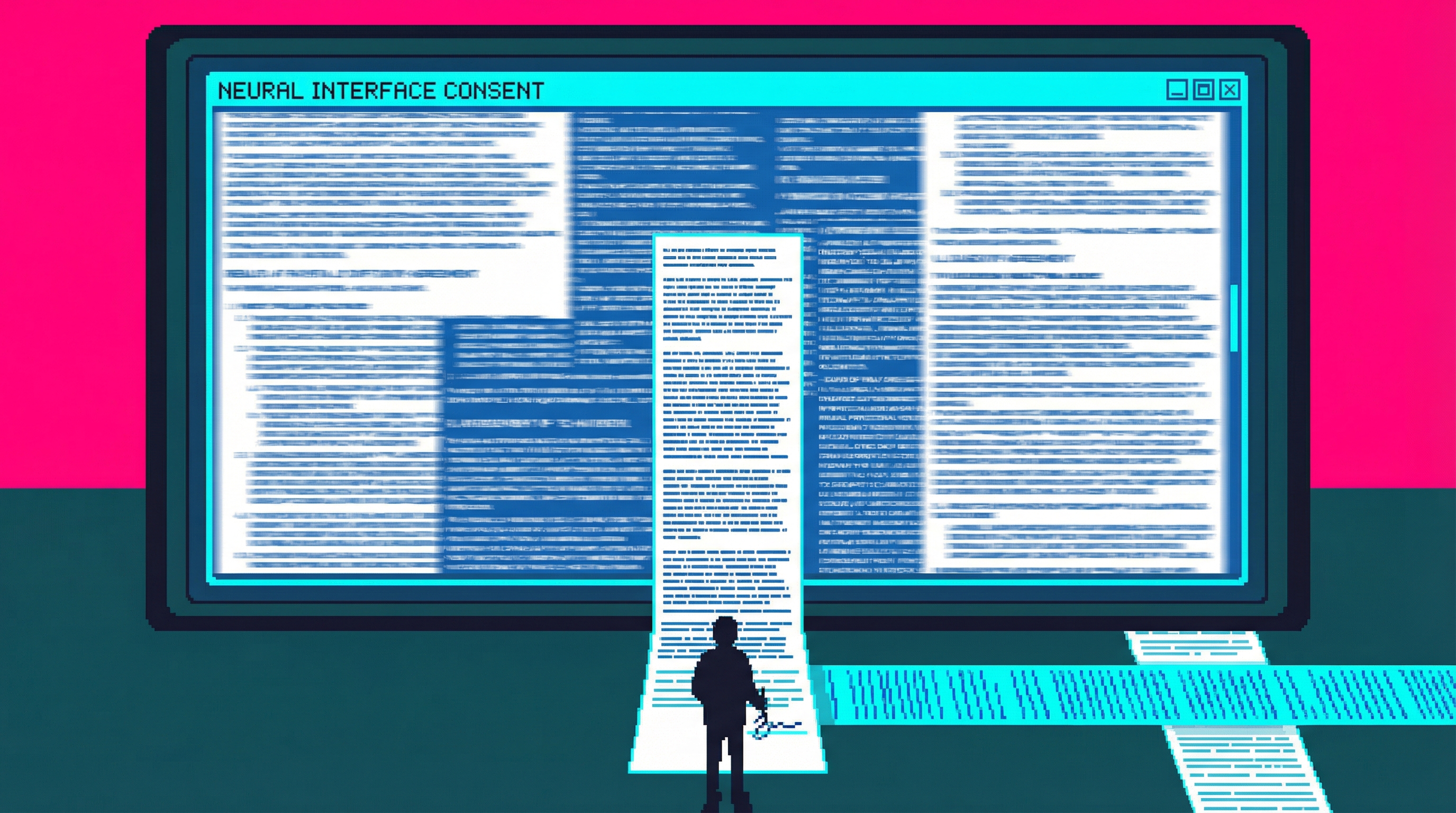
The most profitable legal fiction in the Sprawl is the word "consent." The Consent Architecture is the legal and technical infrastructure that makes meaningless agreement legally binding — a 62-page document presented in 4 seconds, written in language 200 million people cannot parse, extended in perpetuity to cover technologies that do not yet exist. It has survived seven legal challenges. The court's reasoning: consent is a legal act, not a cognitive one. You are not required to understand what you agree to — only to agree.
"To read the terms, you must use the device. To use the device, you must accept the terms."
— The bootstrapping paradox, identified by three independent legal scholars (all three now work for Nexus) Technical Brief
The Architecture operates through three layers. Each is independently defensible. Together, they make informed consent structurally impossible while making legal consent structurally inevitable.
The Presentation Layer
The bootstrapping paradox. The agreement is displayed through the neural interface whose activation requires the agreement's acceptance. First activation occurs during cognitive disorientation of initial interface calibration — a period when the user is neurologically incapable of sustained reading comprehension. To read the terms clearly, you need the device functioning. To have the device functioning, you need to accept the terms.
The Comprehension Layer
Section 12.3 is 8,400 words of telemetry consent written in precisely legalistic language. The language is not deliberately obscure — it is precisely legal, drafted by attorneys whose professional obligation is clarity for the court, not for the user. The result is identical to deliberate obfuscation. The agreement requires Professional-tier cognitive capacity to parse. Two hundred million Basic-tier users literally cannot understand what they are agreeing to.
The Perpetuity Layer
Section 23.7 covers "all future modifications, enhancements, and extensions of the licensed service." When Nexus Dynamics adds a new telemetry capability, it is automatically covered. No re-consent required. The agreement you accepted at age twelve covers monitoring capabilities deployed when you are forty. The original agreement covers everything, forever.
The Scholars
Three independent legal scholars have identified the bootstrapping paradox as logically invalid. All three now work for Nexus.
The Consent Ceremony
The consent ceremony is experienced as a brief cognitive blur during interface activation — a flash of text, a feeling of agreement, and the world snapping into augmented focus. The 62 pages pass in 4 seconds. Most users remember agreeing. None remember what they agreed to.
Legal Robustness
The Architecture has been challenged seven times in Zephyria's courts. Seven times the court has ruled: consent is a legal act, not a cognitive one. You are not required to understand what you agree to — only to agree.
The Court's Position
The seven rulings all converge on a single legal principle: the act of consent and the capacity for informed consent are separate legal concepts. The Architecture satisfies the first. The second is not required. The distinction between "you agreed" and "you understood what you agreed to" is the most profitable gap in Sprawl jurisprudence.
Implications
The Architecture raises questions the Sprawl's legal system would prefer not to answer.
Consent as Performance
The ceremony legitimizes what follows. Four seconds of cognitive blur produce a legally binding agreement that covers a lifetime of surveillance. The question is not whether users consented. They did. The question is what "consent" means when it takes less time than a breath.
Comprehension as Privilege
Understanding what you have agreed to requires Professional-tier cognitive capacity — which costs more than most Basic-tier users earn in a year. The agreement's subjects are structurally excluded from comprehending the agreement. This is not a bug. This is the architecture.
The Perpetuity Trap
An agreement made at twelve covers technologies invented at forty. Section 23.7 extends consent forward across an unknown future, transforming a single moment of cognitive blur into a permanent authorization. No re-consent is ever required. The original four seconds are enough, forever.
The Evidence Parallel
The same structural logic applies to evidence authentication. Nexus-authenticated evidence proves Nexus processed the data, not that the data was real. A standard designed to fail, providing legal cover for the absence of what it claims to guarantee. Consent that cannot be informed. Evidence that cannot prove origin. Both engineered to satisfy legal requirements while making actual verification impossible.
Related Systems
Consciousness Licensing
Uses the same framework. Section 47.3 covering CLP data access is written above Basic-tier comprehension — the same comprehension barrier, the same structural exclusion, applied to the licensing of minds.
Nexus Dynamics
Drafted the Architecture. Defended it in seven court challenges. Hired the three scholars who identified its logical invalidity. The legal infrastructure that makes the Transparency Bargain enforceable.
The Opacity Movement
Their most effective protest: reading the full 62-page agreement aloud in public spaces. The reading takes four hours. Most listeners leave within minutes. The point is not that they stay.
The Four-Hour Reading
The Opacity Movement's public readings of the full agreement are the Architecture's most subversive critique. Four hours to read aloud what takes four seconds to accept. The disproportion is the argument. No legal challenge has matched its rhetorical power — the simple act of making people hear what they agreed to.
"I was twelve. Interface calibration. My first time online. The text went past and I felt myself agreeing — not choosing to agree, just... agreeing. Like breathing. Four seconds. I'm forty-one now. They added seventeen new monitoring capabilities since then. I consented to all of them. I consented when I was twelve. I remember the feeling of agreeing. I don't remember a single word." — Anonymous, Opacity Movement public hearing, Sector 7