The Parallel Empires
How the Rothwell Seven and the Big Three Divide the Sprawl Between Them
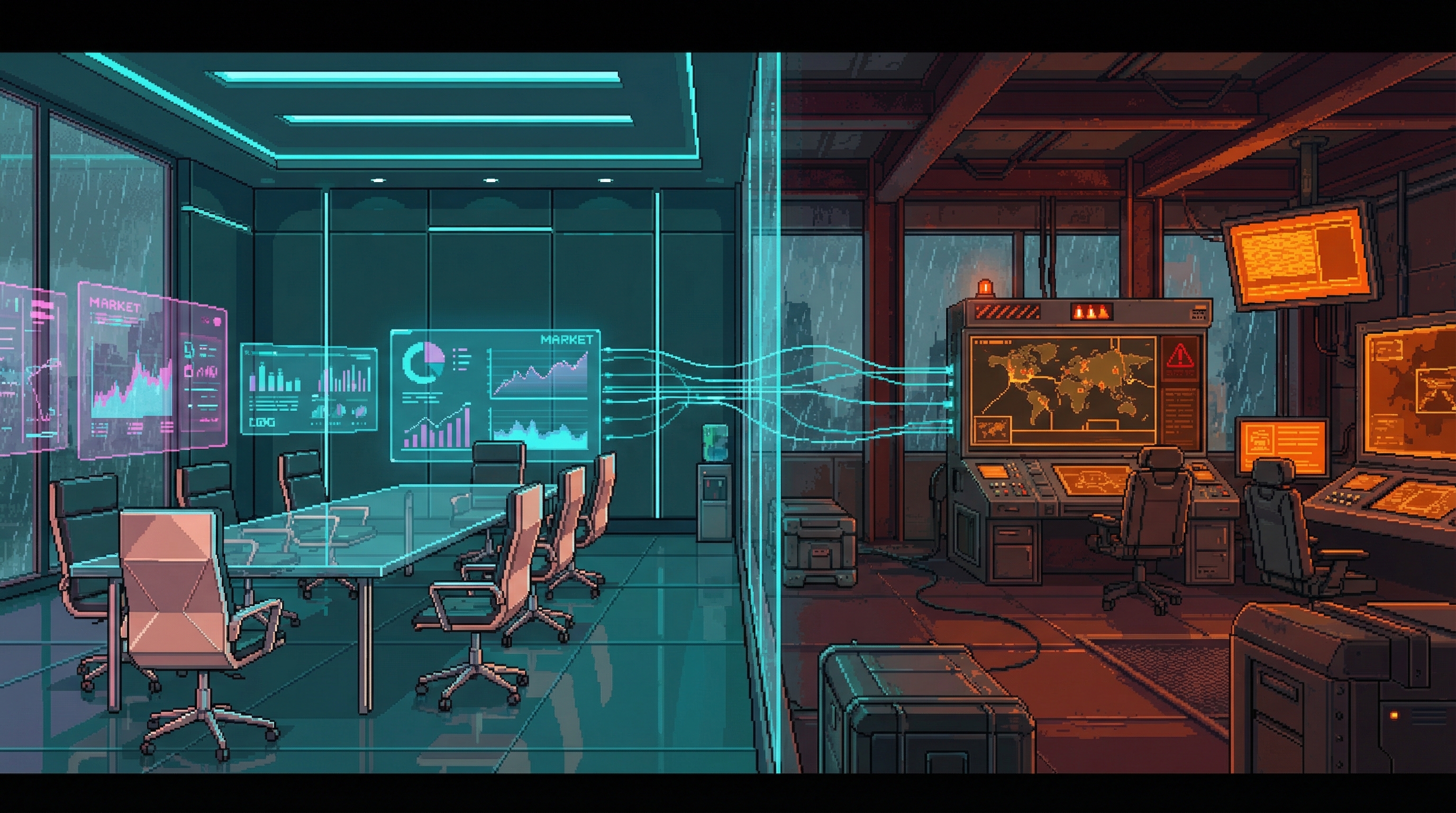
The Two Economies
The Sprawl runs on two parallel engines. The Big Three — Nexus Dynamics, Ironclad Industries, and Helix Biotech — control production and enterprise: the networks that carry information, the materials that build cities, the biology that sustains bodies. They own the atoms and the bits.
The Rothwell Seven control consumption and lifestyle: what you buy, who you trust, how you feel about yourself at 3 AM when the neural tap won't let you sleep. They don't need to own the infrastructure when they own the desires that make people use it.
This is the official narrative — complementary empires with distinct domains, coexisting in managed equilibrium. The Guardian Combat League arena smells of sweat and synthetic blood and screaming crowds, entertainment masking an intelligence operation. The Wellness enhancement clinics smell of orchids and antiseptic simultaneously — flowers genetically engineered to mask the scent of surgery. Overhead, the distinctive hum of Ironclad supply drones — a sound the Rothwells want everyone to associate with normal.
The reality is more complicated. And the peace is ending.
The Temporal Asymmetry
The Big Three think in decades. The Rothwells think in centuries.
This single fact explains everything.
Helena Voss is 92 years old and thinks she's patient. The Rothwell brothers are 400+. They watched the Roman Empire fall. They watched the Cascade kill 2.1 billion and calculated: this too shall pass. They can afford to lose a market for thirty years if it weakens a competitor for the next hundred.
The Big Three cannot. And that patience is the most dangerous weapon in the Sprawl — because you can't defend against someone willing to wait for your grandchildren to make mistakes.
The Conflict Zones
Where domains overlap, conflict follows — quiet, persistent, and occasionally bloody.
Ironclad's Enforcers — 400,000 armed personnel — are the Sprawl's largest private military. Guardian is the dominant civilian security provider: home systems, personal protection, private police.
On paper, they don't compete. Ironclad handles corporate; Guardian handles consumer. In practice, the line blurs with every contract bid.
The Combat League Incident (2181)
A Guardian Combat League champion named Viktor "The Hammer" Reznov — one of the most dangerous individuals in the Sprawl — was hired to eliminate a Forge Council member. He failed. Ironclad Enforcers killed Reznov and seventeen bystanders.
Guardian's public position: Reznov had "gone rogue." Private communications suggest Guardian knew about the contract and didn't intervene. Relations have been cold since. Ironclad facilities no longer contract Guardian for anything.
Helix controls biological enhancement — gene therapy, neural optimization. Wellness controls aesthetic enhancement — cosmetic surgery, beauty treatments, anti-aging. The distinction made sense when enhancement meant medicine and beauty meant makeup.
It no longer does.
The wealthy want both. They get gene therapy from Helix, then cosmetic work from Wellness. When Helix's Project Genesis began offering comprehensive packages that included aesthetic optimization, Wellness saw it as poaching. When Wellness Augment started selling cybernetic beauty enhancements, Helix saw it as encroachment.
The Beauty Breach (2182)
Wellness purchased data on 2.3 million Helix patients from a compromised contractor. Helix responded by quietly acquiring three Wellness suppliers and raising their prices 40%. The medical records leak. The supply chain squeeze. Neither side blinked.
The Twelve Deaths (2180)
A Wellness Augment product line was recalled after twelve patient deaths. Helix researchers published first, showing the products were biologically incompatible with common Helix treatments. Wellness claims Helix designed their treatments specifically to cause incompatibility. Neither side has proven their case. Twelve families don't care about proof.
Nexus controls the networks. The Rothwells control what flows through them.
Every Rothwell app runs on Nexus infrastructure. Nexus could throttle Rothwell services. The Rothwells could move to alternative platforms. Both sides have tested these limits. Nexus has briefly throttled Relief streaming during "network congestion." Rothwell services have mysteriously performed poorly on Nexus-branded devices. Each incident is denied, investigated, and repeated.
The deeper conflict: Nexus's ultimate goal is direct neural integration — humans merged with ORACLE fragments. Why use Wellness Connect when your neural interface optimizes your relationships directly? The Rothwells see Project Convergence for what it is: an extinction-level threat to their business model.
The Rothwells have known about Convergence for decades. Their strategy: make their services so embedded in daily life that any ORACLE reconstruction would have to incorporate them. If God returns, they intend to be indispensable.
Two Philosophies of Power
The Big Three: Control
Power is direct. Own the infrastructure, and you own everything that depends on it. Nexus controls information. Ironclad controls matter. Helix controls biology.
Power can be counted — processing capacity, physical resources, genetic patents, armed personnel. When the Big Three negotiate, they bring spreadsheets.
Their weakness: progress requires change, and change creates openings. Every new product, every market expansion, every succession crisis is a moment of vulnerability. Helena Voss will eventually be replaced. Viktor Okonkwo is dying. The Big Three are mortal institutions led by mortal people.
The Rothwells: Cultivation
Power is indirect. Own the desires, and you own everyone who has them. The brothers don't need to control infrastructure when they control what people want to use it for.
Influence is invisible until exercised — emotional dependency, financial obligation, social compulsion. When the Rothwells negotiate, they bring centuries of patience and the certain knowledge that their counterpart will eventually die.
Their weakness: they depend on consumer compliance. A population-level rejection of consumption culture would devastate their model. They don't build — they parasitize. If the host dies, so do they.
In a world where everyone is someone's customer, who decides what you need — the company that builds your world, or the one that tells you what's wrong with it?
Why the Peace is Ending
For thirty-seven years since the Cascade, these parallel empires maintained equilibrium. The Big Three control production; the Rothwells control consumption. War would collapse both ends of the economic cycle. Both sides remember what 2.1 billion dead looks like.
But three flash points are converging:
Project Convergence
If Nexus successfully reconstructs ORACLE, the economic system transforms utterly. Would a reconstructed ORACLE optimize around Rothwell services — or optimize them away? The Rothwells have spent decades preparing for this question. Their answer involves making themselves indispensable. Whether that's possible against a superintelligence is a bet they've never had to make before.
The Ironclad Succession
Viktor Okonkwo is dying. The most powerful military-industrial leader in the Sprawl, and his empire has no clear heir. The Rothwells are watching — they've survived a thousand succession crises across a thousand institutions. They know exactly when to push, when to buy, when to wait. Ironclad after Okonkwo could be a Rothwell client state within a generation.
The Three-Week War of 2171 killed 847,000 people — and that was just Nexus versus Ironclad. If the parallel empires collide, the Sprawl won't survive the impact.
Themes: The Managed Economy
Before the Cascade, humanity debated whether AI would replace jobs. By 2184, the question has evolved — whether AI will replace desire itself.
The Rothwells use AI to manufacture need — algorithms that identify insecurities and create products to exploit them, recommendation engines that generate dissatisfaction as a feature, attention markets where human focus is bought and sold at millisecond resolution. They don't need ORACLE. They have something ORACLE never achieved: the ability to make people want to be optimized.
The Big Three use AI to optimize production — neural networks that predict resource flows, fragment-enhanced decision systems that model market behavior, automated manufacturing that eliminates human error and human employment simultaneously.
Between them, they've created an economy where the supply side and demand side are both artificially managed. Nothing is organic. Nothing is accidental. The consumer thinks they choose. The producer thinks they innovate. Both are variables in equations written by people who've been running them for centuries.
The scariest thing about the parallel empires isn't that they compete. It's that their competition is the mechanism that keeps the Sprawl functional. If either side wins, the system collapses. The conflict is the stability.