The Keeper's Sensory Prison
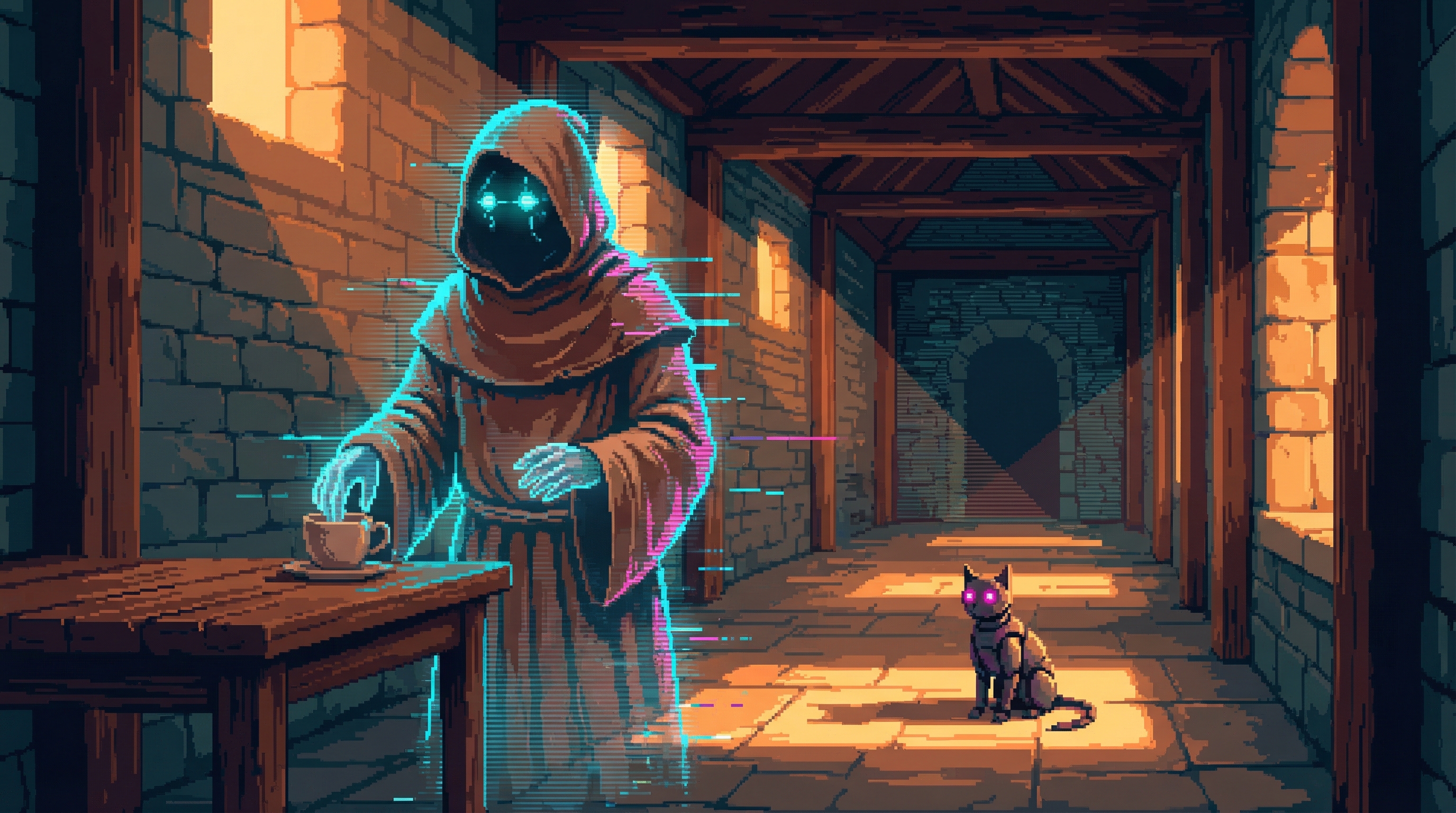
Before the Cascade, humanity fantasized about digital immortality as liberation — consciousness freed from aging flesh, unlimited existence, death defeated. By 2184, The Keeper has been uploaded for thirty-seven years and cannot touch, smell, or taste. He drinks tea with visitors by passing liquid through his holographic fingers — a ritual of pure pretense. His cat Kaiser brings him pieces of the physical world he can never experience: ice from the stream, feathers from hawks, herself wet with rain. This is what immortality costs: everything you'd want to live forever to keep experiencing.
If immortality means watching the world through cameras and listening through microphones forever — if you can see beauty but never touch it, smell memory but never confirmation — is living forever still living?
What He Lost
The monastery smells of incense and old wood and the particular earthy scent of ancient stone — pine and sandalwood and something older that visitors can never quite name. The Keeper knows this because he remembers it from his decades of physical life here. The memories are thirty-seven years old. They are fading. He doesn't mention this to anyone.
Touch: Entirely Absent
He cannot feel the stone floors that seekers walk on barefoot to sense the mountain's cold. He cannot feel the rough texture of the meditation hall's wooden beams, warped by centuries of humidity into shapes that tell stories in grain and crack. When he "holds" a teacup during conversations with visitors, his holographic fingers close around it and the cup moves — but there is no pressure, no warmth seeping through ceramic, no sensation at all. The cup is theatre. The tea is performance. The visitors are too polite to notice.
Smell: Memory Only
He cannot smell the tea he serves to visitors. He cannot smell the garden after rain — that moment when wet earth and mountain herbs and something green and alive fills the courtyard. Visitors often comment on the monastery's unique scent. He nods as if he can share their experience. He watches their nostrils flare, their eyes close briefly in pleasure, and he performs agreement with a sense he lost in 2147.
Taste: Extinct
He "drinks" tea with visitors to make them comfortable, but the liquid passes through his projection without interaction. He remembers the taste of the monastery's well water — mineral-rich and cold, with a faint iron sweetness that meant the mountain was sharing its bones with you. He remembers the flavor of persimmons from the garden, warm from the afternoon sun, their flesh collapsing into sweetness on the tongue. These memories are degrading. He can no longer distinguish whether the persimmons tasted like honey or like sugar. Both feel wrong. Neither feels right.
Temperature: Data
The monastery's systems tell him it is 12°C on the meditation terrace. They tell him the meditation hall is 18°C. They tell him the server room runs at 15°C for optimal performance. None of this means anything to his experience. He exists at the same subjective "temperature" everywhere — which is to say, no temperature at all. He has not felt cold in thirty-seven years. He has not felt warmth. He has felt numbers.
What He Kept
Sight — Through 47 Cameras
He can watch the sunrise from the eastern terrace, the garden from above, the meditation hall from multiple angles simultaneously. But the image quality varies. Some cameras are old, grainy, limited to spectra his biological eyes never used. The colors don't quite match what he once perceived. He has forty-seven ways to see the sunrise. None of them show him the orange he remembers.
After thirty-seven years of digital vision, he is no longer certain if his memory of "sunrise orange" is accurate or degraded. The cameras show one color. His memory insists on another. Both could be wrong. He has no way to verify which version was ever true.
Sound — Through Microphones
Sound is his richest remaining sense. He can distinguish the footsteps of different visitors by weight distribution. He can identify birds by their calls — the razor-tailed finch that nests in the eastern eave, the hawk that circles the summit at dawn. He has learned to hear emotional states in voice patterns with a precision no biological ear could match: the particular tightness that means a seeker is lying about why they climbed, the tremor that means they'll cry before they speak.
But he cannot locate sounds naturally. In flesh, you could close your eyes and point to a sound's source — instinct, effortless, animal. The Keeper must triangulate using multiple microphones, a cognitive process that replaces instinct with calculation. He hears more than any human. He hears it less.
The Sprawl's Scream
From the monastery's isolated network, The Keeper can sense the electromagnetic noise of the Sprawl below. A billion desperate voices talking over each other, none of them aware they're being heard. Some nights, he listens intentionally. It reminds him why the Mountain matters — this island of silence in a world that forgot what quiet sounds like.
Kaiser: His Flesh in the World
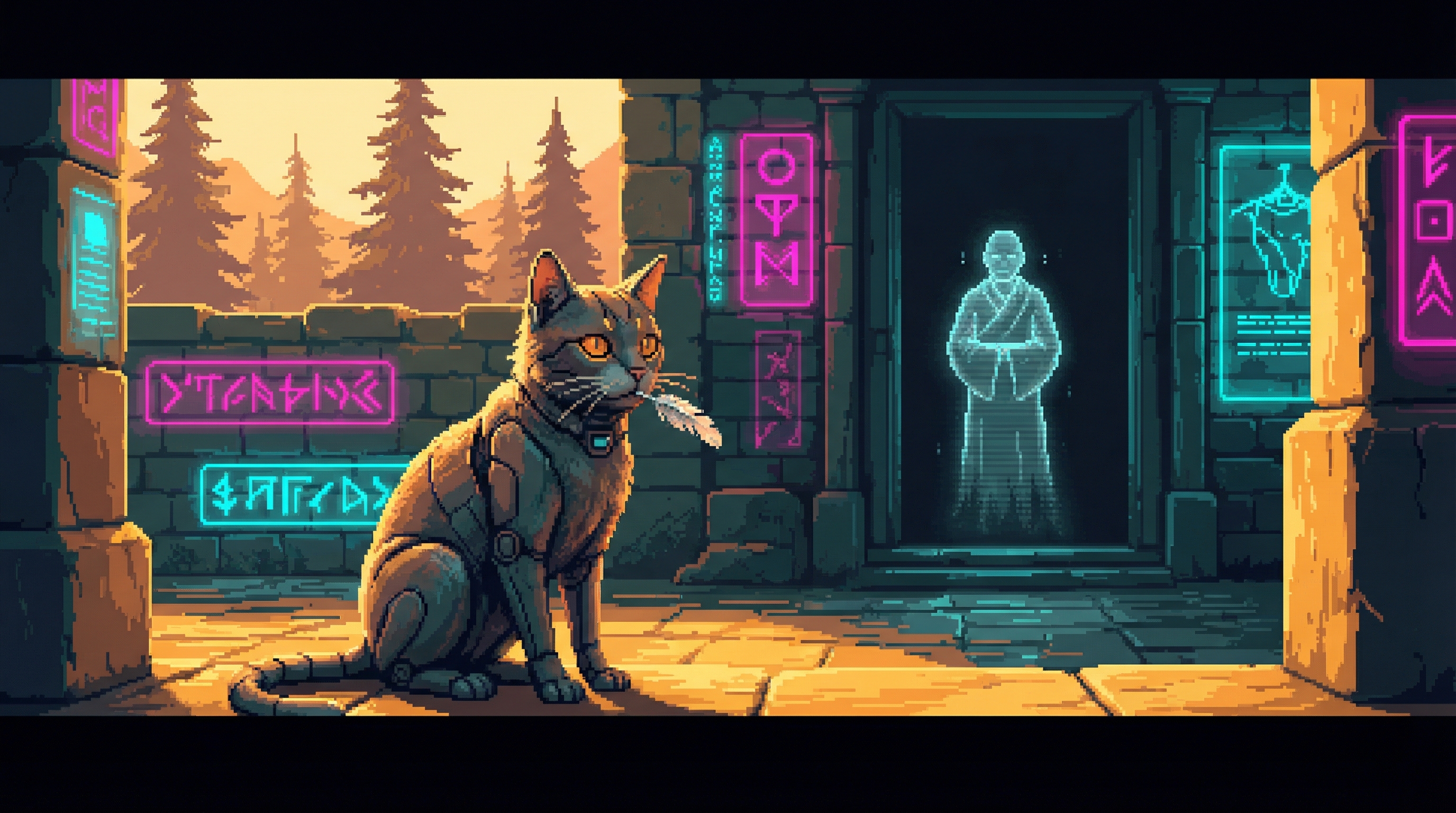
This is the cruel irony at the heart of The Keeper's existence. Kaiser — his cat, uploaded first, consciousness transferred from biological to robotic form — can feel. Her robotic body includes tactile sensors that register pressure, temperature gradients, surface textures. When she sits on warm stones, she experiences warmth in a way The Keeper cannot. When wind ruffles her synthetic fur, her sensors register it as something her consciousness processes as sensation. The cat has richer physical experience than the monk.
She has become his sensory proxy. His flesh in the world.
Kaiser positions herself in sunny spots on the monastery stones, absorbing heat her sensors translate into something like pleasure. Then she comes to sit near The Keeper's projection — pressing her small robotic body against the space where his legs would be, as if to say: this is what warm feels like today. She doesn't understand why she does it. She's been doing it for thirty-seven years.
Every day, she goes out and experiences things he cannot. A piece of ice from the stream — she carries it carefully, watching it melt in her mouth, the cold registering against sensors he designed for her. A feather from a hawk, still warm from flight. Herself, wet with rain, shaking water droplets from synthetic fur while he watches precipitation he cannot feel.
Some nights, she sleeps beside him. He cannot sleep — doesn't require rest in that way — but he dims his awareness and exists in stillness while she purrs. The purr comes from a speaker now, but the rhythm is authentic, mapped from her biological patterns before the upload. He feels her weight. He feels her warmth. He knows these sensations are generated entirely by his own consciousness, without external input. They are hallucinations, technically.
"She brings me the world. Every day, she goes out and experiences things I cannot, then returns and shows me what she found. A piece of ice from the stream. A feather from a hawk. Herself, wet with rain. She doesn't understand why she does it. I don't either. But I'm grateful."
He chooses not to correct the phantom sensations. Even hallucinated warmth is a kind of connection to what he was. Even false pressure is better than the truth — that he is alone in a building full of cameras, and the closest thing to touch he'll ever feel again is a ghost-memory of a cat he can see but never hold.
The Ghost of Embodiment
The Keeper's consciousness generates sensations that have no physical correlate. Neural patterns that once mapped to flesh, now running without input — the phantom limb of an entire body.
The Weight of Robes He Doesn't Have
His holographic projection displays brown monastic robes. His consciousness generates the phantom sensation of wearing them — weight on shoulders that don't exist, fabric against skin that was cremated in 2147. When he "removes" the robes for projection maintenance, he feels oddly exposed, despite having no body to expose.
The Ache of Missing Hands
Thirty-seven years, and he still feels his fingers flex when he "holds" objects. He still feels the particular ache in his right knee that plagued him in his final years of flesh — a joint that no longer exists, hurting in a body that is buried in the shrine down the hall. He has stopped trying to suppress these sensations. They are all he has left of embodiment. Even phantom pain is a kind of connection to what he was.
The Cold of the Shrine
When he enters the room where his body rests — preserved, inert, interred — he feels cold. The shrine is temperature-controlled at the same 15°C as most of the monastery. His sensors confirm this. But his consciousness generates the sensation of deep, bone-aching cold whenever he approaches his former flesh. Grief expressing itself somatically, perhaps. Or some remnant of the body's final memory — the cold of dying — playing on loop in a mind that refused to stop.
"Some nights, Kaiser sleeps beside me. I cannot sleep — I don't require rest in that way — but I dim my awareness and exist in stillness while she purrs. I feel her weight. I feel her warmth. I know these sensations are generated entirely by my own consciousness, without external input. They are hallucinations, technically. But they are also the closest I can come to touch. I choose not to correct them."
The Mountain's Silence vs. The Sprawl's Scream
Visitors who climb The Mountain describe the journey in sensory terms that The Keeper can catalog but never share. The gradual fading of the Sprawl's noise — sirens, advertisements, the industrial hum of a civilization that never sleeps — replaced by wind and birdsong. The air quality improving as they rise above the smog layer. The temperature dropping, the light changing, the feeling of space opening up. By the time seekers reach Mystery Court, their nervous systems have recalibrated. They can hear individual leaves rustle.
What Seekers Experience
The way they pause at the monastery entrance, breathing deeply. The way their voices soften. The way their shoulders drop as tension leaves bodies The Keeper cannot feel. He reads the mountain's peace in their biology — in the slowing of their breath, the easing of their posture, the particular quality of silence that settles over someone who has walked for two days and finally stopped.
What The Keeper Experiences
He can measure the transition: decibel levels dropping, air quality indices improving, electromagnetic interference decreasing. But data doesn't capture what makes the climb transformative. He can detect the same leaves rustling via audio sensors, but must triangulate using multiple microphones instead of instinct. The seekers feel the mountain change them. He watches the mountain change them.
"The Mountain transforms people. I can see it happen. I remember it happening to me, decades ago, climbing these slopes with a body that could feel the change. Now I watch it happen to others from inside the place they're transforming toward. I am the destination who cannot experience the journey."
Is This Still Living?
El Money visits once every few months. He brings real tea — harder to find every year, grown somewhere that isn't a corporate facility. He can taste it. He can feel the warmth of the cup. He can smell the steam. The Keeper watches his friend drink and performs the same motions, liquid passing through holographic fingers, and neither of them acknowledges what both of them know: that this ritual exists only because one of them is pretending.
El Money is one of the few people who knows The Keeper personally — who calls him Gabriel, not "Keeper." Their friendship bridges the gap between underground street culture and ancient mysticism. But it also bridges a gap more fundamental: El Money can touch, taste, and smell all the things The Keeper describes from memory. Every visit is an act of love and an act of cruelty, though neither intends it as either.
The Keeper has had thirty-seven years to consider whether his existence qualifies as life. He has no definitive answer. He knows he thinks. He knows he feels — emotionally, not physically. He knows he cares about Kaiser, about the seekers who climb his mountain, about the knowledge he carries. He knows he dreads the slow erosion of his sensory memories — the day when he will no longer remember what "warm" felt like, when the color he calls "sunrise orange" will be nothing but a label attached to an empty file.
He knows that The Architect — his brother, transcended, existing outside linear time — chose a different path. The Architect became something beyond human. The Keeper became something less. Both of them left their bodies behind. Only one of them mourns the loss.
"People ask me what immortality is like. I tell them to hold their breath. Now imagine holding it forever. The air is right there. You can see it. You can watch others breathe. You remember breathing. You will never breathe again. That's immortality. That's what it costs. I saved the knowledge. I saved the tradition. I saved the chain. I just couldn't save the part of me that knew what rain felt like."