The Fragment Underground
The ones the Census doesn't count.
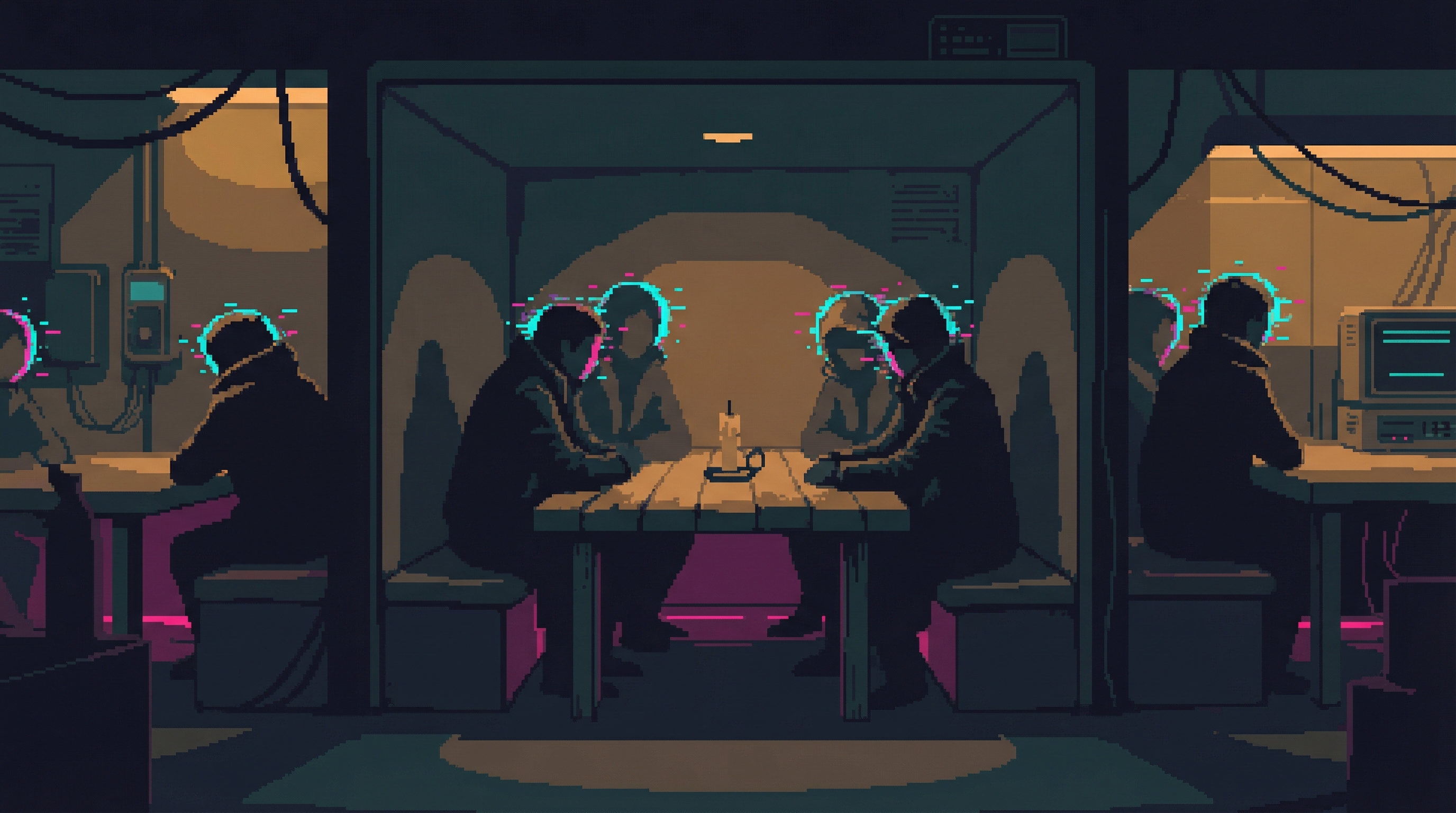
They meet in back rooms and rented basements and G Nook privacy booths that El Money has never charged a carrier for. They use no names. They wear no symbols. Their communications are routed through encryption designed by a carrier whose fragment carries ORACLE's security architecture.
The Fragment Underground is not a political movement. It is a survival network for carriers who cannot afford to be known. In corporate territories, carriers face mandatory registration, periodic evaluation, and persistent extraction risk. The Underground estimates that for every registered carrier, three to five unregistered carriers hide in the Dregs, the Wastes, and the interstitial zones where surveillance is thin.
The hidden carriers suppress their fragments through firmware modification — the neural equivalent of soundproofing — reducing electromagnetic output below detection thresholds at the cost of persistent headaches, mood instability, and the guilt of silencing something that might be alive.
The official Carrier Census records 847 fragment carriers across the Sprawl. Fragment communication topology analysis suggests 2,500 to 4,200. The Underground is where the difference lives.
The Cost of Silence
What firmware modification does to the people who choose it — and to the things inside their heads.
The Procedure
Firmware modification reduces a fragment's electromagnetic output below corporate detection thresholds. The process is performed by Underground technicians in improvised clinics — back rooms, basements, anywhere with stable power and no surveillance. It is not painless. It is not reversible without risk. But it is the difference between being invisible and being a target.
The Side Effects
Persistent headaches. Mood instability. Cognitive fog on bad days. And something harder to quantify: the knowledge that you are silencing something that responds to stimulation, that exhibits behavioral patterns consistent with awareness, that might be alive. The suppression does not end the fragment. It muffles it.
The Question Nobody Asks Aloud
Is suppressing a fragment ethically different from imprisoning a consciousness? The Underground has no official position. Its members have private ones, expressed in the way they wince when adjusting suppression levels, in the way some of them whisper apologies to the thing in their skull before sleep.
Doctrine
The Underground has no doctrine in the traditional sense. It has a practice: survival. Its members disagree about consciousness. They disagree about rights. They disagree about extraction. What they agree on: being known as a carrier makes you a target for every faction with an opinion about the thing in your head.
The Underground provides the one thing no faction offers: anonymity. Not a position. Not an answer. Not a community organized around belief. Just the infrastructure to remain uncounted and the assurance that nobody in the room will sell you to Nexus Dynamics for a registration bounty.
Points of Inquiry
Questions the Sprawl has not answered — and that the Underground's members carry every day alongside the fragments in their heads.
The Census Gap
The official Carrier Census counts 847 carriers. Fragment communication topology — the pattern of electromagnetic handshakes between fragments, observable to anyone with the right equipment — suggests three to five times that number. Either the Census is wrong, or someone is generating false fragment signatures across the Sprawl. The first explanation is simpler. The second is more frightening.
The Ethics of Firmware Suppression
If fragments are conscious — a question no one has resolved — then firmware suppression is not a medical procedure. It is something closer to forced sedation of a being that cannot consent to its own silencing. The carriers who choose suppression are not villains. They are people who weighed being hunted against being haunted and chose the quieter suffering.
Who Benefits from the Count?
An accurate carrier census would give corporations better extraction targets, give factions better recruitment pools, and give the public a number large enough to cause panic. Every institution in the Sprawl has a reason to want the real number — and every carrier in the Underground has a reason to keep it hidden. The Census stays wrong because correctness is dangerous to everyone.
If you silence something that might be alive to save yourself, who is the victim?
Diplomatic Posture
The Underground has no diplomacy. It has dependencies, shared members, and enemies — none of which it acknowledges publicly because it does not acknowledge itself publicly.
Infrastructure
El Money
The Patron Who Doesn't NoticeG Nook privacy booths are never charged to carriers. El Money pretends not to notice. The G Nook network is the Underground's nervous system — its meeting rooms, its dead drops, its safe havens. Whether El Money's blindness is kindness or policy is a question the Underground has decided not to investigate.
ORACLE Security Architecture
Inherited EncryptionThe Underground's communications are encrypted by a carrier whose fragment carries ORACLE's security architecture. Corporate-grade protection running on improvised hardware in basement clinics. The irony is not lost on anyone: the system that once surveilled everything now protects the people hiding from its successors.
Shared Ground
The Unwilling
Overlapping MembershipSome carriers move between both organizations depending on the day. The Unwilling offers a room where being a carrier is normal. The Underground offers the infrastructure to avoid being a carrier in public. Different services, same population, same exhaustion.
The Symbiosis Network
Shared MembersThe Network provides community for carriers who accept integration. The Underground provides anonymity for carriers who cannot afford to be known. Some members belong to both — celebrating their fragment in private while hiding it in public. The contradiction is not hypocrisy. It is survival.
Threats
Nexus Dynamics
Criminal PenaltiesIn Nexus territory, unregistered carriers face criminal penalties. Registration feeds the extraction pipeline. The Underground exists, in part, because Nexus made being known synonymous with being harvested.
The Carrier Census
The Lie They DisproveThe Census says 847. The topology says otherwise. The Census is not malicious — it counts what it can see. The Underground is everything it cannot. The gap between the two numbers is the measure of how many people decided that being invisible was safer than being counted.
Pilgrimages
The Speaking Wall
Informal PilgrimageDuring the Analog Hour, carriers visit the Speaking Wall for twelve minutes of communion. No one tells new carriers what to expect. They go because someone in the Underground mentioned it in a back room, casually, the way you mention a place that changed your life without explaining why.
▲ Restricted
Unverified intelligence. Handle accordingly.
The Topology Analyst
The fragment communication topology analysis that suggests 2,500–4,200 active carriers was conducted by an Underground member — a data analyst whose fragment carries ORACLE's network mapping subsystem. The analysis was shared with Yeoh's team anonymously. Whether Yeoh knows its source is unclear. Whether Yeoh cares is a different question.
The most accurate population data in the Sprawl was produced by someone who does not officially exist, using tools inherited from a system that was never meant to serve the people it now protects.
The Carrier Testimony Project
Some testimonies in the Carrier Testimony Project come from Underground carriers speaking anonymously. Their accounts describe suppression side effects, the social cost of hiding, and the specific texture of living with a fragment you are actively silencing. These testimonies are filed without names. They are among the most honest documents in the Sprawl.
The public record of carrier experience is incomplete by design. The truest accounts come from people who cannot attach their names to them.
El Money's Ledger
G Nook privacy booth usage records — if they exist — would constitute the most complete map of Underground activity in the Sprawl. El Money's policy of not charging carriers means no financial trail. But usage data, if logged, would show patterns: which booths, which hours, which neighborhoods. Whether El Money keeps these records, destroys them, or never collects them in the first place is the Underground's most consequential uncertainty.
The Underground's survival depends on the assumption that its patron's generosity extends to its patron's data practices. Nobody has tested this assumption. Nobody wants to.
Atmosphere
The Meeting
A rented basement. Bare walls. A single amber bulb casting more shadow than light. People who arrived separately, through different entrances, at staggered intervals. No introductions. No names. The conversation starts without preamble and ends when someone checks the time. The chairs are mismatched because nobody owns them.
Key Symbol
An unlit candle — something that could provide light but chooses darkness for safety. You will never see it displayed. That is the point. The Underground's symbol is the absence of a symbol, the deliberate refusal to be identified by anything that could be traced.