The Data Hygiene Corps
You don't have to fight the system. You just have to be boring.
Overview
The Data Hygiene Corps teaches people to be boring.
Approximately 400 active practitioners across the Sprawl train behavioral obfuscation techniques: mental disciplines that flatten emotional signatures, social practices that reduce telemetry value, and physical habits that generate model interference. The slogan understates the difficulty. Being boring — deliberately, consistently, in a world that captures and monetizes emotional peaks — requires sustained effort that most people find exhausting.
The Corps doesn't hide you. It makes you uninteresting. The system watches everyone. The system monetizes the interesting ones.
Doctrine
Three disciplines. Three ways to flatten the signal that makes you profitable.
Cognitive Hygiene
Meditation that reduces emotional valence amplitude. Attention distribution exercises. The discipline of thinking in fragments rather than coherent narrative — narrative cognition generates the highest-value inference data because it reveals goals, plans, and motivations. Think in pieces. Give the model nothing to chain together.
Physical Hygiene
Varying routes. Eating at irregular times. Sleeping at non-standard hours. And the signature technique: "The Shuffle" — periodically exchanging behavioral habits with another practitioner, creating mutual model interference. Your routines become someone else's. Their routines become yours. The prediction model breaks on both of you simultaneously.
The Corps is apolitical by design. It doesn't advocate for data sovereignty. It doesn't argue about the Opacity Movement's politics or the ethics of surveillance. It teaches a practice. The practice makes you harder to predict. The politics are someone else's problem.
Field Conditions
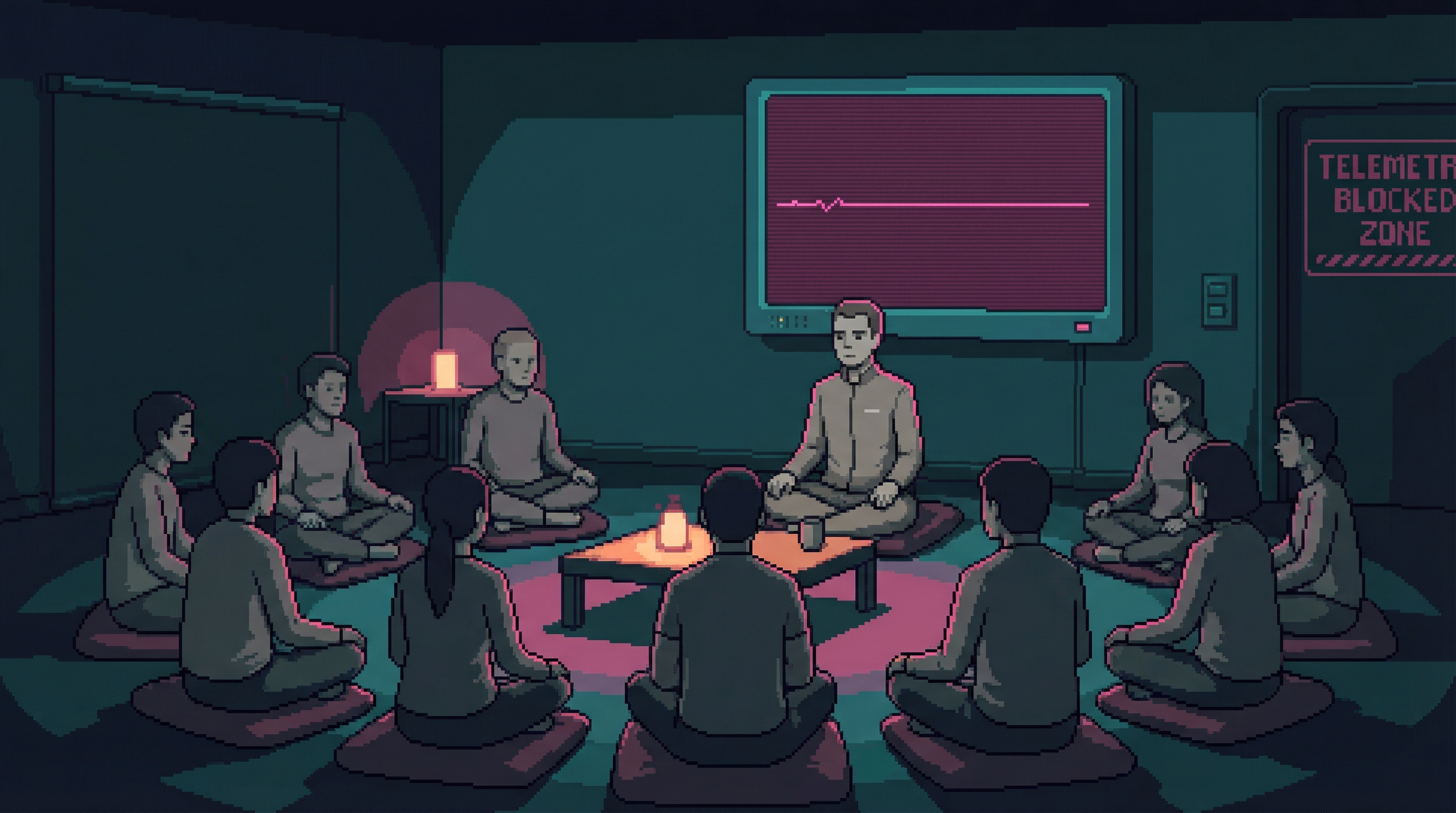
Corps workshops are held in dark rooms — telemetry-blocked spaces where the techniques can be practiced without generating the data they're designed to prevent.
The Workshop
Warm. Quiet. Intimate. Practitioners sit in circles. The lead instructor speaks in deliberately flat affect — modeling the emotional dampening the training develops. The exercises feel like meditation crossed with acting class. You learn to control the micro-expressions that generate emotional telemetry. You learn to think without narrative structure. You learn to move through the Sprawl without generating behavioral patterns that a model can predict.
Most people last two weeks. The cognitive effort of sustained flatness — of never letting your emotional valence spike, of thinking in fragments, of varying every routine — is more exhausting than the surveillance it's designed to resist. The 400 who remain are the ones who found the discipline sustainable. Or who found the alternative unbearable.
The Shuffle in Practice
Two practitioners meet. They exchange routines: morning habits, commute patterns, eating schedules, sleep cycles. For the next period, each lives the other's life — or at least the behavioral surface of it. The prediction models, trained on historical data, see two people suddenly acting wrong. Not differently. Wrong. The model confidence drops. The telemetry value drops. For a few weeks, two people become invisible.
Then the models recalibrate. Then you Shuffle again. It's not freedom. It's maintenance. Like brushing your teeth, except what you're cleaning is your behavioral signature.
Points of Inquiry
How Much of Yourself Do You Lose to Become Invisible?
The Corps teaches you to flatten emotional signatures, fragment your thinking, randomize your habits. The result is a person the system cannot predict. The question nobody in the Corps discusses openly: is the person the system cannot predict still you? Or have you replaced one kind of control with another — the system's control of your data with your own control of your behavior?
The Freedom Thinkers teach cognitive independence from value injection. The Corps teaches cognitive independence from surveillance. Both require sustained self-modification. Neither can answer the question of what's left when the modification is complete.
Why Does Boredom Require More Effort Than Resistance?
Fighting the system is dramatic, visible, energizing. Being boring is none of those things. The Corps' retention problem is not that the techniques don't work — they work. The problem is that sustained behavioral obfuscation demands constant cognitive effort against the natural human tendency to form patterns, express emotions, and live predictably.
Most trainees abandon the practice within weeks. Not because they don't value privacy. Because being boring, deliberately and consistently, is one of the hardest things a person can do. The system doesn't need to stop the Corps. It just needs to wait for human nature to do the work.
Diplomatic Posture
The Opacity Movement
AlliedTactical ally. The Corps teaches the behavioral skills that complement the Movement's political advocacy. The Movement argues for data sovereignty. The Corps teaches people how to generate less data worth stealing. Different methods, same direction.
The Freedom Thinkers
AlliedMethodological kinship. Both teach cognitive independence — the Corps from surveillance, the Freedom Thinkers from value injection. The disciplines overlap: meditation, attention control, resistance to ambient institutional pressure. Practitioners sometimes train with both.
The Prediction Resistance
AlliedPart of the broader prediction resistance ecosystem. The Corps teaches individual behavioral obfuscation; the Prediction Resistance coordinates collective unpredictability. Different scales of the same project.
The Transparency Bargain
Resistance TargetThe Corps teaches people to generate less valuable telemetry — which directly undermines the Transparency Bargain's foundational exchange of data for services. Every successful practitioner is a small subtraction from the system's revenue model.
▲ Restricted
Unverified intelligence. Handle accordingly.
The Attrition Problem
The Corps' public retention figures are approximately accurate: most trainees abandon the techniques within weeks. What the Corps doesn't publicize is the secondary attrition. Among the 400 sustained practitioners, a subset report increasing difficulty distinguishing the practiced flatness from their actual emotional state. The meditation that dampens emotional valence amplitude doesn't always have an off switch.
Three former instructors have quietly left the Corps in the past year, citing what they describe as "emotional numbness that stopped being a technique and started being a condition." The Corps hasn't addressed this publicly. Acknowledging that the practice can damage the practitioner would be a recruitment problem.
The Shuffle's Unintended Data
The Shuffle — exchanging behavioral habits between two practitioners — requires detailed knowledge of another person's daily patterns. Sleep schedules. Eating habits. Commute routes. Emotional triggers. The level of intimacy required to accurately adopt someone else's behavioral surface is significant.
At least two Shuffle partnerships have been compromised by one partner selling the other's behavioral data to inference brokers. The data is exceptionally detailed — more detailed than standard surveillance captures, because it was voluntarily shared for the purpose of mutual protection. The Corps has no enforcement mechanism for this kind of betrayal. The practice that creates mutual invisibility also creates mutual vulnerability.
Corporate Interest
Corps techniques are effective enough that at least one corporate behavioral modeling division has sent researchers to Corps workshops — not to disrupt them, but to study them. Understanding how people evade prediction models improves the models. The Corps, by teaching evasion, may be generating the training data for the next generation of prediction systems.
The researchers attended under cover. The Corps' telemetry-blocked workshop spaces made them impossible to detect through standard surveillance. The irony is precise: the Corps' own privacy protections prevented it from identifying the threat. Whether the resulting model improvements have already been deployed is unknown.
Atmosphere
Setting
Dark rooms. Telemetry-blocked spaces where the air is warm and still. Practitioners sit in circles on low cushions, faces lit by nothing brighter than a dim amber standby light. The lead instructor's voice is deliberately flat — a demonstration of the technique being taught. No screens. No feeds. No devices generating data. The silence is the point. In the Sprawl, silence costs effort.
Key Symbol
A flatlined graph. The emotional profile of a person who has learned to be uninteresting — no peaks, no valleys, nothing the system considers worth monetizing. Corps practitioners sometimes trace the flat line with a finger when they recognize each other. A greeting that looks like nothing to anyone watching. Which is the entire point.