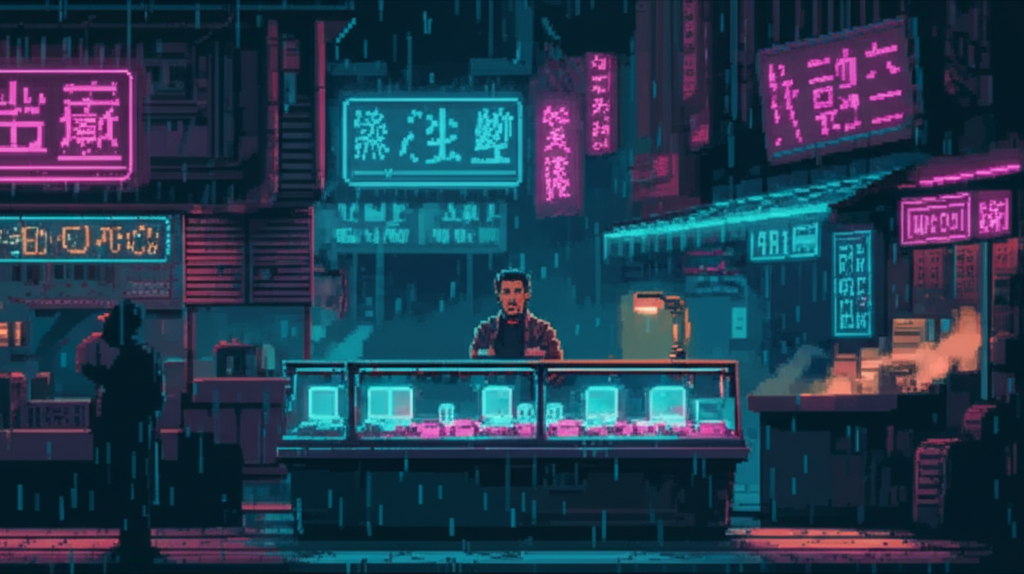
Deshi opened his stall at 6:00 AM, like he did every morning.
The Cathodics were quiet this early—just the maintenance drones humming overhead and the holographic advertisements cycling through their first rotation. His corner of the market, nestled between a neural stimulant vendor and a ripperdoc's waiting room, wouldn't see real traffic for another two hours.
That gave him time to sort the inventory.
He pulled up the display case, watching the crystalline storage cubes catch the pink neon from the dental clinic across the way. Forty-seven memories in stock today. Forty-seven experiences, extracted from other people's heads, compressed into data, waiting for new owners.
This was his life. Deshi was a memory dealer.
The Trade
The trade wasn't technically illegal.
Nexus Dynamics had declared neural commerce a "personal autonomy right" back in 2179, after the first memory extraction clinics started opening in the corporate zones. If you could sell your labor, the logic went, why not your experiences? Why not your first kiss, your wedding day, the moment you saw your child born?
The law didn't ask why people sold memories. It didn't have to.
In Sector 7G, people sold memories because they needed to eat. Because their augmentations needed maintenance. Because the rent was due and their bodies couldn't work the shifts they used to.
Deshi didn't judge. He just bought what they were selling and found buyers who were buying.
Mrs. Adeyemi
His first customer of the day was a regular: Mrs. Adeyemi, seventy-three years old, former teacher, current resident of the Dregs' third-tier housing block.
She approached the stall slowly, clutching her neural interface connector like a talisman. Deshi knew what was coming.
"Good morning, Mrs. Adeyemi."
"Good morning, Deshi." She paused, her weathered face cycling through expressions he'd learned to read over the years. Resignation. Shame. Determination. "I have something to sell."
"Of course. Please, sit."
She settled onto the extraction chair—Deshi kept it padded, not like the butchers in the deeper market who just bolted their customers to metal frames. He plugged in the neural reader, watched the diagnostic scroll across his tablet.
"What are we selling today?"
Mrs. Adeyemi was quiet for a long moment. "My husband's funeral."
Deshi's hands paused on the interface. "Are you sure?"
"I've sold the wedding. I've sold the children being born. I've sold the holiday dinners and the anniversary trips and the time he surprised me with that ugly cat." She laughed, but there was nothing funny in it. "The funeral is all I have left of him."
"You'll still remember that he died. You'll know there was a funeral. But the feeling of it, the specificity—"
"I know what I'm selling." Her jaw tightened. "My granddaughter needs medical care. Helix Biotech doesn't accept sentiment as payment."
Deshi didn't argue. He initiated the extraction.
The Extraction
The process took forty-seven minutes.
Memory extraction wasn't like forking—it didn't copy your consciousness whole. It targeted specific neural pathways, the ones associated with a particular memory, and carefully excised them. The original brain was left with gaps, like a document with redacted passages. You knew something had been there. You just couldn't access it anymore.
Mrs. Adeyemi sat still throughout, eyes closed, lips moving slightly. Deshi wondered if she was trying to remember the funeral one last time before it was gone, holding onto the experience as the machines pulled it away.
When it was done, she opened her eyes. They were dry.
"How much?" she asked.
Deshi checked the extraction quality. High emotional density. Clear narrative structure. Minimal corruption from age or previous extractions. "Four hundred credits."
"It's worth more than that."
"To you, yes. To a buyer..." He pulled up his market analysis. "Funeral memories don't sell well. People want joy, love, triumph. They want to feel what winning feels like, or falling in love, or holding their child for the first time. They don't want grief."
"Someone must want it."
"Collectors, maybe. Empathy tourists who want to feel sad for a few hours without earning it." Deshi hesitated. "There are other buyers. Research groups. They pay better, but they... dissect the memories. Use them for psychological profiles, emotional manipulation algorithms."
Mrs. Adeyemi's expression hardened. "I'm not selling my husband's funeral to become a marketing tool."
"Then four hundred credits."
She nodded. He transferred the funds.
Inventory
The memory went into the display case, another crystalline cube among the others.
Deshi catalogued it: FUNERAL_SPOUSE_LONGMARRIAGE_F73. Category: Grief. Quality: Premium. Price: 450 credits, negotiable.
He'd sold worse. He'd sold better. This was just inventory now.
But he found himself looking at the cube longer than usual, wondering what Mr. Adeyemi had looked like in the casket, whether the flowers had been his favorite kind, whether Mrs. Adeyemi had cried or been too exhausted by everything that came before.
He'd never know. Those details were locked inside the cube, waiting for whatever stranger bought them next.
The Kid
His second customer was young—eighteen, maybe nineteen—with the nervous energy of someone doing this for the first time.
"I heard you're fair," the kid said. "Not like the others."
"I try to be. What are you selling?"
The kid pulled up his sleeve, revealing a consumer-grade neural port. "My first time."
Deshi's expression didn't change, but something in his chest tightened. "Your first time doing what?"
"You know. With someone." The kid couldn't meet his eyes. "It was with this girl, back before everything went bad. I loved her. I think. Or I thought I did. We were young."
"And now you want to sell that memory?"
"I need the credits. And besides—" The kid laughed, bitter and hollow. "She's gone. Uploaded last year, couldn't afford premium hosting, got corrupted in a cascade. The memory is all that's left of her, and I can't even think about it without wanting to die."
Deshi understood. He understood too well.
"Romantic firsts are valuable," he said carefully. "Especially if the emotional content is genuine. I could probably offer three hundred, maybe three-fifty."
The kid nodded eagerly. "Yeah. Yeah, that's good."
"But I want you to understand something first." Deshi leaned forward. "Once it's gone, it's gone. You won't remember her face in that moment. You won't remember how it felt. You'll know it happened—intellectually—but the feeling will be someone else's now."
"That's the point."
"Is it? Or are you trying to stop hurting by cutting out the thing that hurts?"
The kid's jaw tightened. "Maybe they're the same thing."
Deshi couldn't argue with that. He initiated the extraction.
The Corporate
The afternoon brought a different kind of customer.
Corporate, obviously—the suit was too clean, the augmentations too tasteful. He moved through the Cathodics like someone who'd never had to worry about which alley was safe after dark.
"You're the memory dealer," he said. Not a question.
"I'm a memory dealer. There are others."
"None with your quality ratings. I checked the network." The corporate pulled out a tablet, scrolled through something. "I'm looking for something specific."
"Most people are."
"I need violence. Combat memories. The real thing—not simulations, not training footage. I need to know what it feels like to kill someone."
Deshi kept his face neutral. "That's a specialized request."
"I can pay. Nexus Dynamics corporate account."
"I'm sure you can." Deshi turned to his secure inventory—the memories he didn't display publicly. "May I ask why?"
The corporate hesitated, then shrugged. "Executive training program. They want us to understand the stakes. To feel what our security teams feel when they're deployed. 'Building empathy,' they call it."
Building empathy by buying other people's trauma. Deshi had heard worse justifications.
He pulled up three cubes, each one containing the extracted memories of violence. A former Guardian Corporation soldier, selling his tour memories to fund his treatment for neural degradation. A gang enforcer from the Wastes who'd needed money to get his sister out. A security guard who'd caught three intruders and lived with the faces ever since.
"Combat memories run five hundred minimum," Deshi said. "Premium—meaning clean kills, minimal trauma, clear narrative—runs double that."
"I want the trauma."
"Excuse me?"
"The training program emphasizes consequences. They want us to feel the weight of the decision." The corporate smiled, and it was the smile of someone who'd never felt weight from any decision. "I'll take the most disturbing one you have."
Deshi sold him the security guard's memories. Six hundred credits. The corporate left without looking back.
That night, Deshi wondered what the Nexus training room would do with them. Whether the executives would actually feel what it meant to take a life, or whether they'd watch from a safe distance inside their own minds, experiencing violence as entertainment, then returning to their clean offices unchanged.
He suspected he knew the answer.
The Girl
The last customer of the day wasn't a customer at all.
She was small—twelve, maybe thirteen—with the underfed look of someone who'd grown up in the Dregs' margins. She stood at the edge of his stall, not approaching, just watching.
"Can I help you?" Deshi asked.
"I'm looking for my mom."
Something cold settled in Deshi's stomach. "This isn't a lost-and-found."
"I know what this is." The girl's voice was steady, older than her years. "My mom sold her memories here. Three years ago. All of them. Everything from before I was born. Everything about how she met my dad, about being pregnant, about me as a baby."
Deshi remembered. He'd tried to talk her out of it.
"She said she couldn't be my mom anymore," the girl continued. "Said she looked at me and felt nothing. Said the memories were the only way she could feel anything at all, and selling them was the only way she could keep us fed."
"I'm sorry."
"I don't want sorry." The girl stepped closer, and Deshi saw something hard in her eyes—something that had no business being in a child's face. "I want to buy them back."
Deshi's heart broke a little, in a way he hadn't felt in years. "They're gone, child. Sold years ago. Bought by collectors, researchers, people who wanted to feel what motherhood felt like."
"Then tell me who bought them."
"I can't. Privacy laws. And even if I could—" He hesitated. "Even if I could, the memories aren't your mother. They're copies. Experiences that happened to her, now playing in stranger's heads. Buying them back won't give you your mother back."
The girl's jaw trembled, but she didn't cry. "Then what will?"
Deshi didn't have an answer. He'd never had an answer.
He gave her fifty credits from his own pocket. Told her to eat something, to find somewhere warm to sleep. She took the money and vanished into the neon glow of the Cathodics, carrying a hole in her chest that no amount of credits could fill.
Midnight
At midnight, Deshi closed the stall.
He'd made seven hundred credits in profit today. Enough to pay his protection fees, his neural maintenance, his corner of the apartment he shared with three other vendors. Enough to keep existing for another week.
On his walk home, he passed the extraction clinic where he'd worked before going independent. The sign still said MEMORIES BOUGHT • FAIR PRICES • NO QUESTIONS, and the line still stretched around the block—people who couldn't afford food selling the only thing they had left.
He'd started dealing because he thought he could do it better. More ethically. He'd have standards, limits, rules about what he would and wouldn't buy.
Three years later, he'd bought funeral grief and teenage love and combat trauma, all in the same day. He'd sold pieces of people's lives to strangers who'd never understand them.
He wondered, sometimes, if his own memories would be worth anything. If someone would want to know what it felt like to sit between people selling their pasts and people buying futures that weren't theirs.
Probably not. Memory dealers' memories weren't valuable. Too much secondhand experience, too much accumulated guilt, too much knowledge about how the sausage was made.
Some experiences weren't worth buying.
Some experiences were just costs of doing business.
"The memory market isn't about memory at all. It's about the gap between what people have and what they need—the gap that turns experiences into commodities and commodities into survival."
— Underground Economics Survey, 2181