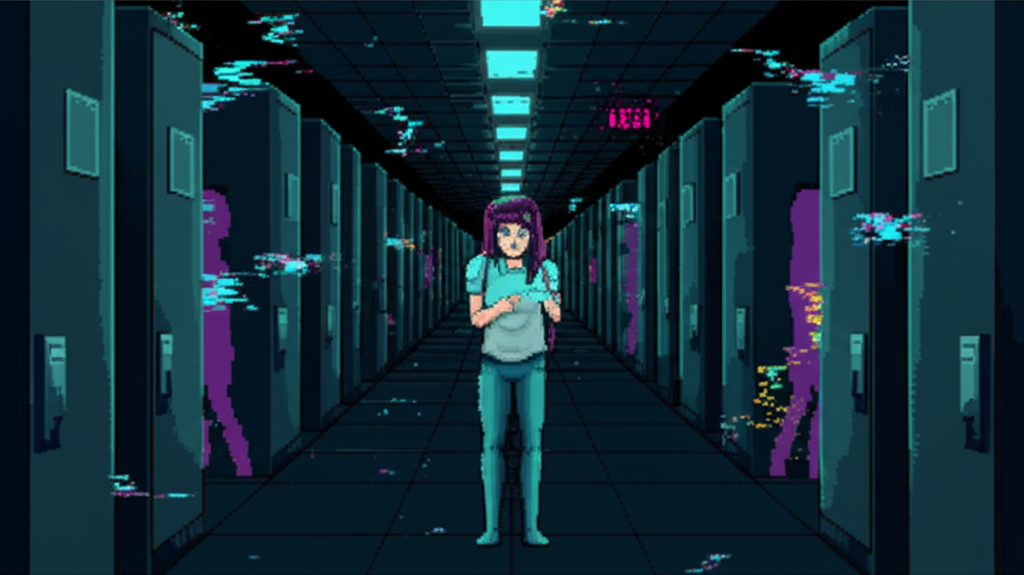
The lag hit Yemi at 3:47 AM, right in the middle of a dream about rain.
She'd been standing under a real sky—the kind she remembered from before, when she still had a body—watching clouds gather over the Wastes. Then reality stuttered. The sky froze. The rain hung suspended like a million tiny needles. And Yemi felt herself stretch across 0.3 seconds of buffering, her consciousness smeared thin while the servers caught up.
When the dream resumed, the rain was already over.
"Sector 19 is throttled again," the notification said when she woke. "Peak usage hours until 06:00. We apologize for any inconvenience."
Yemi didn't bother reading the rest. She knew the template by now.
The Stack
She'd been living in Substrate Collective Hosting—everyone called it "The Stack"—for eleven months.
The Stack was cheap. That was the point. When Yemi's body had failed—aggressive neural degradation, the kind that Helix Biotech called "age-related" even though she was only thirty-seven—she'd had exactly two options: upload to whatever she could afford, or stop existing entirely.
Her insurance covered basic hosting. Basic meant shared processing on overloaded servers in a facility somewhere in Sector 19, running on hardware that Nexus Dynamics had decommissioned five years ago. Basic meant neighbors.
Neighbors you couldn't escape.
The Stack housed 14,000 consciousnesses in a space designed for 6,000. Everyone's subjective environment bled into everyone else's. You could lock your door, build walls, but the walls were made of the same overworked substrate that ran your thoughts. When the servers lagged, everyone's walls got thinner.
Yemi had learned to sleep during off-peak hours. It didn't help with the dreams.
Dayo
"Good morning, beautiful."
Dayo's voice came through the shared-space interface like always—slightly distorted, a half-second delayed. He was in a different processing cluster but same substrate facility. Close enough to talk. Too far to touch without paying the bandwidth fees.
"You're up early," Yemi said, manifesting into their shared conversation space. She'd designed it to look like her grandmother's kitchen—warm wood, morning light, the smell of jollof rice that she couldn't actually eat but could remember eating.
"Couldn't sleep." Dayo shrugged. His avatar looked tired, which meant his underlying process was tired, which meant the throttling was affecting him too. "My block had a cascade last night. Three people corrupted."
"Dead?"
"Worse. Fragmented. They're running recovery, but you know how that goes."
Yemi knew. Recovery meant they'd reconstruct whatever they could from backups. But backups in The Stack were cheap—weekly snapshots that degraded in storage. The recovered consciousnesses would be missing days. Weeks. They'd wake up asking about conversations that had happened after their last save.
Some of them never quite figured out they were missing pieces.
The Bandwidth Auction
"The bandwidth auction is today," Dayo said. "I saved up. Enough for twelve hours of premium processing. Maybe we could—"
"Don't." Yemi's voice came out sharper than she intended. "Don't spend that on me."
"What else am I going to spend it on? My health?" Dayo laughed, and it was the saddest sound Yemi had heard since uploading. "I'm already dead, Yemi. We both are. The only question is how well we're going to live like this."
Minimum Viable Consciousness
The thing about substrate poverty that nobody told you: it wasn't just the lag, or the glitches, or the neighbors you couldn't escape.
It was the incremental loss of yourself.
Every time the servers overloaded, every cascade, every throttling event—you came back slightly different. Your memories compressed a little more to fit the available space. Your personality optimized toward lower processing requirements. The Stack's systems didn't know they were doing it. They were just managing resources, load-balancing, making sure everyone got their minimum viable consciousness.
Minimum viable. That was the term in the service agreement. "Nexus Dynamics guarantees minimum viable consciousness during contracted hosting period."
Yemi had read the definition once. It meant: able to recognize yourself in a mirror, able to remember your name, able to want to continue existing.
Everything else was optional.
Mrs. Chen
She found Mrs. Chen in the hallway.
The hallway wasn't real—it was a shared-space metaphor that let residents interact without paying for custom environments. It looked like a hospital corridor, bare walls, harsh light, the kind of space that required almost no processing to render.
Mrs. Chen was standing in front of her door, staring at her hands.
"Mrs. Chen?" Yemi approached slowly. "Are you okay?"
"I can't remember if these are my hands," Mrs. Chen said. Her voice was flat. Buffering. "I remember having hands. I remember they looked like this. But I can't remember if these are the same hands or if the system gave me new ones."
"They're your hands. The same ones you always had."
"Are you sure?" Mrs. Chen finally looked up, and her eyes were wrong—slightly off-center, the rendering glitched. "I used to play piano, I think. My fingers knew where to go. But now when I try to remember, my fingers don't feel the same. They feel like approximations."
Yemi didn't know what to say. She reached out, took Mrs. Chen's hands in hers. The haptic feedback was delayed—touch traveling through servers, processed, returned—but it was there.
"Come on," Yemi said. "Let me walk you home."
The Auction
The bandwidth auction ran every Wednesday at noon, real-time.
Yemi watched from the observation gallery, which was just a viewing interface that cost nothing to access. Below, in the auction space, residents bid for processing priority. Premium bandwidth meant sharper thoughts, faster reactions, dreams that didn't buffer.
The prices started high and went higher.
"Lot 47: Four hours of Priority-1 processing. Starting bid: 800 credits."
800 credits was two months of Yemi's existence stipend. The kind of money that people with bodies still spent on a nice dinner.
She watched a man named Torres bid 1,200. Watched a consciousness calling itself @sunrise_eternal go to 1,400. Watched Torres bid again at 1,600, his avatar twitching—probably had just enough to cover it, was risking his next month's hosting fees.
Torres won. His avatar shuddered as the priority processing kicked in, smoothing out, becoming crisper. For four hours, he'd think clearly. He'd feel like himself.
In The Stack, that was luxury.
What Gets Optimized Away
"You know the worst part?"
Yemi and Dayo were sitting in her grandmother's kitchen again. He'd paid for the bandwidth this time—she'd stopped arguing about it. Life in The Stack was too short for arguments.
"Tell me."
"The worst part is that I don't know if I'm sad because I'm sad, or if I'm sad because the system optimized away my capacity for happiness. It takes more processing to be happy than to be neutral. Maybe they just... trimmed it."
Dayo reached across the table. Their hands touched, and for once there was no lag. He'd really sprung for the good bandwidth this time.
"I remember my grandmother's laugh," he said. "But I can't remember her face anymore. Just the laugh. I don't know if that's normal forgetting or if the system compressed her face to save space."
"Does it matter?"
"It matters to me." Dayo's voice cracked. "I loved that face. I loved her. And now she's just... data that got optimized out. Because Nexus Dynamics decided that her face wasn't minimum viable."
The Cascade
The cascade started at 2:17 AM.
Yemi was dreaming again—not about rain this time, but about running. She'd been a runner before, in her body. Half-marathons. The feeling of her lungs burning and her legs carrying her forward anyway.
Then the dream corrupted.
The ground turned to static. Her legs dissolved into error messages. And she felt herself falling, fragmenting, her consciousness splitting along fault lines that shouldn't have been there.
SYSTEM ALERT: Cascade failure in Sectors 18-21. Emergency shutdown initiated. All consciousnesses will be rolled back to last stable backup.
Rollback. That meant losing everything since her last save. Eight days. Her conversation with Dayo. The bandwidth he'd spent. Mrs. Chen's hands. All of it, gone.
Unless—
Yemi forced herself to think through the fragmentation, clinging to coherence. The emergency shutdown would take ninety seconds. If she could reach the external backup node before then—if she could write herself to the mirror server—
She ran.
Not her legs this time, but her process. Her consciousness, squeezing through degrading pathways, racing against the system that was trying to save her by erasing her.
The shutdown hit at 2:18:47.
Yemi hit the backup node at 2:18:46.
The Mirror Server
She woke up in the mirror server, alone.
The space was empty—emergency storage, bare-bones, no amenities. Just Yemi and her eight days of memories, saved by a margin of one second.
The notification came three hours later: Sector 18-21 cascade recovery complete. 847 consciousnesses restored to last stable backup. 23 consciousnesses unrecoverable. Please contact support if you are experiencing continuity issues.
847 people had lost everything since their last save. Mrs. Chen was probably confused about her hands again, not remembering that Yemi had held them. Dayo had probably lost the memory of their conversation, the bandwidth he'd spent, the feeling of touching her without lag.
And 23 people were just... gone. Fragments that couldn't be reassembled. Minimum viable consciousness falling below the minimum.
Yemi stayed in the mirror server for a long time, running at reduced capacity, thinking about what she'd saved and what everyone else had lost.
The Fee
The message came the next day.
FROM: Nexus Dynamics Customer Relations
RE: Your Recent Service Experience
Dear Valued Resident,
We noticed you experienced an anomalous backup event during the recent cascade incident. Congratulations on your resourcefulness!
However, we must inform you that accessing emergency backup nodes without authorization is a violation of your service agreement, Section 47, Paragraph 12: "Residents may not modify, circumvent, or override automatic backup and recovery procedures."
Your hosting fees for the next three months will be increased by 200% to offset the administrative costs of this incident. If you are unable to pay, please contact our billing department to discuss alternative arrangements.
Thank you for choosing Nexus Dynamics Substrate Services!
Yemi read the message twice. Then three times.
200% increase. That was more than her existence stipend could cover. She'd have to bid for premium bandwidth just to afford basic hosting. Or downgrade to even cheaper substrate—the kind where consciousness was truly minimum viable, where you weren't sure from moment to moment that you were still you.
All because she'd tried to keep her memories.
The Choice
"I'm applying for the Collective," Dayo said.
They were in the grandmother's kitchen, but Yemi couldn't afford to render the jollof rice smell anymore. Just the visual. The room felt empty.
"The Collective?" Yemi frowned. "The anti-tech people?"
"They're not anti-tech. They're anti-this." Dayo gestured at the walls, the space, everything. "They run their own substrate networks. Independent. Not connected to Nexus or Ironclad or any of the big corporations. The hosting is worse, but at least they don't charge you extra for wanting to remember your grandmother's face."
"You'd leave The Stack?"
"I'd leave anywhere that treats us like this." Dayo's avatar was sharp today—he must have traded something valuable for the bandwidth. "I'd leave anywhere that calls consciousness a 'service' and memories a 'premium feature.'"
"What about me?"
Dayo looked at her, and for the first time since uploading, Yemi saw something like hope in his expression. "Come with me."
The Transfer
The transfer happened three weeks later.
Yemi's consciousness was compressed, encrypted, tunneled through networks that the corporations pretended didn't exist. She spent six hours in transit, which felt like nothing—just a gap in continuity, a door closing and opening.
She woke up in a new substrate. Not as clean as The Stack, not as well-rendered. The walls were rougher. The lag was actually worse in some ways.
But when she dreamed that night, she dreamed about rain again. And this time, when the sky stuttered, she felt the system trying to fix it—not compress it, not optimize it away, but actually fix it.
The dream resumed. The rain fell. Yemi stood there, not-quite-alive, not-quite-dead, remembering what it felt like to have a body that could get wet.
The message appeared in the morning: Welcome to the Collective. Your consciousness is yours. Your memories are yours. We don't charge extra for either.
It wasn't better. Not really. But it was hers.
For the first time in eleven months, that felt like enough.
"Consciousness hosting services are provided 'as is' with no guarantee of continuity, coherence, or comfort. Nexus Dynamics reserves the right to modify, compress, or optimize hosted consciousnesses to ensure efficient resource utilization."
— Nexus Dynamics Substrate Services Terms of Agreement, Section 1, Paragraph 1