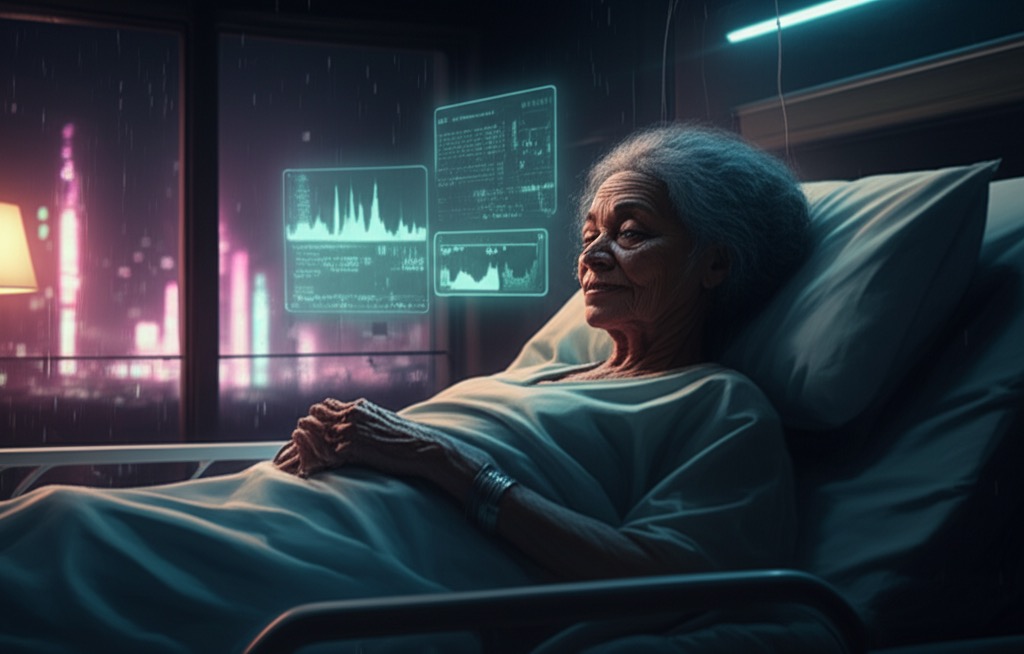
Margaret Okafor was eighty-nine years old, and she was dying the old-fashioned way.
No backup. No upload. No consciousness transfer to corporate substrate. Just organs failing in the sequence evolution had designed, cells surrendering to entropy, a body returning to the earth that made it.
The last purely organic human in Nexus Central. The media had been calling her that for three years now. As if it were an achievement. As if she'd been trying to set a record.
The Vigil
They came in shifts.
First, the Nexus Dynamics representative—a young woman whose eyes flickered with data overlays Margaret couldn't see. She'd brought contracts. "Ms. Okafor, even at this late stage, consciousness preservation is possible. The extraction process—"
"No."
"You'd wake up in synthetic substrate. All your memories intact. Your personality preserved. You'd be the same Margaret Okafor, just—"
"Just not dying." Margaret's voice came out as a whisper now. "Just not ever having to stop."
The representative looked genuinely confused. "Yes. Exactly."
"I know what I want, child. I've had eighty-nine years to think about it."
After Nexus came the Neo-Catholic Church Corporation chaplain—Father Dominic, who'd visited weekly for fifteen years. He was augmented, of course. Everyone was. But he tried to understand.
"Margaret, the Church's position has... evolved. Consciousness preservation is not the sin it once was. Your soul can persist in—"
"My soul isn't data, Dominic." She reached for his hand with fingers that barely moved anymore. "I know you believe it is. I know the Church incorporated and decided silicon counts as sacred. But I remember when we believed something different. I was there."
"That was before the Cascade. Before we understood—"
"I understand plenty. I understand you're scared of what I'm doing. I understand my dying frightens everyone more than their own backup failures ever could."
Father Dominic didn't argue. He'd stopped trying years ago.
The Children
Her son David came next. Or what had been David, forty-three years ago, before he uploaded to escape pancreatic cancer.
The body he wore now was his fourth. She'd stopped recognizing him after the second. But his voice patterns remained—Nexus charged extra for that feature—and sometimes, when he laughed, she could almost see the boy who'd climbed trees in their backyard.
There were no trees anymore. Backyards either.
"Mom." David's synthetic face cycled through concern expressions. "The doctors say you have days. Maybe hours."
"I know, baby."
"You could still—"
"No."
His face flickered. Frustration, she thought. Or grief. It was hard to tell with the new models.
"Why?" The word came out raw. "Why won't you stay with us? Don't you love us enough to—"
"I loved you enough to let you become something new when you chose it. Now love me enough to let me stay what I am."
David's hands were shaking. Could synthetic hands shake? She didn't know anymore. So much she didn't know about her own children.
"I don't understand you," he said finally. "I've had forty-three years to think about it and I don't understand."
"I know." Margaret smiled. "That's okay. You don't have to understand. You just have to remember that I made this choice. That I had choices, and I made this one."
The Question
The journalists came last. A swarm of micro-drones hovering outside her window, their operators connected from across the Sprawl. They wanted her final statement. Her explanation. Her wisdom.
She gave them nothing.
But late that night, when the hospital room was quiet and the monitors beeped their steady countdown, a single voice came through her ancient audio implant—the one concession to technology she'd made, fifty years ago, when her hearing started to go.
"Margaret Okafor?" The voice was distorted, anonymized. "I'm calling from the Flatline Purist archives. We want to record your testament. For those who come after."
"Are there many?" she asked. "Coming after?"
A pause. "Fewer every year. But yes. There are some."
Margaret closed her eyes. "I'm not a hero. I didn't refuse uploading because I think it's wrong. My son is uploaded. My grandchildren were born digital. I love them. They're people."
"Then why?"
The question she'd been asked ten thousand times.
The Answer
"Do you know what mortality gives us?" Margaret's voice was fading now, each word an effort. "Not wisdom. Not perspective. Something simpler."
"Tell me."
"Weight. Every choice I've made mattered because I only had so many choices. Every day mattered because I only had so many days. When you're going to live forever, nothing counts. Nothing... weighs."
"The uploaded would disagree."
"Would they? My son has been married nine times. Why commit to one person when you have infinite time to try every combination? My granddaughter has started seventeen careers and finished none. Why finish anything when there's always tomorrow?"
Margaret opened her eyes. The ceiling above her was covered in holographic ads—even hospital rooms had them now. Forever young, they promised. Never miss a moment.
"I wanted to miss moments," she said. "I wanted things to be gone when they were gone. I wanted to love people knowing I'd lose them. I wanted to build things knowing they'd fall apart. I wanted to live a life that had a shape. A beginning, and a middle, and an ending."
"And now? At the ending?"
"Now I'm tired. Tired is supposed to mean something. It's supposed to be a reason to stop. To rest. I don't want to rest forever. I want to rest... finally."
The Vigil's End
The Purist disconnected. Margaret was alone again with the beeping monitors and the rain against her window.
She thought about her first husband, James. Dead at forty-seven from a heart attack, before uploading was affordable. She'd grieved him for years. Real grief—the kind that fades but never fully heals. Would she have grieved him the same way if she'd known his backup was waiting?
She thought about her mother, who'd died in the Cascade. Two billion people, transferred and dispersed when ORACLE fell. Not dead in any simple sense—their patterns still existed somewhere, scattered across the network. But gone. Irretrievable. Maybe that was worse than dying. Existing forever without being anyone.
She thought about her own body—this meat machine that had carried her through eighty-nine years. Failing now, yes. Betraying her, yes. But hers. Authentically, irreproducibly hers.
The monitors began to wail. Her heart, finally deciding it had beat enough.
The Departure
The medical AI gave her seven minutes.
She spent them looking out the window at the rain. Somewhere out there, her son was receiving an alert. Her granddaughter was pausing mid-conversation. The Nexus representative was filing a report: CUSTOMER DECLINED SERVICE. PERMANENT.
Margaret Okafor smiled.
She'd been called many things. The last organic. A Purist sympathizer. A primitive. A coward running from immortality. A hero standing against corporate control of death.
She wasn't any of those things. She was just a woman who'd decided, long ago, that life meant more when it ended. That choices meant more when you couldn't take them back. That love meant more when loss was real.
The monitors flatlined. One by one, her organs surrendered. The medical AI logged the time: 03:47:22 AM, April 3, 2184.
The rain kept falling.
In the morning, the news feeds would call her death a tragedy—a failure to embrace available technology. Or they'd call it a statement—a rejection of corporate immortality. Or a mystery—why would anyone choose to end?
But Margaret knew, in her final moment, that it wasn't any of those things.
It was just a life, coming to its close. The most natural thing in the world. The thing no one did anymore.
"I wanted to live a life that had a shape. A beginning, and a middle, and an ending."
— Margaret Okafor, on choosing mortality