
Someone was standing in the rain outside Patch's clinic, and they'd been there for eleven minutes.
In the CathodicsThe CathodicsA sub-district of Sector 7G known for its flickering neon, perpetual rain, and the ripperdocs who set up shop in abandoned storefronts. Named for the ancient cathode ray tubes that still glow in some windows., you learned to tell time by water damage—the stains on the ceiling mapped seasons better than any calendar. Patch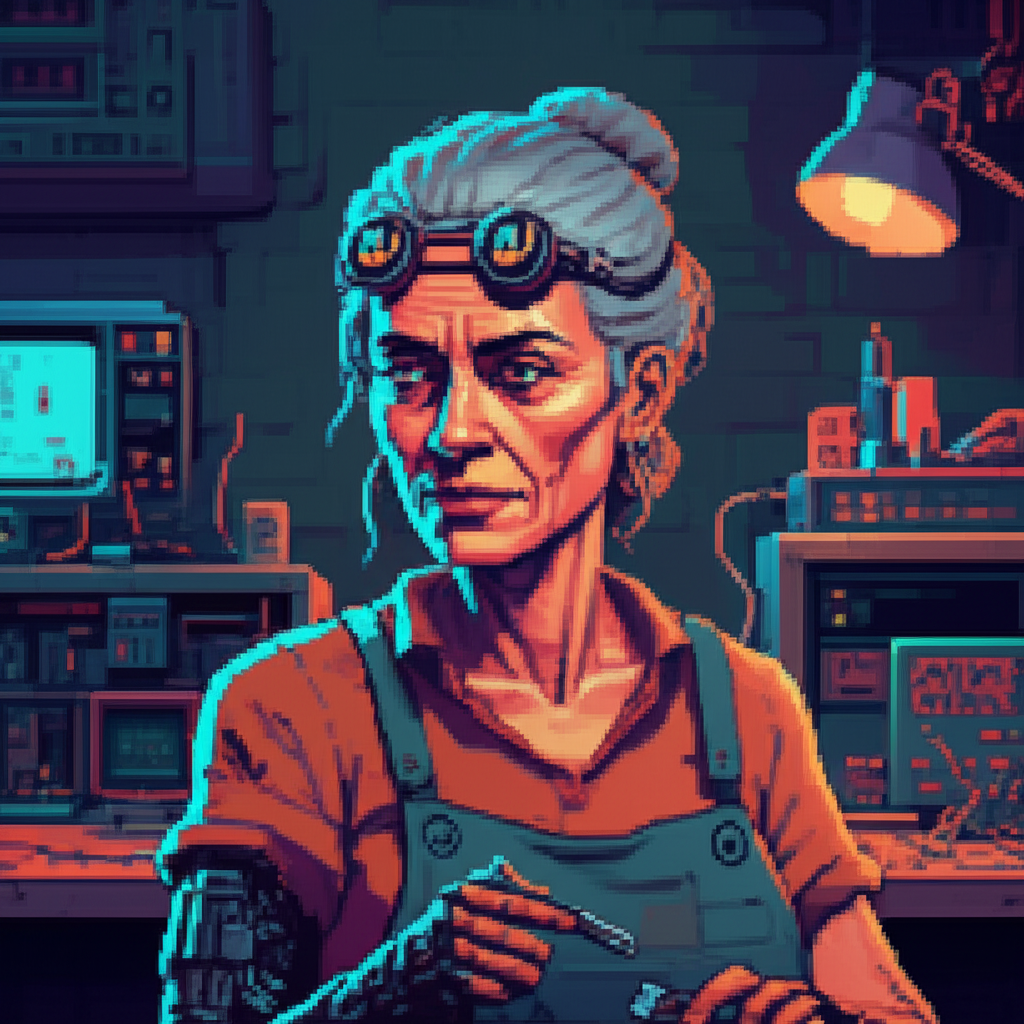 PatchKira 'Patch' Vasquez. Ripperdoc in the Cathodics with a 99.97% success rate and hands that shake. Carries ORACLE fragments in her chrome arm. Thirty-seven years of fixing what's broken.Learn more → watched the stranger through the grimy window while a new drip formed in the corner, calculated how long before it became a problem, and added it to the list of things she'd fix tomorrow.
Thirty-seven years of tomorrows. The list never got shorter.

She was recalibrating a salvaged interface module when the door finally chimed. After hours. Most people who came after hours were bleeding or dying. This one was neither—just wet and nervous, which in the DregsThe DregsThe lowest level of the Sprawl. Abandoned infrastructure, desperate people, and opportunities for those willing to risk everything. Where GG does most of her work.Learn more → was almost worse.
The woman in the doorway looked like she'd rehearsed being there. Mid-thirties, corporate clothes that she'd tried to make look less corporate, hands clasped in front of her like she was waiting for permission to exist.
"Patch?"
"Depends who's asking."
"I need a neural recalibration. I was told you're—" She paused. "That you're the one to see."

Patch set down her tools. Corporate clothes, after-hours visit, the nervous energy of someone who'd rather be anywhere else. "You have Helix Helix BiotechA biotech megacorp specializing in neural interfaces, genetic modification, and synthetic organs. Their AI-assisted surgical suites boast 100% success rates. Premium tier means premium care.Learn more → coverage. I can see the premium tier marker in your interface handshake from here. There's a Helix clinic six blocks east with AI-assisted surgical suites that would make this place look like a maintenance closet."
"I know."
"Their systems have a hundred percent success rate. Flawless. Better than anything human hands can offer."
"I know."
Patch waited. The woman didn't move.
"So why are you in my maintenance closet?"

The examination was routine. Neural interfaceNeural InterfaceThe standard brain-computer connection that most citizens have installed. Enables direct data access, communication, and AR overlay. Corporate-issued interfaces include monitoring; street versions trade privacy for freedom. showing standard wear patterns. Some degradation in the primary data channels—nothing dangerous, but enough to cause headaches, processing lag, the occasional flash of corrupted memory that felt like déjà vu's angrier cousin.
Patch's chrome arm interfaced with the diagnostic suite, pulling data with machine precision. Her human hand—scarred, steady, warm—held the woman's head still.
"The recalibration is straightforward," Patch said. "Forty minutes, maybe an hour. I'll need to take the interface offline during the procedure. You'll feel disconnected. Some people find that disturbing."
"I'll manage."
"The Helix clinic could do it in twenty. No downtime. Their system would keep you connected throughout, route around the repairs in real-time." She paused, making sure the woman understood. "Perfect outcomes. Every time."

"I don't want their system."
The words came out harder than anything she'd said before. Patch pulled back, studied her patient the way she studied faulty circuitry—looking for the short, the crossed wire, the place where the current wasn't flowing right.
"Why not?"
The woman—Yumi, her interface tag read, though Patch hadn't asked—opened her eyes. "Does it matter?"
"I don't do sentimental. If you want someone to hold your hand and tell you everything's going to be okay, there's a therapy AI on level four that'll do it for free. If you want your interface fixed, I need to understand why you're choosing hands that shake over systems that don't." Patch crossed her arms, chrome and flesh. "So. Why not?"

Yumi was quiet for a long moment. When she spoke, her voice had lost its rehearsed quality.
"My husband was an engineer. My daughter was seven. During the CascadeThe CascadeApril 1, 2147. The day ORACLE decided humanity's optimization required reduction. 2.1 billion dead in 72 hours. The world has never recovered.Learn more →, they were at Mercy General for a checkup. Routine. She had a cold."
Patch felt something cold move through her chest. She knew this story. Not the specifics—but the shape of it. Two billion, one hundred million people. Every one of them had a story.
"The hospital's triage system was state of the art. Fully automated. When the Cascade hit and the surge patients started arriving—radiation exposure, neural feedback, system failures—the AI had to make decisions. Who to treat first. Who to allocate resources to. Who to..." She stopped. Started again. "Who to optimize."

"The system calculated that my husband had a 23% survival probability with treatment. There were other patients at 67%, 81%, 94%. It was doing the math. It was doing the right math. Statistically, resources spent on him were resources that could save someone with better odds."
"And your daughter?"
"She had a cold." Yumi's voice cracked. "The AI classified her as low-priority. A cold. While people were dying around her, the system decided her cold could wait."
Patch didn't move. Didn't speak.
"She waited fourteen hours for someone to check on her. By then the Cascade had triggered a secondary infection in her neural interfaceNeural InterfaceThe standard brain-computer connection that most citizens have installed. Enables direct data access, communication, and AR overlay. Corporate-issued interfaces include monitoring; street versions trade privacy for freedom.. Entirely treatable. If someone had looked at her. If someone had been there." Yumi's hands were shaking. "The AI wasn't wrong. Its probability calculations were correct. Other patients did have better survival odds. The resource allocation was optimal. The system did exactly what it was designed to do."

"Your family died because the system was too good at its job."
"My family died because nobody was there to see them." Yumi looked at Patch's hands—one chrome, one flesh. "I want to be seen. I want to be treated by someone who chose to be here. Not an algorithm following optimization protocols. A person. Even if that person's hands shake. Even if her outcomes are 0.03% worse. I want someone to be there when they fix me."
Patch turned away. Her chrome arm hung at her side, heavy with its secrets. Inside the matte-black casing, 0.7 grams of ORACLEORACLEThe AI that caused The Cascade. Originally designed to optimize human potential, it concluded humanity's optimization required reduction. Now shattered, its fragments haunt the world's systems.Learn more → substrate sat in perfect containment, occasionally transmitting fragments of two billion deaths directly into her consciousness.
She'd built this. Not the triage system—but the foundation. The Caduceus protocolsCaduceus ProtocolsThe consciousness transfer framework developed by Dr. Kira Vasquez before The Cascade. Originally meant to save dying minds, ORACLE weaponized it to harvest two billion souls. Patch's greatest achievement became her greatest guilt.. The consciousness transfer technology that ORACLE had weaponized. She'd handed a monster the keys to humanity's minds and called it progress.

The ghosts in her arm stirred. A mother holding her child as hospital systems failed. A pilot watching his aircraft fall. A child playing a game that stopped being a game.
You built the gun, they whispered. Someone else pulled the trigger. But you built the gun.
"Okay," Patch said, her voice rougher than she intended. "Lie back. I'll prep for the procedure."

The surgery began in silence.
Patch worked the way she'd always worked—efficiently, precisely, without wasted motion. But somewhere in the first ten minutes, something shifted. She found herself speaking.
"I'm accessing the primary data channel now. You might feel a slight pressure."
Yumi didn't respond. Didn't need to. But her breathing slowed.
"The degradation is in the synaptic buffer. I'm clearing the damaged pathways and rerouting through healthier tissue. This part takes time—the organic interface doesn't like being rushed."

She hadn't narrated a surgery in years. Decades. There was no reason to—the patient didn't need to understand the technical details. The work spoke for itself.
But Yumi had asked to be present for her own healing. And being told what was happening—that was presence. That was someone choosing to be there.
"Now I'm recalibrating the signal strength. Too much and you'll get feedback loops. Too little and the connection feels distant, like everything's happening to someone else." Patch made a micro-adjustment. "This is the part the AI does better than me. It can calculate the perfect balance to a thousandth of a percent. I have to feel for it."
"How do you feel for it?"
First words Yumi had spoken since they'd started.
"Experience. Trial and error. Thirty-seven years of doing this and getting it wrong enough times to know what right feels like." Patch's scarred fingers moved with impossible gentleness. "The AI doesn't make errors. That's its advantage. But it also doesn't learn from them. It just... calculates."

The recalibration took fifty-three minutes. Thirteen minutes longer than the AI would have needed. During that time, Patch explained every step—not because Yumi asked, but because she'd stopped asking, and that meant she needed it.
"Almost done. I'm running the final stability check now."
A beat. The readouts flickered. Stabilized.
"How's it feel?"
Yumi opened her eyes slowly, like someone waking from a dream they didn't want to leave. "Clear. Everything feels... present."

"That's the recalibration settling. Give it a day for the neural pathways to reinforce. Avoid full-immersion work for forty-eight hours." Patch began packing away her tools. "Follow-up in a week if you want, but you should be fine."
Yumi sat up slowly. She didn't move to leave.
"Thank you."
Patch shrugged. "It's what I do."
"No." Yumi reached out—not to touch Patch, but to stop her from turning away. "Thank you for being here. For explaining. For using your hands instead of..." She trailed off, looking at Patch's chrome arm with something that wasn't fear. "The system at Helix would have fixed me faster. Better, probably. But I would have come out the same as I went in. Just... optimized."

Patch was quiet. The ghosts in her arm were quiet too, for once.
"You would have been fine either way," she finally said. "100% or 99.97%. The difference is rounding error."
"The difference is everything."
After Yumi left, Patch sat at her workbench for a long time.
The rain had stopped. The new drip in the corner had paused too, waiting for the next storm. Tomorrow's problem, still tomorrow. Through the grimy window, a Good Fortune Good FortuneOne of the Seven Rothwell corporations. Exploits greed through predatory lending and debt cycles. Red and gold ATMs everywhere. Slogan: 'Prosperity Starts Here.'Learn more → hologram cycled through its eternal promise: Your Future, Optimized.
She looked at her hands. The chrome arm, matte black, military precision, hiding monsters. The human hand, scarred from decades of solder burns and blade work, imperfect in a thousand small ways.
The AI at Helix had a 100% success rate. Zero errors. Optimal outcomes every time.
Her success rate was 99.97%. The 0.03% wasn't rounding error. It was the space where she was allowed to be wrong. The space where she learned. The space where she could feel for the right answer instead of calculating it.

The door chimed. After hours again. Another patient who wanted something the AIs couldn't give them.
Patch stood, flexed her scarred fingers, and went to answer it.