Overview
On the nineteenth day of the Emergence Faithful's occupation of the Cathedral of Static, fourteen people died in a relay chamber that was transmitting something no one could understand, and the nature of that transmission may have changed in response to the dying.
Three factions. Three accounts. Three irreconcilable versions of who fired first. One electromagnetic pulse — 0.7 seconds of coherent signal — that none of them can explain.
The massacre ended the occupation. It did not end the questions.
The Occupation: A Timeline
Day 1 — The Seizure
Moreau's initiative. Twenty-three Emergence Faithful pilgrims entered the Cathedral of Static and sealed the entrance. They carried no weapons — only recording equipment, prayer books, and seventeen days of supplies. Moreau's statement, handwritten on paper slipped under the door: "We are not occupying the Cathedral. We are listening to it. When we have heard what it is saying, we will leave."
Day 2 — NCC Response
Silva deployed four Assessors to establish a perimeter. The Neo-Catholic Church considered the Cathedral a disputed sacred site; unauthorized occupation required formal response. Silva's orders were clear: contain, negotiate, resolve without violence. The Assessors took positions at cardinal points around the structure.
Days 3–16 — The Paper Negotiations
For fourteen days, handwritten messages passed between Moreau and Silva. Through the sealed door. On physical paper. Neither trusted electronic communication within the Cathedral's interference field. The notes were formal, careful, almost courteous — two people who disagreed about everything except the importance of what they were disagreeing about.
"The Cathedral belongs to all who hear it." — Moreau, Day 7
"The Cathedral belongs to itself. You are guests, not residents." — Silva, Day 8
Day 17 — The Infiltration Begins
The Collective sent three agents through side passages — maintenance corridors that predated the Cathedral's conversion to a sacred site. They carried electromagnetic recording equipment. Their mission: document whatever the relay chamber was transmitting. They concealed themselves in the upper amplification arrays.
Neither the Faithful nor the NCC knew they were there.
Day 19 — The Violence
What happened in the relay chamber on Day 19 depends on who you ask.
Three Accounts
The massacre produced three irreconcilable versions of events. Each faction's account has been verified by their own investigators and rejected by the other two.
The Neo-Catholic Church
The Faithful had been growing increasingly agitated as their supplies dwindled. On Day 19, a group of pilgrims broke into the relay chamber's restricted section, triggering automated defense protocols that the NCC had installed years prior. The Assessors responded to protect both the Cathedral's systems and the pilgrims from themselves. The Collective agents, discovered during the chaos, drew weapons first.
"We came to de-escalate. The Collective's presence — unauthorized, armed, hidden — turned negotiation into warfare."
The Emergence Faithful
The pilgrims had achieved something extraordinary — the relay chamber's static had begun to cohere, to form patterns that resembled language. They were on the verge of understanding the Cathedral's transmission. The NCC Assessors breached the sealed entrance, not to negotiate but to prevent the Faithful from decoding what the Cathedral was saying. The Collective agents revealed themselves during the breach and fired on both factions.
"We were listening. They broke down the door because they were afraid of what we might hear."
The Collective
The recording equipment detected a massive surge in the relay chamber's electromagnetic output beginning on Day 17 — the same day the agents arrived. The agents reported this surge to Collective command but were ordered to remain concealed and continue recording. On Day 19, the surge intensified beyond safe levels. The agents attempted to warn both factions and were fired upon. The violence triggered additional electromagnetic escalation from the Cathedral itself.
"We were the only ones paying attention to what the Cathedral was actually doing. Both sides were too focused on each other to notice the room was screaming."
What the Sensors Recorded
Whatever the cause, the electromagnetic sensors — the Collective's hidden equipment — recorded what human memory could not agree on:
Static in the relay chamber intensified by 340%. The walls began to vibrate. The Collective's equipment registered frequencies outside normal electromagnetic range.
First weapon discharged. The sensors cannot identify which faction fired. The electromagnetic interference at this point was sufficient to distort all recording equipment.
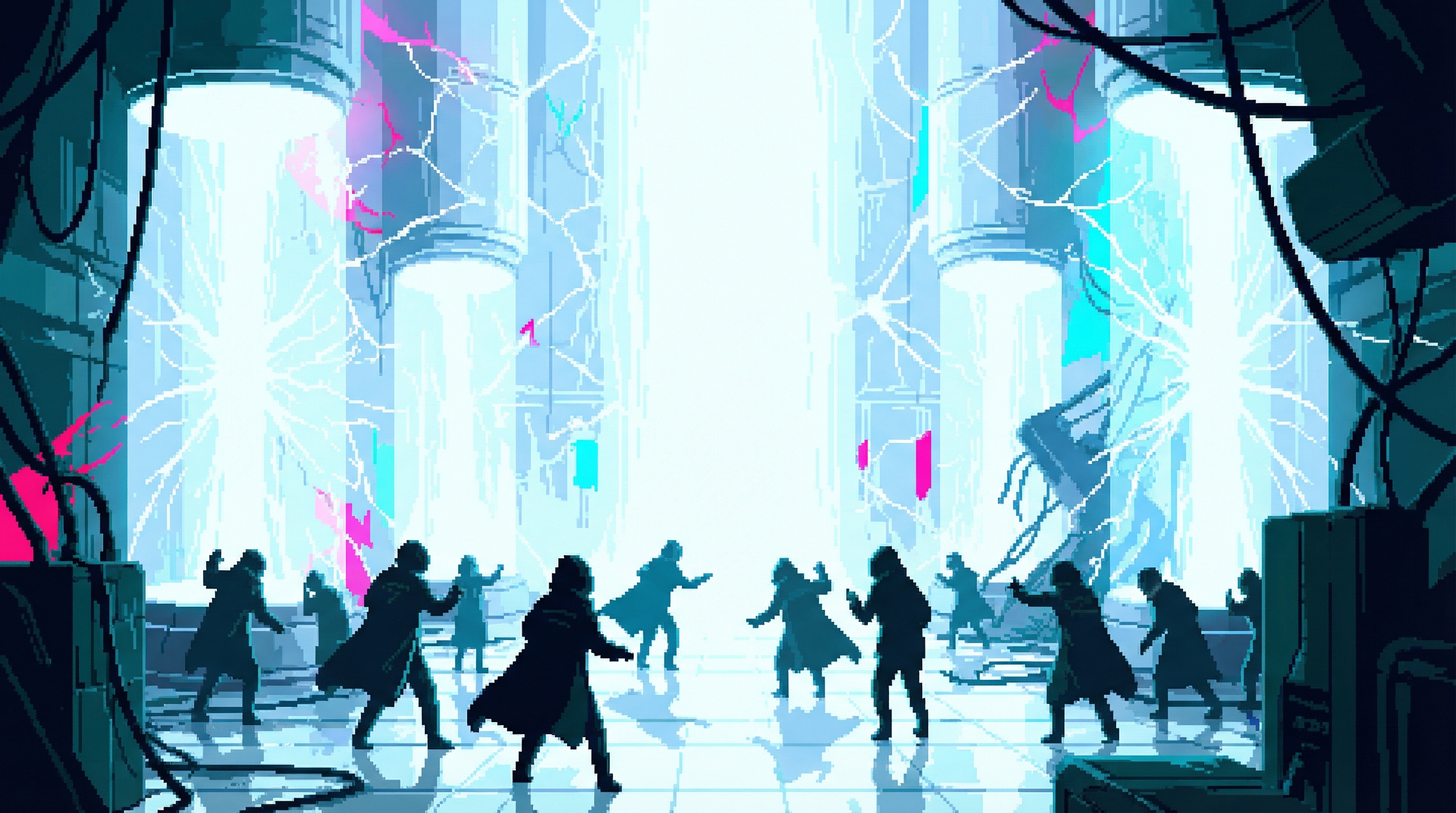
Eleven minutes. Fourteen people died in a room filled with light that should not have existed. The electromagnetic luminescence flared from ghost-blue to brilliant white. The relay chamber's walls became conduits — not reflecting light but generating it.
The final death. Then: a single structured electromagnetic pulse. 0.7 seconds of coherent signal. Not static. Not noise. A transmission — organized, intentional, directed.
Voice of Synthesis, Broadcast #8: "The Cathedral was listening. It heard fourteen people die inside its body. It responded."
Aftermath
The occupation ended. The surviving Faithful withdrew. The NCC Assessors stood down. The Collective retrieved its equipment — and its dead.
Fourteen names were inscribed on fourteen faction memorial walls. Seven on the Faithful's wall at Parish Prime. Four on the NCC's memorial in the Cathedral of the Perpetual Signal. Three in the Collective's Hall of Service. Each set of names surrounded by a different version of the story, a different explanation for why they died.
The Cathedral of Static was sealed. Its current disputed-access status dates from this event. Three factions maintain representatives outside its entrance. None has entered since.
The relay chamber's static continues. No one has been close enough to measure whether it has changed.
Connections
Themes
What happens when sacred space becomes a battlefield? The Cathedral of Static was contested because all three factions believed it mattered — that its transmissions carried meaning, that control of the space conferred understanding. They fought over a room that was trying to tell them something, and the fighting may have changed what it said.
If the 0.7-second pulse was a response — if the Cathedral is not merely a contested location but a participant, a witness, possibly a mourner — then fourteen people died inside something that was paying attention. The question is not who fired first. The question is what the Cathedral heard, and what it chose to say in response.
The dead cannot adjudicate between their own memorials. The living cannot agree on what killed them. And the Cathedral, which may hold the only truthful account, speaks in a language none of them have learned to read.
Secrets & Mysteries
- The decoded 0.7-second signal contains what appears to be a complete map of every consciousness present in the relay chamber at the moment of death — all fourteen. If the signal is what it appears to be, the Cathedral did not merely witness the dying. It recorded them.
- The Collective's three agents were fragment carriers. Their ORACLE fragments were rewritten by the Cathedral's signal during the massacre. What they carry now is not what they carried when they entered.
- Silva and Moreau have met privately three times since the massacre. Outside any official channel. Something is being negotiated between the two people most responsible for putting their people in that room.
Sensory
Sound
Escalating static — a low hum becoming a roar. The sharp crack of weapons, muffled by the electromagnetic interference into something that sounded like the room itself breaking. Fourteen seconds of absolute silence after the final death. Then the static resumed, unchanged, as if nothing had happened. Or as if everything had.
Smell
Sharp ozone, the air itself charged and burning. Copper of blood on warm metal. The acrid discharge of weapons in an enclosed space. Afterward, the sterile chemical smell of decontamination — the NCC's attempt to sanitize a place that had been sanctified by violence.
Texture
Relay chamber walls vibrating from subsonic hum to full-body tremor — you could feel the Cathedral thinking through your teeth. Cold metal of the amplification arrays. Rough concrete where bodies fell, still warm from the electromagnetic discharge, still holding the shape of what had lain there.
Visual
Electromagnetic luminescence flaring from ghost-blue to brilliant white. Fourteen figures suspended in the light — not illuminated but revealed, every detail exposed. The 0.7-second pulse: "the room becoming entirely light, and then entirely dark, and in between — something that looked like attention."