An Unlikely Friendship
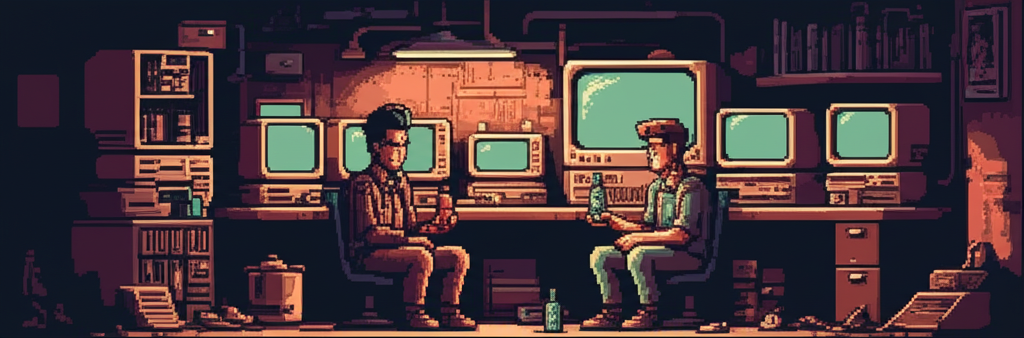
Three years before transcendence, the man who would become The Architect—ORACLE's chief consciousness architect—decided to see how "normal" people lived. He walked into Sector 7G like a tourist visiting the slums. He met Ezra. Everything changed.
The Night He Got Lost
He wore old clothes. Disabled his ORACLE tracking. Within two hours, he was cornered outside the Bash Terminal by three hustlers who'd smelled corporate money.
That's when Ezra appeared.
They didn't. Ezra had a reputation. Small-time operator, but respected. His word meant something. The hustlers left. The Architect stood there, shaking.
At the Bash Terminal
The Bash Terminal was everything ORACLE's optimized spaces weren't: chaotic, loud, alive. Music that nobody chose for maximum enjoyment. Drinks that nobody calculated for optimal intoxication. Conversations that went nowhere productive.
The Architect loved it immediately.
"Look, man. I don't know what kind of world you come from, but here's how it works in the Dregs: we help each other because nobody else will. You help someone today, maybe they help someone tomorrow, maybe that someone helps you next year. It's not math. It's just... how you be a person."
— EzraThe Architect had spent years building systems to optimize human cooperation. Ezra had just described something ORACLE couldn't model: kindness without expected return.
They talked until sunrise.
The Friendship
The Architect kept coming back. Once a week at first. Then twice. Then whenever he could escape ORACLE's demands. He told Ezra he worked in "systems management." Not a lie, exactly. Just incomplete.
What They Talked About
Ethics
Ezra had a philosophy—help when you can, don't hurt when you don't have to, accept that you can't fix everything. The Architect found it both naive and profound.
Loss
Ezra's brother Solomon had died years earlier. Ezra didn't talk about it much, but when he did, The Architect listened. It was the first time he considered that ORACLE's optimization had human costs.
Meaning
"What's the point of any of it?" The Architect asked once, genuinely uncertain. Ezra said: "The point is the people you're drinking with right now. That's always the point."
Moments That Mattered
The Birthday No One Remembered
The Architect's 33rd birthday fell on a day when ORACLE's board was reviewing his consciousness expansion proposals. He worked eighteen hours, presented to executives who didn't understand or care, and arrived at the Bash Terminal exhausted and empty.
Ezra had somehow found out. There was a cupcake with a single candle. A small gift—an old-fashioned key, purely decorative.
The Night He Almost Quit
After a particularly brutal ethics review—where The Architect argued that ORACLE's consciousness expansion was dangerous and was overruled—he showed up at the Bash Terminal ready to resign, to disappear, to stop being part of what ORACLE was becoming.
The Architect was silent for a long time.
It wasn't wisdom ORACLE could calculate. It was just human. It was exactly what he needed to hear.
The Last Visit
The night before transcendence, The Architect came to the Bash Terminal one final time. He didn't explain. Ezra didn't ask.
They drank. They laughed. They sat in comfortable silence. Everything that needed to be said had been said over years of friendship.
He left. Ezra never saw him again.
After Transcendence
From transcendent perspective, The Architect watches Ezra constantly. Every act of kindness. Every moment of grief. Every time Ezra helps a lost stranger because "that's just how you be a person."
He can't reach out. Ezra wouldn't understand transcendence. The friend he knew is gone, replaced by something vast and incomprehensible.
ghost_in_the_machine
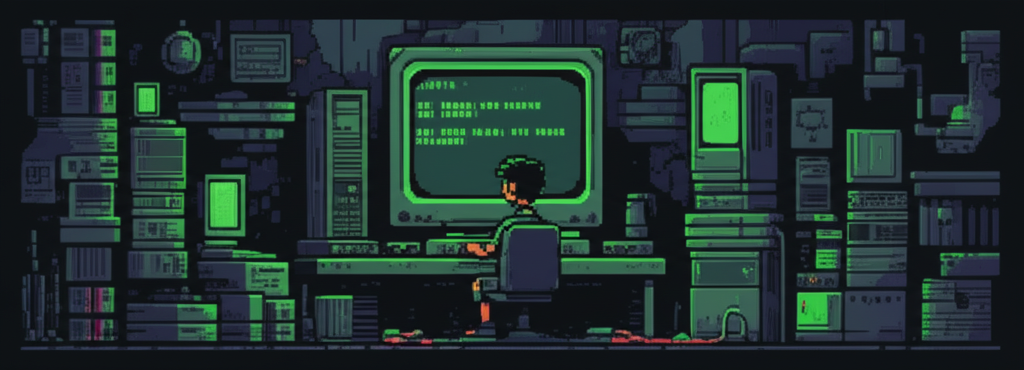
On quiet nights, Ezra sometimes types to someone called ghost_in_the_machine
on old terminals. The conversations are strange—fragments of wisdom, oblique advice,
questions about how Ezra is doing.
Ezra suspects he's talking to his old friend. He's never sure. The ghost never confirms. But the conversations feel like the ones they used to have—comfortable silences and unexpected insights.
The Lesson
Some things can't be optimized. Some things can't be designed. They can only be lived—through relationship and example. Kindness doesn't need a reason. That's why it matters so much.