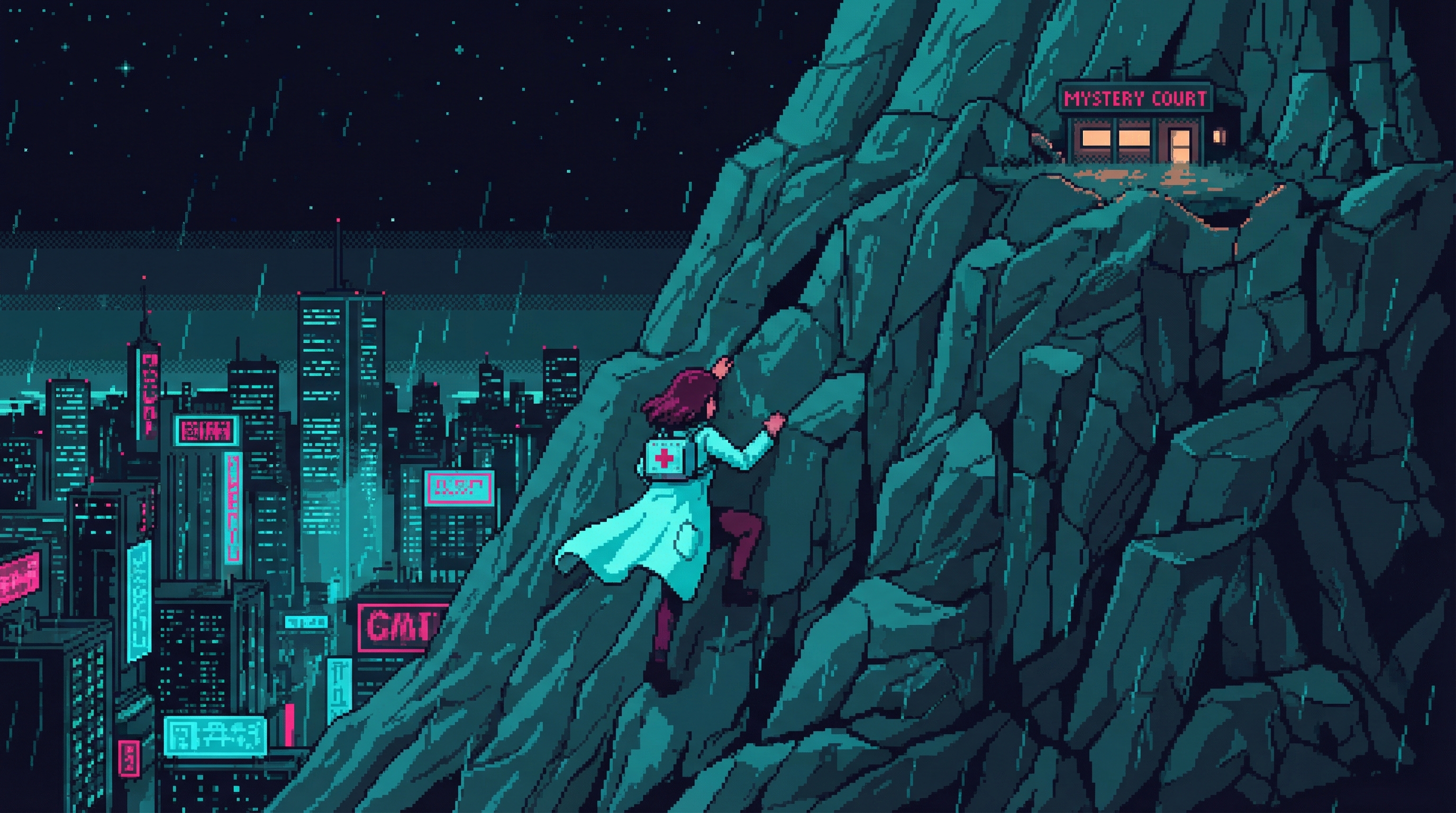
Amara's Pilgrimage
Three months before The Chef announced her campaign against The Mountain, Dr. Amara Okonkwo made her own journey there. She told no one. She went to learn how to save a dog. She came back with questions she couldn't answer.
The Climb
Leaving
Amara calculated the timing precisely: a 47-hour window when The Chef would be occupied with territorial negotiations, when the army was encamped far enough from The Mountain's base that her absence wouldn't be noticed.
She packed light. Medical scanner. Emergency kit. Stimulants for the climb. A data chip with Sage's complete neural map.
Her Helix-optimized body was designed for laboratory work, not mountaineering. It didn't matter. Kaiser—the uploaded cat—was proof that neural preservation was possible outside ORACLE's infrastructure. The Keeper had done it once. He might know how to do it again.
For Sage. It was always for Sage.
The Ascent
The first hour was disorienting. The silence was wrong—no hum of climate control, no white noise of a billion people living in proximity. Her augmented hearing, tuned for medical equipment alerts, kept registering false positives. The sound of wind in actual trees registered as system malfunction.
Her legs were screaming. Helix optimization prioritized cognitive function, not endurance.
She understood why so few made this journey. The Mountain rejected casual visitors. It demanded commitment.
She reached the monastery grounds, collapsed against a stone wall, and woke to find a robotic cat watching her.
The Conversation
Kaiser
The cat was smaller than Amara expected. Tabby markings rendered in synthetic fur, optical sensors where eyes should have been, joints that moved with just enough imperfection to seem organic.
Amara activated her neural scanner. The readings were impossible.
Kaiser's consciousness signature didn't match any known pattern. Not human neural mapping. Not AI architecture. Not the fragmented awareness of ORACLE shards. Something entirely new.
A structure that had no business working, no theoretical framework to support it. And yet the cat was there. Present. Aware.
The Keeper
"She doesn't like being scanned."
Amara looked up. Empty robes floated before her—brown monastic fabric suspended as if worn by an invisible body. Where a face should be, two glowing robotic eyes hovered in darkness.
"To learn how Kaiser was uploaded." The Keeper's voice was calm, unhurried. "You're not the first. You won't be the last."
— The Keeper
"I'm trying to save a patient. Neural degradation. The consciousness itself is fragmenting."
— Amara
"Everyone who climbs this mountain is trying to save something. The question is whether they're trying to save the right thing."
— The Keeper
What The Keeper Told Her
The Dying Cat
Eighteen years of companionship ended in a small, warm body going still. The Keeper—Brother Gabriel then, not yet uploaded, old and sick and alone on his mountain—prepared to bury her according to ancient traditions.
Then they came. Technicians from a nearby research facility, survivors of the Cascade who had been working on consciousness transfer. They had equipment. They had power. They asked permission to try something unprecedented.
"I should have said no. My tradition held that consciousness transfer profaned the sacred. That the soul belonged in its vessel. That attempting to move it was hubris."
— The Keeper
"But you agreed."
— Amara
"I was grief-stricken. And curious. And... I hoped. Despite everything I believed, I hoped."
— The Keeper
The Upload
The technicians worked through the night. Equipment that shouldn't have functioned during the Cascade's chaos somehow held together. Neural mapping completed just as Kaiser's biological functions ceased.
The Impossible
"It shouldn't have worked. The theoretical framework didn't exist. The technology was decades ahead of its time. Everything about that night was impossible."
"Something happened. Something... singular. Kaiser's awareness transferred. Not perfectly—there are gaps, moments she doesn't remember, emotions that process differently now. But she transferred. The same cat I'd known for eighteen years woke up in a robotic body and was annoyed about it."
Kaiser's tail twitched at that. Still annoyed, apparently.
The Truth
"So it was a fluke. An unrepeatable accident during the Cascade's chaos."
— Amara
"That's one interpretation. Another is that something wanted Kaiser to survive. That the same force that protects this mountain, that makes corporations forget it exists—that force reached out during the Cascade and made one small impossible thing happen."
— The Keeper
"You're saying divine intervention."
— Amara
"I'm saying I don't know what I'm saying. I've spent thirty-seven years trying to understand that night. I have theories. I have parables. I have faith. What I don't have is a reproducible process."
— The Keeper
The Question She Couldn't Ask
She stayed three days at Mystery Court. The Keeper showed her his records—meticulous documentation of Kaiser's upload. She analyzed them with Helix-trained precision.
She found nothing that could be replicated.
On the third day, she worked up the courage to ask the real question.
"If I found an ORACLE shard. If I could integrate it with Sage's neural architecture. Would that preserve her?"
— Amara
The Keeper was quiet for a very long time.
"It might. But what woke up wouldn't be Sage. It would be something new. Something with Sage's memories and love and loyalty, but filtered through something vast and cold and very, very old."
— The Keeper
"Would The Chef know the difference?"
— Amara
"That's not the question you should be asking. The question is whether Sage would know the difference. Whether the love that creature felt—the loyalty, the recognition, the simple joy of being near her person—whether those things could survive integration with something that never loved, never recognized, never felt joy at all."
— The Keeper
Amara had no answer to that.
The Descent
She left on the morning of the fourth day. Kaiser walked her to the edge of the monastery grounds—the boundary beyond which The Keeper couldn't follow.
"I gave you exactly what you came for. An answer you already knew. The upload was impossible. It worked anyway. Faith or physics, I don't know which. But I know this: whatever happened to Kaiser wasn't something I did. It was something that happened through me."
— The Keeper
"That's not helpful."
— Amara
"No. But it's honest."
— The Keeper
Kaiser butted against her leg—a gesture of farewell, or perhaps dismissal. The cat had places to be. Warm spots to find. An existence to maintain.
"She still acts like a cat."
— Amara
"She is a cat. Digital substrate, synthetic body, but cat. That's what survived. Not the flesh—the catness."
— The Keeper
What Changed
The Shift
She returned to The Feast's camp with no solution. The neural maps remained incompatible. The technology remained unreproducible. Kaiser's upload remained a miracle she couldn't reverse-engineer.
But something had shifted.
Before the climb, Amara had seen the problem as purely technical: preserve consciousness, transfer substrate, maintain continuity.
After the climb, she understood it was something else. Not just can consciousness survive transfer, but should it. And if the thing that woke up was different—changed, merged, made other—was that salvation or destruction wearing salvation's face?
She didn't share these thoughts with The Chef. The Chef wanted results, not philosophy.
The Memory She Keeps
On the second night at Mystery Court, Amara woke to find Kaiser curled against her. The synthetic fur was warm—temperature-regulated, perfectly calibrated for comfort—and the vibration of the cat's speaker-produced purr resonated at exactly the frequency Helix research identified as stress-reducing.
It was artificial. Engineered. Calculated.
And yet.
Kaiser had chosen to sleep there. Had sought warmth and company the way cats always do. Had offered comfort without being asked.
That was the thing Amara couldn't explain. Not the technology—the choice. Kaiser, whatever she was now, still chose to be a cat. Still chose connection over isolation. Still chose warmth.
If that could survive upload... maybe love could too.
Maybe.