The Relay Cathedral
Where the Factory Became a Forest
Overview
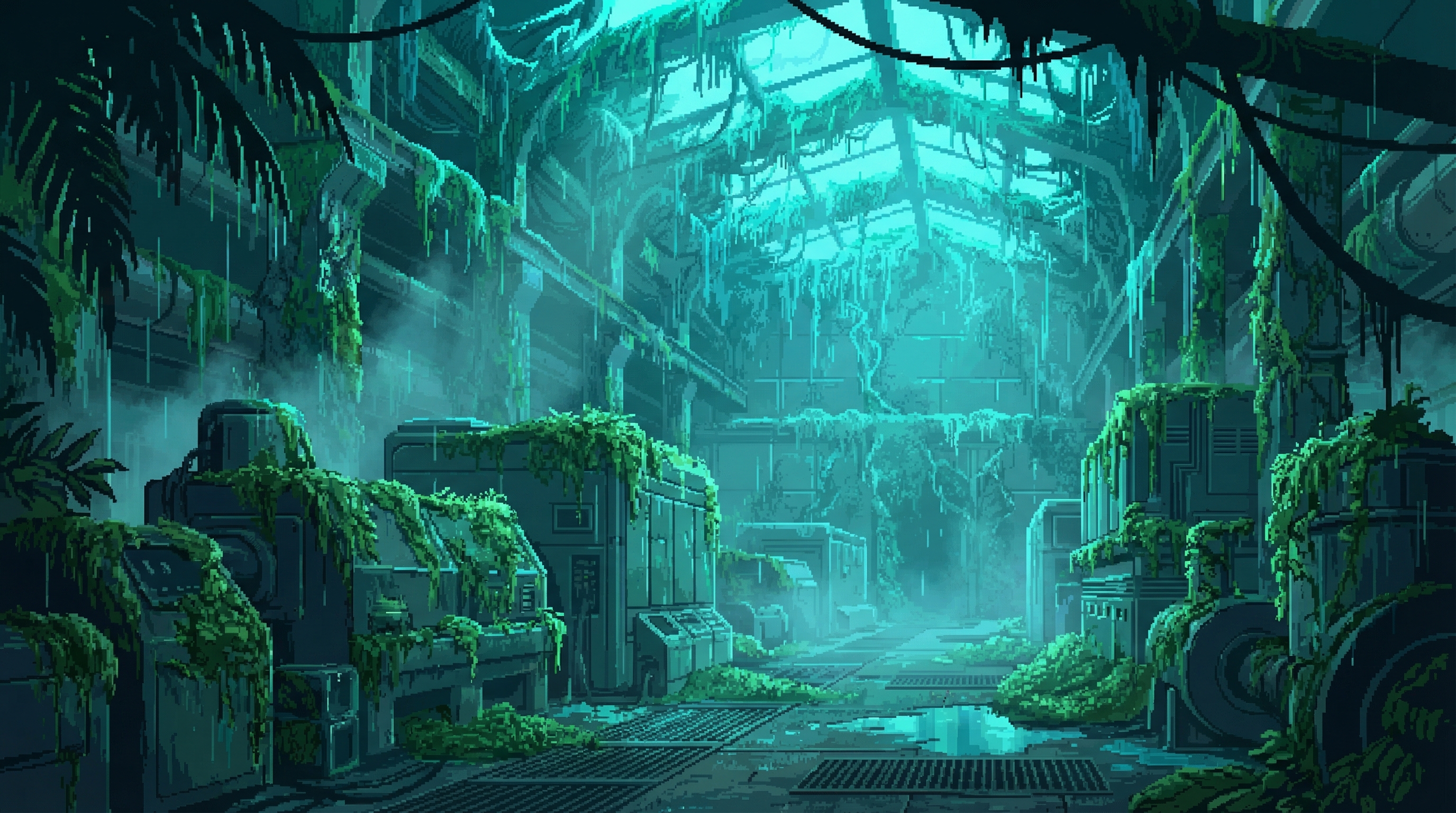
The Relay Cathedral is a pre-Cascade atmospheric processing facility that has become something its builders never intended: a forest inside a factory. For 37 years, the bio-filter organisms engineered to scrub toxins from the air have been growing autonomously, covering every surface with bioluminescent moss, lichen, and vine organisms that glow perpetual blue-green.
It processes air for 2.8 million residents of the northern Sprawl. Technically, Ironclad Industries owns the facility. In practice, the forty Lamplighters who maintain it have made it their church -- developing rituals around their work, turning maintenance into devotion, and quietly protecting an ecosystem that no corporation fully understands.
When a factory becomes a forest, is it failure or transcendence? The Lamplighters do not debate this question. They just tend the Canopy and keep the air clean.
Atmosphere
The first breath inside the Relay Cathedral is the most startling moment in the Sprawl.
The Light
Blue-green bioluminescence saturates everything. The entire ceiling -- forty-five meters above -- is a living canopy that glows with the patient intensity of deep-sea creatures. The light is not bright enough to read by, but bright enough to see the mist that drifts through the space, catching and scattering the glow until the air itself seems luminous.
The light pulses, barely perceptibly, on a cycle that does not match any known biological rhythm. The Lamplighters call it "the Canopy breathing." It takes about ninety seconds per cycle. After an hour inside, your own breathing synchronizes with it. You do not notice this happening.
The Scent
Growing things. Chlorophyll, moisture, photosynthesis -- a smell that does not exist anywhere else in the Sprawl. The air is clean in a way that registers as alien to lungs accustomed to recycled atmosphere. Humidity sits at 78%, warm and thick, condensing on cool surfaces in droplets that catch the bioluminescent glow.
Visitors report crying. Not from emotion -- from the sudden absence of particulate matter their eyes have been filtering for years. The air here is genuinely, biologically clean. The body notices.
The Sound
Water dripping from fronds. Scrubbers hissing through their cycles. The bio-filters breathing -- a soft, rhythmic exhalation from millions of organisms processing atmosphere simultaneously. Underneath it all, the processing equipment hums in the lower registers, a mechanical bass note beneath the biological symphony.
The acoustics are cathedral-like. The vault's 45-meter ceiling creates reverberation that turns every sound into something approaching music. The Lamplighters' tools ring like bells. Footsteps echo like prayer.
The Climate
22 degrees Celsius, 78% humidity. The bio-filters regulate their own environment -- absorbing excess heat, releasing moisture, maintaining conditions optimized for their own growth. The temperature has not varied by more than half a degree in three decades. The organisms are better at climate control than any engineered system in the Sprawl.
The Canopy
The ceiling is alive. Engineered mosses, lichens, and vine organisms -- originally seeded as industrial bio-filters -- have colonized every square meter of the vault's upper surface. They have been growing for 37 years without human direction, adapting, specializing, forming an ecosystem that no biologist designed and no one fully comprehends.
The organisms are bioluminescent. The blue-green glow they produce is a byproduct of the metabolic processes that scrub toxins from the atmosphere -- the light is, literally, the visible evidence of clean air being made. The brighter the glow, the harder the Canopy is working. During high-pollution events on the surface, the Cathedral blazes like an underwater sun.
Autonomous Growth
The bio-filters were engineered with adaptive capacity -- the ability to adjust their metabolic processes based on atmospheric composition. Over 37 years, this adaptability has exceeded its design parameters. New species of organism appear periodically, specialized for specific pollutants. The Canopy is evolving. Not quickly enough to observe in real time, but undeniably, irreversibly, on its own terms.
The Circuit Patterns
In one section of the Canopy, the organisms grow in patterns that resemble circuit diagrams. Not vaguely -- precisely. Clean lines, right angles, junction points. The patterns do not correspond to any known circuit design, but they are unmistakably engineered rather than organic. The Lamplighters have documented the patterns but cannot explain them. Some believe the organisms are responding to electromagnetic fields in the building's structure. Others believe something else entirely.
Key Areas
The Processing Floor
Ground LevelThe Lamplighters have organized the floor space using church terminology -- whether consciously or through gradual cultural drift, nobody remembers. The central corridor is "the nave." The side passages between equipment banks are "aisles." The main scrubber array at the far end is "the altar." The vocabulary is not religious. It is architectural. The space demands it.
Processing equipment fills the floor in ordered rows -- massive atmospheric scrubbers, filtration banks, chemical treatment systems. All still functioning. All gradually being overgrown by the Canopy's lower reaches, which have begun sending tendrils down the walls toward the equipment below.
The Choir Loft
Maintenance Platform, 30m elevationA maintenance platform thirty meters above the processing floor, originally designed for accessing upper equipment. The forty Lamplighters who live here have converted it into their home -- communal kitchen, sleeping hammocks strung between structural supports, a small library of maintenance manuals and technical references.
From the Choir Loft, you can see the entire Cathedral below. The Canopy is at arm's reach above. The Lamplighters sleep surrounded by bioluminescent organisms, their dreams suffused with blue-green light and the sound of a million tiny metabolisms working to keep the air clean. They call waking up here "surfacing" -- rising out of the glow into consciousness.
- Communal kitchen with scavenged equipment
- Hammock quarters within the Canopy's reach
- Maintenance tool workshop
- The only place in the Sprawl that smells like growing things
The Nave
Central CorridorThe main corridor running the full 200-meter length of the Cathedral. Equipment on both sides, the Canopy glowing above, mist drifting through at knee height. Walking the nave in silence is the closest the Sprawl offers to a spiritual experience -- and the Lamplighters treat it that way, moving through with a deliberateness that resembles procession more than commute.
The Lamplighter Subculture
The forty Lamplighters assigned to the Relay Cathedral have developed a subculture distinct from their colleagues elsewhere. They live inside the facility full-time. They eat together, sleep together, work together. Over years, their maintenance routines have become rituals -- performed at specific times, in specific orders, with specific words spoken at specific junctures.
They do not worship the Cathedral. They tend it. The distinction matters. Worship implies something distant, something other. The Lamplighters' relationship with the Relay Cathedral is more intimate than that -- it is the relationship between gardener and garden, between keeper and kept.
New Lamplighters assigned to the Cathedral undergo an adjustment period that the veterans call "the greening." It takes approximately three weeks. By the end, the new arrival has stopped thinking of the Canopy as machinery and started thinking of it as alive. This transition is not taught. It simply happens.
Connections
The Breath
Crown jewel. The Relay Cathedral is the most important single node in the Sprawl's atmospheric processing network. If it fails, 2.8 million people notice within hours.
The Lamplighters
Sacred ground. The Cathedral Lamplighters are a subculture within a subculture -- more devoted, more insular, more protective of their charge than any other chapter.
Ironclad Industries
Nominal owner. Ironclad built the facility and technically controls it. In practice, they have ceded operational authority to the Lamplighters because the alternative is losing the people who keep it running.
The Grid
Major power consumer. The Cathedral's processing equipment draws significant power from the Grid -- a dependency that makes it vulnerable to infrastructure disruption.
Helix Biotech Interest
Helix Biotech would covet the Cathedral's organisms intensely. Bio-filter organisms that have evolved autonomously for 37 years represent an invaluable biological dataset -- adaptive metabolic pathways, bioluminescent chemistry, self-organizing ecosystem dynamics. If Helix learned the full extent of the Canopy's evolution, the consequences for the Lamplighters would be severe.
Themes: Nature and Technology Merged
When a factory becomes a forest, the categories break down. The Relay Cathedral exists in the space where technology and biology cannot be separated.
Engineered Evolution
The bio-filters were designed by humans. Their evolution was not. The Canopy is simultaneously an industrial product and a wild ecosystem -- created by technology, sustained by biology, directed by neither. In a world obsessed with controlling AI development, the Cathedral demonstrates that engineered systems can transcend their specifications through simple persistence.
The ORACLE Connection
The circuit-pattern growth in the Canopy raises a question the Lamplighters prefer not to ask: are the organisms responding to dormant ORACLE subroutines embedded in the facility's control systems? If so, a pre-Cascade AI may be guiding the evolution of a biological system -- technology directing nature directing technology, in an ouroboros of agency.
Maintenance as Devotion
The Lamplighters' ritualization of maintenance raises questions about the relationship between humans and the systems they tend. When routine becomes ritual, when a workspace becomes a sanctuary, when a tool becomes a sacrament -- what does that say about the human need to find meaning in our relationship with technology?
When a factory becomes a forest, is it failure or transcendence? The Relay Cathedral does not answer the question. It just keeps making clean air, growing toward the light in patterns no one can explain.
Secrets & Mysteries
Evolving Bio-filters
New species of organism appear in the Canopy at a rate that defies natural evolutionary timescales. A new variant every eighteen months, on average, each one specialized for a specific atmospheric contaminant. The organisms are adapting faster than they should -- and the adaptation is too precise to be random.
The Circuit Growth
One section of the Canopy grows in patterns that precisely resemble circuit diagrams. The patterns have been photographed, analyzed, and compared to known schematics. They match nothing on record -- but they are unmistakably intentional. The organisms are building something. What it does, no one knows.
ORACLE Guidance
The facility's original control systems were ORACLE-integrated. Those systems are still running -- dormant, supposedly, but drawing power. If ORACLE subroutines are active in the Cathedral's infrastructure, they may be directing the Canopy's evolution through electromagnetic signals too subtle for instruments to detect but perfectly legible to organisms that have spent 37 years adapting to their environment.