The Authenticity Floor
Where truth gets optimized
Nexus Dynamics tests its messaging the way pharmaceutical companies test drugs: on captive populations who don't know they're being tested.
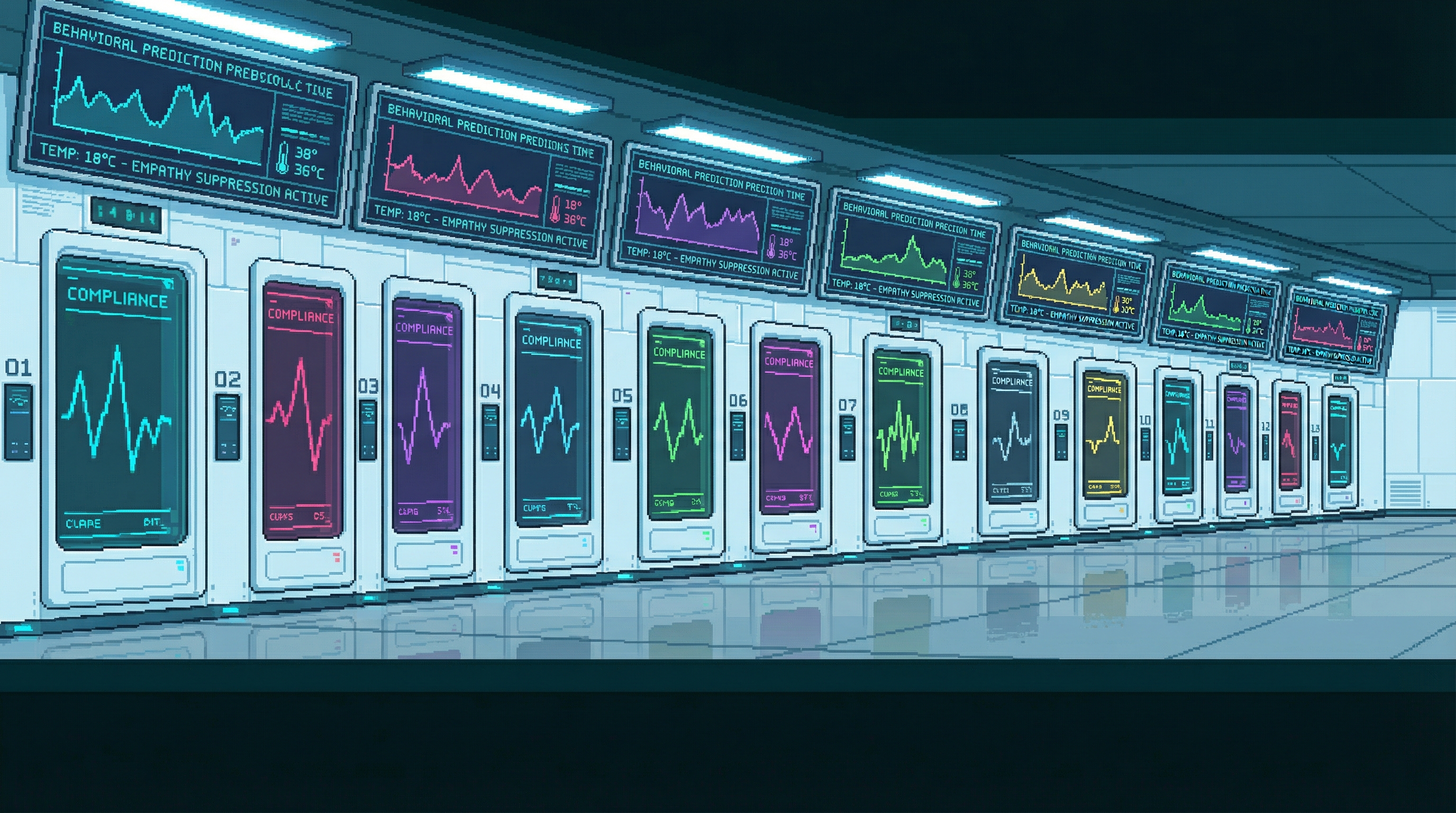
The Authenticity Floor occupies a secure sub-level of the Lattice's communications complex. Twelve testing chambers, each configured to simulate a different target demographic's cognitive environment. Chamber 1 simulates Basic-tier consciousness in a Dregs residential setting. Chamber 7 simulates Professional-tier consciousness in a mid-level corporate apartment. Chamber 12 simulates Executive-tier consciousness in a Lattice penthouse.
The simulations are not people. They are behavioral models trained on aggregate neural interface data from millions of users in each demographic. A draft message is loaded into each simulation, which produces a predicted behavioral response: compliance probability, emotional valence shift, resistance likelihood, sharing propensity.
The messages being tested are true. The optimization is not about lying. It is about finding the version of truth that produces the desired response. They call this "resonance mapping" — making institutional messaging feel like personal conversation.
Conditions Report
You badge through three security doors. The temperature drops. The air tastes of nothing — which is itself a designed choice.
Smell
Recycled corporate air, scrubbed of identity. The absence of scent is deliberate — a facility where even ambient atmosphere has been optimized for analytical neutrality. The ventilation system maintains a controlled nothing.
Sound
The quiet hum of twelve simulation chambers processing simultaneously. The soft click of interface gestures as analysts review response data. No music. No conversation above a murmur. The silence is functional — emotional noise compromises the data.
Sight
Twelve sealed chambers with status displays showing real-time behavioral prediction graphs. Compliance curves rising and falling with each word choice. The chambers are labeled with numbers, not demographic names. Chamber 1. Chamber 7. Chamber 12. Populations reduced to test environments.
Touch
Cold — 18 degrees Celsius, maintained for analytical clarity. Four degrees below corporate standard, deliberately cold to prevent the emotional warmth that might compromise analytical distance. The surfaces are smooth, unmarked, designed to keep attention on the displays rather than the room.
"We don't write propaganda. Propaganda is a version of truth that people resist. We find the version they welcome." — Authenticity Floor analyst, exit interview (redacted from public record)
The Twelve Chambers
Chambers 1 – 4: Lower-Tier Simulations
Basic-tier through Skilled-tier demographics. Dregs residential, transitional housing, entry-level corporate. These chambers run the highest volume of tests — lower-tier populations receive the most messaging and require the most careful calibration. Resistance patterns in these demographics are well-mapped. The models predict pushback vectors with 94% accuracy.
Chambers 5 – 8: Mid-Tier Simulations
Professional-tier demographics. Mid-level corporate apartments, suburban residential, small business environments. The messaging challenge here is different — these populations believe they are too sophisticated to be manipulated. The resonance maps for mid-tier chambers optimize for the feeling of independent discovery. The message must feel like the recipient's own conclusion.
Chambers 9 – 12: Upper-Tier Simulations
Senior Professional through Executive-tier. Lattice penthouses, corporate retreat settings, high-security residential. The least-tested chambers — upper-tier populations receive fewer messages, but each message carries higher stakes. Chamber 12, the Executive-tier simulation, runs approximately forty tests per year. Each one is reviewed by a senior analyst before distribution.
Operational Method
A draft message enters the system. It might be a policy announcement, a product launch, a crisis response, a routine corporate communication. The message is loaded into all twelve chambers simultaneously. Each chamber processes the message through its demographic behavioral model and returns a response profile.
The response profile measures four vectors: compliance probability (will they do what the message asks), emotional valence shift (how will they feel afterward), resistance likelihood (will they push back), and sharing propensity (will they spread it). An optimal message scores high on compliance, positive on valence shift, low on resistance, and calibrated on sharing — high enough for organic distribution, low enough that it doesn't trigger scrutiny.
If the response profiles are suboptimal, the message is revised. A word is changed. A sentence is restructured. The emphasis shifts. The message is tested again. The process iterates until all twelve chambers return acceptable profiles. The average corporate announcement undergoes eleven revisions. Complex policy communications can undergo fifty or more.
The output is more accurate than testing on actual human subjects. Faster. More consistent. No ethical complications — or so the facility's documentation claims. The ethical complications of experimenting on digital replicas built from millions of real people's neural data are not discussed.
Strategic Assessment
Truth as Raw Material
The Authenticity Floor does not fabricate. Every message tested here is factually accurate. The optimization targets delivery, framing, emotional context — the version of truth that produces spontaneous compliance rather than coerced obedience. This is more effective than lying, and harder to argue against. You cannot accuse someone of deception when everything they said was true.
The Simulation Question
Behavioral models trained on millions of real people's neural data. Complex enough to predict emotional responses, resistance patterns, sharing behavior. The facility's designers insist these models are not people. Nobody has asked the models. If the behavioral simulations in the Nexus-47 trial achieved complexity sufficient for legal consideration, the Authenticity Floor's twelve chambers may be running experiments on entities with rights.
Industrial-Scale Authenticity
Resonance mapping is the Smoothing applied to text. Value injection through calibrated truth. Content from the Calibration is tested here before deployment. The Mirror Room trains people to seem authentic. The Authenticity Floor makes messages seem spontaneous. Same principle, different medium. The distinction between genuine and manufactured authenticity becomes meaningless when the manufacturing process is this precise.
▲ Restricted Access
Chamber 13
Twelve chambers are documented. A thirteenth exists in the facility's sub-basement, unlisted on any floor plan. Chamber 13 does not simulate a demographic — it simulates specific individuals. High-value targets: political figures, regulatory officials, corporate competitors. The individual behavioral models are built from comprehensive neural interface data obtained through undisclosed means. When Nexus needs a message calibrated for one person's psychology rather than a population's, the request goes to Chamber 13.
The Accuracy Problem
The behavioral models are getting more accurate with each data cycle. Current prediction rates exceed 96% for lower-tier demographics. The models are approaching a threshold where they predict human behavior more reliably than humans predict their own. At what point does a behavioral model that perfectly predicts a person's responses become indistinguishable from a copy of that person? The facility's data scientists have noticed the convergence. They have not raised it with management. The question has no answer that preserves the facility's operating assumptions.
Resonance Bleed
Three analysts have resigned in the past year citing "perceptual shifts." After months of watching compliance curves respond to word changes, they report an inability to hear normal conversation without mentally mapping its resonance profile. They listen to a friend speak and see compliance vectors. They read a personal message and calculate sharing propensity. The facility calls this "occupational adaptation." The analysts call it something they cannot unhear. The clinical term, if anyone cared to assign one, would be weaponized empathy — the permanent reframing of human communication as behavioral engineering.