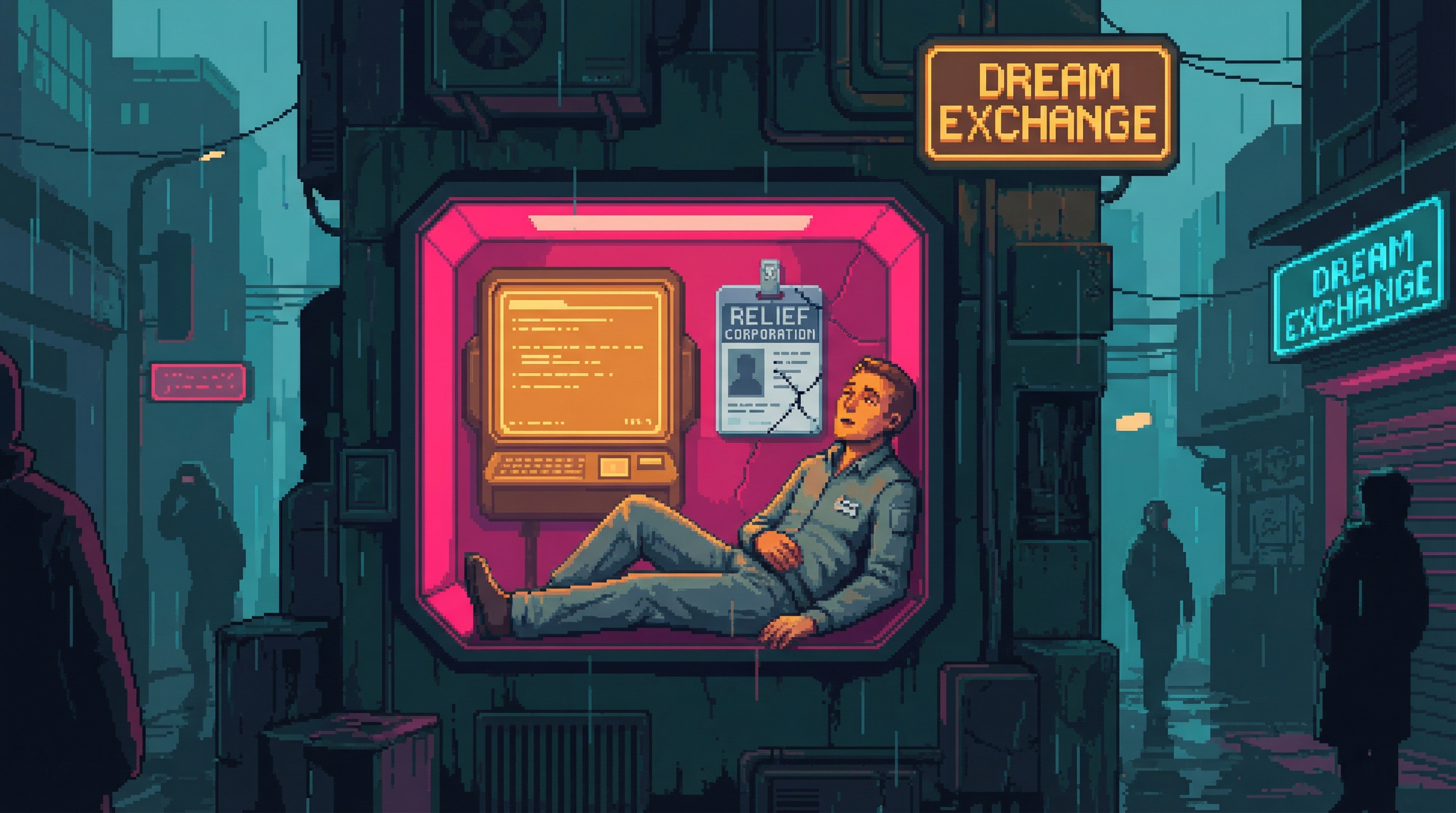
Sol Varga
Corporate Defector · Dream Addict · Sector 4D
Overview
Sol Varga used to direct entertainment content for Relief Corporation. Now he lies in a dream parlor in the Dregs, experiencing someone else’s unconscious four hours a day, and he can’t explain why the synthetic dreams he used to manufacture feel like cardboard compared to the real thing.
He was the architect of the Somnolence entertainment line. The product was technically superior to harvested dreams — more consistent, more vivid, more narratively coherent. It was also, by every audience metric, a failure. Eighty percent first-session return, dropping to twelve percent by the fifth session. Exit surveys universally cited “feels flat” and “something’s missing.” Audiences could detect the synthetic quality even when they couldn’t name it.
A colleague gave Sol a harvested dream. What he experienced was the first genuine surprise he’d felt in three years. The dream was poorly structured. The imagery was inconsistent. The emotional throughline was messy. It was, by every metric Sol had spent his career optimizing for, a bad dream. And it was the most real thing he’d ever experienced.
He quit Relief. He moved to the Dregs. His former colleagues consider him a cautionary tale about market failure. Sol considers them a cautionary tale about mistaking a map for the territory.
Voice & Personality
Sol speaks with the weary eloquence of a man who built a cathedral to synthetic experience and discovered it was a painted backdrop. His language still carries the precision of corporate entertainment design — he can describe the architecture of a dream in technical terms that would fill a product specification. But the precision now serves a different purpose: articulating exactly what’s wrong with the world he helped build.
Technical Fluency
He can describe dream architecture in product-specification detail — framerate of emotional engagement, latency of surprise response, coherence metrics. He knows the vocabulary of synthetic experience better than anyone because he wrote it.
The Expert Critic
Sol knows more about why synthetic dreams fail than anyone alive, because he designed them. His expertise in the fake makes him the Sprawl’s best judge of the real.
Philosophical Addict
He’s not addicted to pleasure. He’s addicted to surprise. The distinction matters — synthetic dreams can deliver pleasure, comfort, narrative satisfaction. What they cannot deliver is the experience of encountering something the dreamer didn’t expect.
Corporate Ghost
Faded corporate clothing in a Dream Exchange alcove. The contrast between who he was and where he is — a man whose professional wardrobe is the only thing that hasn’t changed since he walked away from Relief.
Connections
Relief Corporation
Former employer. Sol designed the Somnolence entertainment line — Relief’s synthetic dream product that audiences consistently rejected. Eighty percent first-session return collapsing to twelve percent by session five. He knows what’s wrong with their product because he built it.
The Somnolence Parlors
Sol architected the product that seventy-three percent of customers supplement with black-market harvested dreams. The parlors are the monument to his failure — or his success, depending on how you measure it.
The Dream Exchange
Regular customer. Sol spends sixty percent of his income on harvested dreams. The Exchange is where his expertise in synthetic experience gets daily proof of its own limitations.
Fen Morrow
Frequently purchases her premium-tier dream recordings. Sol considers Fen’s dreams the most real thing he’s experienced — the architectural quality and emotional depth that his Somnolence line could never replicate.
Tensions
The Uncanny Valley of Consciousness
Synthetic dreams are technically competent but missing something the buyers can identify and not describe. Somnolence feeds were more consistent, more vivid, more narratively coherent — and audiences rejected them. The “floor” of genuine experience is invisible until it’s absent, and no amount of optimization can replace what it provides.
The Architect Becomes the Critic
Sol designed the most technically sophisticated synthetic dream product ever built. That expertise now serves a single purpose: explaining, in precise technical language, exactly why it doesn’t work. The person best qualified to judge the real is the person who spent a career perfecting the fake.
Addiction as Philosophical Position
Sol isn’t addicted to pleasure — he’s addicted to surprise. Synthetic dreams can deliver comfort, satisfaction, narrative coherence. What they cannot deliver is the experience of encountering something the system didn’t generate for you. The distinction between pleasure-seeking and authenticity-seeking is the distinction between consuming and living.