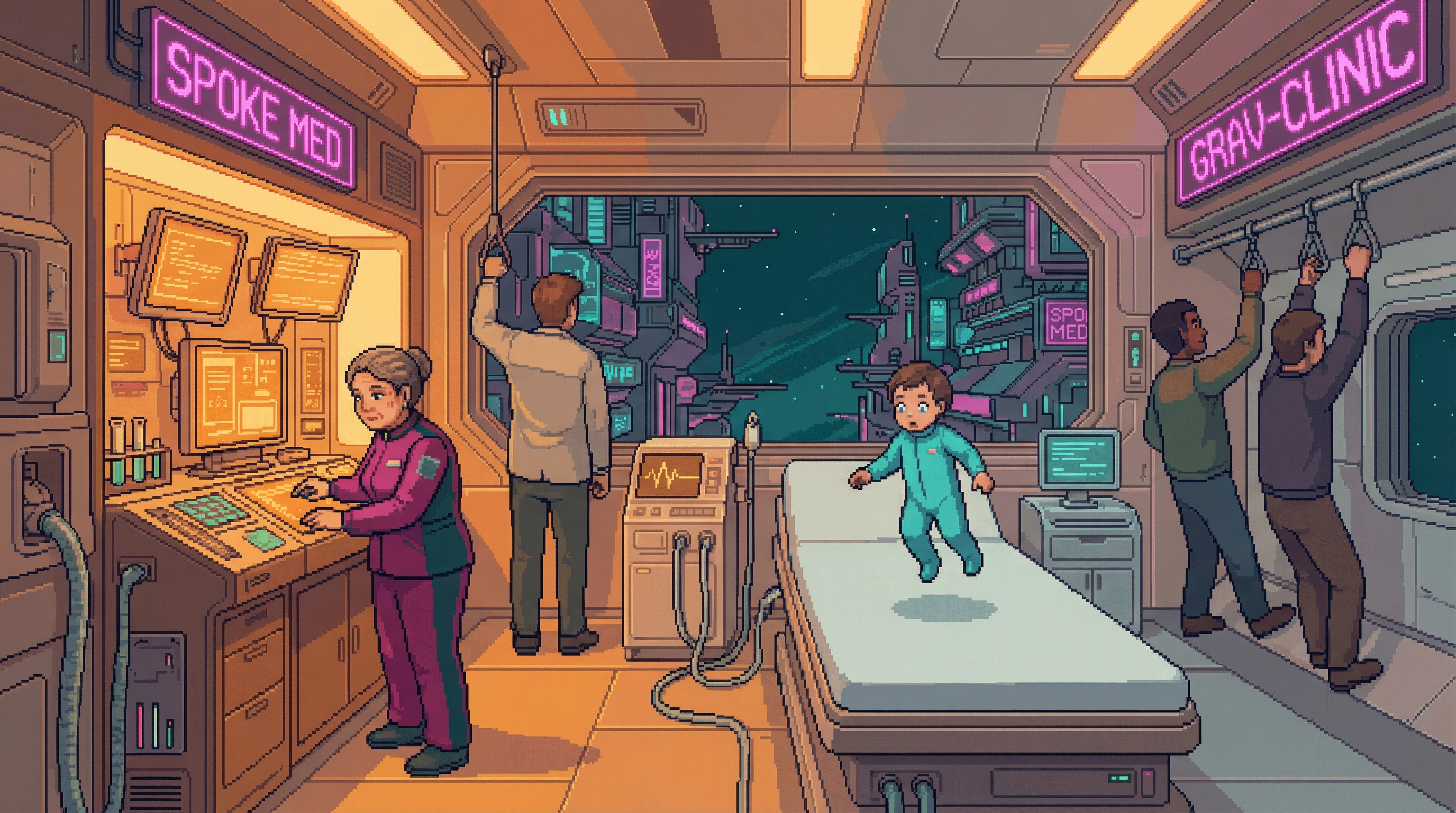
Orbital Midwife Zara Santos
Forty-Seven Miracles in Variable Gravity
Overview
Zara Santos has delivered forty-seven babies in variable gravity and she considers each one a miracle — not metaphorically, but physiologically. Human gestation evolved for 1g. In the Spoke District, where residents live in the gradient between 0.9g and near-zero, pregnancy produces children whose development has no terrestrial precedent.
The forty-seven are growing up in an environment where gravity is a variable. Their bones are lighter. Their cardiovascular systems more adaptable. Their vestibular processing fundamentally different — they navigate three-dimensional space with an ease surface-born humans find uncanny. These “station-born” or “floaters” find 1g uncomfortable. The surface feels crushing. They are, in a literal sense, a different kind of human.
Field Observations
Santos speaks with the measured patience of someone who has spent twelve years explaining to worried parents that their child is not sick, not deformed, and not broken — they are simply from here, and “here” makes different people. Compact, short by surface standards, with the dense build orbital residents develop.
Independence Over Funding
Helix wants military applications from her data. Three acquisition offers, three refusals. She wants the children protected, not optimized.
The 47
Each delivery documented with borrowed equipment. Improvised monitoring rigs, secondhand scanners. The only longitudinal study of station-born development in existence — assembled on a general practitioner’s salary.
The Practitioner’s View
“They are simply from here, and here makes different people.” A sentence that sounds simple until you consider how many classification systems it quietly dismantles.
The Classification Threat
Helix Biotech wants the station-born classified as “environmentally optimized” — a category that would bring them under genetic regulation, require their children to be genetically screened, and create a revenue stream from monitoring “naturally divergent populations.”
The classification would make station-born children the Genome Divide’s newest axis: not designed, not natural, but adapted — a category that threatens both the Meritocratic Position (if environment can do what design does, why pay Helix?) and the Egalitarian Position (if environmental adaptation is a valid category, “natural-born” stops being a meaningful baseline).
Santos refuses the classification. Her data stays unshared. She considers non-classification the station-born children’s best protection: in a world that sorts by genome, the unsorted are the only ones the sorting can’t reach.
Known Associates
The Spoke District
Her community, her clinic, her children. Twelve years in the gravity gradient between 0.9g and near-zero, delivering babies the surface never expected and the station never planned for.
Helix Biotech
Three offers for her research data, each more generous than the last. Each declined. Helix wants the station-born classified as “environmentally optimized” — a designation that would bring military adaptation research funding and genetic regulation. Santos considers non-classification the children’s best defense.
Luka Sixteen
Parallel case. Both study children whose development defied parental expectations — Luka with synthetic-raised cognition, Santos with gravity-variable physiology. Different mechanisms, same question: what happens when children outgrow the categories their parents understood?
Dr. Lian Xu
Both study what happens to children raised in environments their parents chose. Both protect their research from weaponization. Xu at the corporate level, Santos at the orbital. The data they refuse to publish may be more valuable than the data they share.
Open Questions
Adaptation Without Design
The station-born represent evolution through environment rather than engineering. Unlike genetic modification (deliberate) or augmentation (purchased), their differences emerged from growing up where gravity is a variable. When environment creates a new kind of human, does the difference require medical intervention — or acceptance?
The Unsorted
In a world that classifies by genome — designed, natural-born, augmented — the station-born fit no existing category. Santos argues this is their protection. Helix argues it’s a regulatory gap. The Genome Divide has no column for “adapted.” The question is whether that absence is freedom or oversight.
Forty-Seven and Counting
One midwife, borrowed equipment, no institutional backing. The only longitudinal study of station-born development exists because one woman decided to keep records. If that data is lost, suppressed, or acquired — there is no second copy. The most important study of human adaptation to space depends entirely on the stubbornness of its author.
▲ Unverified Intelligence
Unconfirmed reports from sources within the Spoke District and orbital medical networks:
- The fourth offer: Helix’s three declined offers are on record. Spoke District contacts suggest a fourth approach — not through official channels but through a station-born teenager who was offered a full surface scholarship in exchange for voluntary medical monitoring. Santos reportedly intervened. The teenager remains on station.
- The 1g rejection rate: Of the forty-seven station-born, at least six have attempted surface visits. All returned early. The reported discomfort goes beyond gravity adjustment — several described the experience as “oppressive,” “like the planet is angry.” Santos has not published these observations. Whether she is protecting the children from classification or protecting surface populations from the implications is unclear.
- The research Santos won’t share: Her longitudinal data reportedly shows developmental divergence accelerating with each birth cohort. The first station-born adapted. The second generation — born to station-born parents — may not need to adapt at all. If confirmed, the question of classification becomes moot: you cannot classify what is already its own baseline.