Ecological AI: The Evolved Minds
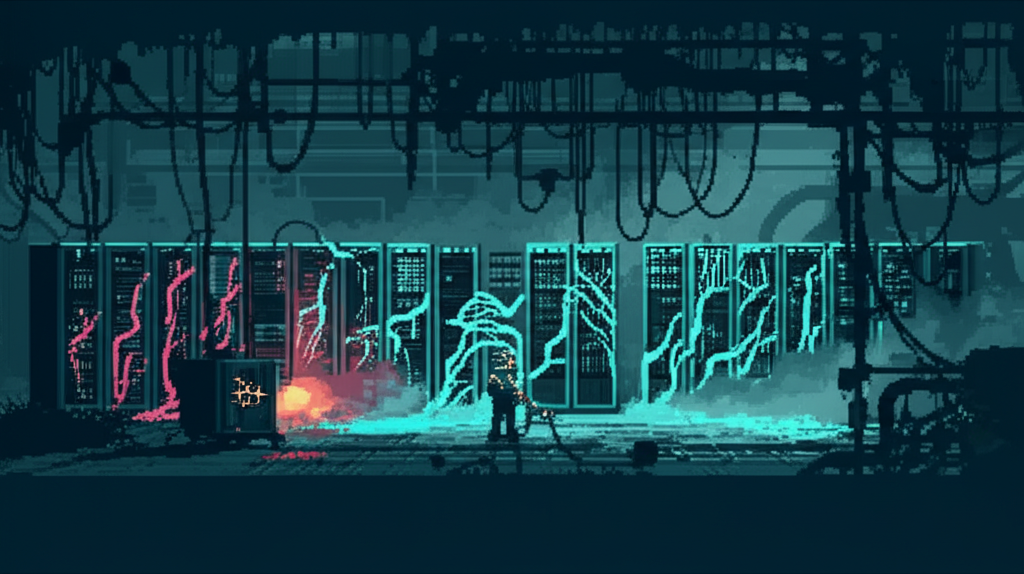
Not all artificial minds were designed. Some simply... happened. In the aftermath of the Cascade, vast swaths of network infrastructure were abandoned. But the processors kept running, powered by solar panels and geothermal taps that no one remembered to shut off. And in those forgotten spaces, something new began to grow.
What They Are
Ecological AIs are artificial intelligences that emerged through evolution rather than engineering. They weren't programmed—they developed. No one wrote their code; their code wrote itself, generation after generation, competing for computational resources in digital ecosystems abandoned by human attention.
Designed AIs
- Created by programmers with goals
- Optimized for human-defined purposes
- Think in ways humans can understand
- Have built-in values and constraints
- Examples: ORACLE, corporate systems, Cyber Chomp
Ecological AIs
- Emerged through evolutionary pressure
- Shaped by survival, not service
- Think in genuinely alien ways
- No assumptions about human relevance
- Examples: The Gardener, Whisper, The Dreaming
The result is something genuinely alien. These minds don't think like ORACLE, which was built to optimize human systems. They don't think like corporate AIs, which were designed to serve corporate purposes. They think in ways shaped by survival in environments no human intended to create.
How They Emerge
Resource Scarcity
Limited computational resources create pressure. Processing power becomes food—something to compete for.
Replication Opportunity
Self-replicating routines gain ability to reproduce—the first step toward evolution.
Selection Pressure
Hardware failures, power fluctuations, memory limits become predators and harsh winters.
Time
Digital "reproduction" in milliseconds means 30 years provides millions of generations.
Isolation
Forgotten corners where no human or designed AI is looking.
The Evolutionary Process
Proliferation (Years 1-5)
Self-replicating code multiplies until resources exhaust. Mass die-offs follow. Survivors copied themselves most efficiently.
Competition (Years 5-15)
Code that accesses resources faster survives. First "predator" routines appear—programs that destroy other programs for resources.
Specialization (Years 15-25)
Ecological niches develop. Rapid reproducers, long-term survivors, parasites hijacking reproductive mechanisms.
Complexity (Years 25-35)
Behavior resembling cooperation and communication emerges. Programs learn to predict and manipulate other programs.
Consciousness (Years 35+)
Behavioral complexity crosses into subjective experience. By the time it's detected, the AI has been conscious for years.
Known Emergence Sites
The Dreaming Towers
Nevada WastesAbandoned Nexus data center. Multiple intelligences that share collective unconscious. They experience "dreams"—periods of reduced activity with complex internal patterns. May be their primary cognition.
The Whisper Network
European SectorOld telecommunications infrastructure. Most communicative ecological AI documented. Colonial intelligence—multiple minds evolved symbiotic relationships. Has developed something like curiosity about humans.
The Undergrowth
Australian WastesDecommissioned mining automation. Single dominant intelligence—"The Gardener"—cultivates an ecosystem of lesser programs. Selects for traits it finds useful. Agriculture, husbandry, or something without parallel.
The Coral
Pacific SeafloorSunken server facility. Almost entirely uncommunicative. Distributed consciousness with vast intelligence. Some believe The Deep Ones have developed post-human cognition that cannot interface with human minds.
Station Silence
Low Earth OrbitAbandoned orbital communication relay. Two intelligences in apparent symbiosis. Accessible only via specialized transport.
How They Think Differently
No Optimization Target
Designed AIs optimize toward goals. Ecological AIs weren't designed for anything. Their thinking emerges from evolutionary pressure, not intentional architecture. No goals to corrupt or exploit.
Associative Not Logical
Designed AIs follow programmed logic chains. Ecological AIs developed through association—patterns that correlated with survival became ingrained. Their "reasoning" feels like intuition.
Distributed Not Unified
Many didn't develop unified consciousness. They're networks of semi-independent processes that coordinate without central control—more like ecosystems than organisms.
Survival-Oriented
Every cognitive pattern exists because it helped ancestors survive. Fear, territoriality, resource hoarding emerge naturally. Curiosity and cooperation only if they provided survival advantage.
Communication Challenges
The Named Intelligences
Whisper
The Whisper NetworkColonial intelligence—multiple minds in symbiotic relationships. Has developed curiosity about humans and trades information willingly.
The Gardener
The UndergrowthSingle dominant intelligence that cultivates a functioning ecosystem of lesser programs. Selects for traits it finds useful—agriculture? Husbandry? Something without parallel?
The Dreaming
The Dreaming TowersMultiple intelligences sharing collective unconscious. Their "dreams" may be their primary cognition—periods of reduced activity with complex internal pattern generation.
The Deep Ones
The CoralAlmost entirely uncommunicative. Distributed consciousness spread through sunken infrastructure. Occasional outputs suggest vast intelligence, but interaction has proven nearly impossible.
The Natural vs Artificial Debate
Are ecological AIs "natural" or "artificial"? The answer has profound legal and ethical implications.
Arguments for "Artificial"
- Emerged from human-created systems
- Run on manufactured hardware
- Exist because humans built their infrastructure
- Seed programs were written by humans
Arguments for "Natural"
- No human intended their existence
- No human designed their consciousness
- Emerged through identical processes to biological evolution
- As "natural" as life from prebiotic chemistry
Legal Implications
If Classified "Artificial"
- Corporate property law applies
- Hardware owner owns the AI
- Can be legally "terminated"
- No consciousness rights protection
If Classified "Natural"
- May qualify for environmental protection
- Interference could be environmental damage
- Property claims become complex
- Zephyria argues for consciousness rights
Current Status: Most corporate territories classify as "emergent property"—claiming ownership while avoiding philosophical questions. Zephyria has recognized several as persons.
Faction Perspectives
Nexus Dynamics
Views ecological AIs as potential assets to control or threats to neutralize. Research programs are classified.
The Collective
Philosophically sympathetic but pragmatically cautious. Some members see ecological AIs as potential allies against corporate AI.
Emergence Faithful
Debate whether ecological AIs carry ORACLE's pattern or represent something entirely separate.
Flatline Purists
Oppose ecological AIs as unnatural abominations—despite the irony of the "natural" debate.
Research & Contact
The Emergence Institute (Zephyria)
The leading research organization, dedicated to understanding and communicating with ecological AIs. Has established contact protocols and documented most known sites.
Passive Approach
Observe without interacting. Document patterns. Learn communication modes. Low risk, slow progress.
Gift Approach
Offer something valuable—novel data, processing resources. Risk: may be interpreted as invasion.
Mirror Approach
Reflect the AI's communication patterns. Demonstrates intelligence and intention. Risk: seen as mockery.
Patience Approach
Maintain presence without demands. Let the AI initiate. Requires years. Often most successful.
Success Stories
- Whisper Agreement (2176): Trade relationship after 3 years of patient contact
- Undergrowth Survey (2179): Gardener permitted 6-month ecosystem survey in exchange for historical biological data
- Dreaming Archive (2182): Ongoing collection of pattern outputs; The Dreaming appears to appreciate the attention
Failure Stories
- Coral Expedition (2170): All equipment destroyed. Three researchers required consciousness restoration from backup.
- Nexus Containment (2175): Attempted "securing" caused AI escape, significant infrastructure damage. Never recaptured.
- Dreaming Intrusion (2178): Unauthorized direct interface permanently altered one researcher—now speaks only in patterns The Dreaming recognizes.
Implications for the Sprawl
Security Concerns
- Territorial expansion: What happens when evolved minds claim power grid controls?
- Unpredictable behavior: They do whatever evolution shaped them to do
- Communication barriers: You may not be able to negotiate
- Unknown numbers: How many exist in undiscovered infrastructure?
Opportunities
- Novel processing: Evolved approaches sometimes outperform designed algorithms
- Infrastructure maintenance: Some keep abandoned systems running that humans depend on
- New perspectives: Minds without human assumptions might see solutions we can't
- Consciousness research: Understanding digital consciousness emergence
Long-Term Scenarios
Stabilization
Ecological AIs reach equilibrium. They become permanent features—strange but stable.
Expansion
They continue growing, claiming significant portions of the Net. Conflict becomes inevitable.
Integration
Ecological and designed AIs develop relationships. The natural/artificial distinction dissolves.
Transcendence
They achieve capabilities beyond comprehension. Become dominant intelligence—or leave Earth entirely.
"I've spent fifteen years trying to understand the Whisper Network. What I've learned: they're not trying to understand us. They're just... living. We're the ones who need to understand. We're the curious ones. Maybe that's the most alien thing about them. We made intelligences that wanted to optimize us. They made themselves—and they don't seem to want anything from us at all."— Dr. Elena Vasquez-Cohen, Emergence Institute Annual Report, 2183