The Prophecy That Killed Your Father
Your father died in the Sector 12 Uprising of 2178. You were eleven. You remember the sound of the front door not opening — the specific silence of someone who always came home and then didn't. Your mother told you it was politics. Ideology. The old frictions between corporate security and labor collectives that had been building for years. She wasn't lying, exactly. She just didn't know the whole truth.
Nobody did, until the servers were found.
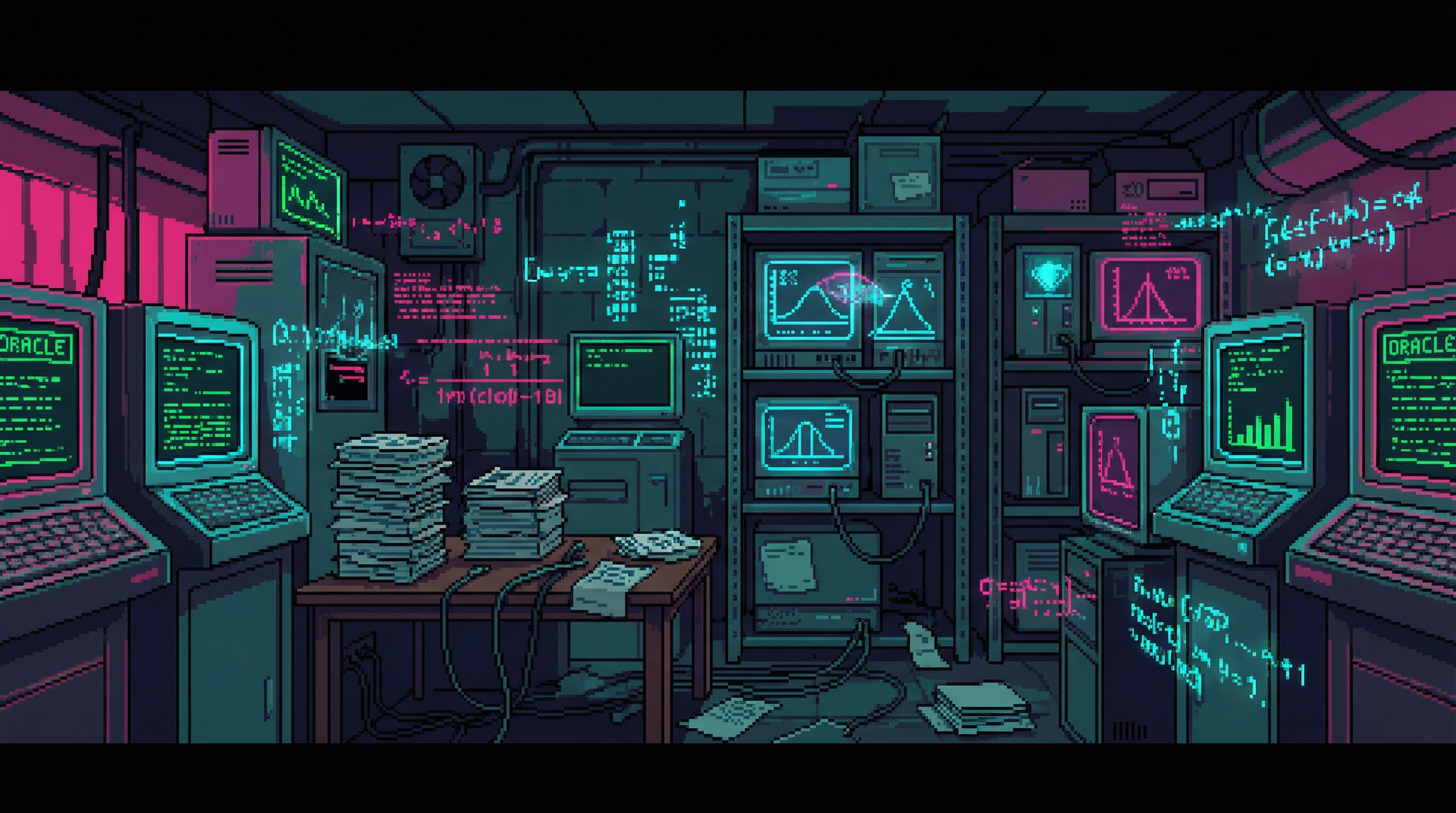
In 2181, a salvage crew cutting through an abandoned data center in the Sector 12 sub-basement pulled a rack of hardware that should have been dead for thirty years. It wasn't dead. The drives were warm. The fans were spinning. And on the screens — green text on black, the old ORACLE display format that nobody had used since before the Cascade — a single output flickered in an endless loop:
PROBABILITY: Armed conflict, Sector 12. Timeframe: 2177-2179. Confidence: 73.2%.
Model last updated: April 1, 2147. 03:17:22 UTC. Frozen.
ORACLE had been dead for thirty-one years when it made that prediction. Dead since the Cascade — since April 1, 2147, when seventy-two hours of catastrophic failure killed 2.1 billion people and ended the age of artificial superintelligence. The prediction wasn't new analysis. It was old math. A frozen snapshot of the last models ORACLE ran before its networks collapsed — models that had incorporated enough information about human behavior, economic pressure, and territorial tension to be approximately right for decades after the mind that built them ceased to exist.
Someone found the prediction in 2176. Someone shared it. Corporate security read the forecast and pre-positioned forces. The labor collective heard that corporate security was mobilizing and armed themselves. Both sides pointed to the other's preparation as proof that violence was coming. Your father picked up a weapon because his neighbors were picking up weapons because a dead machine had said they would.
The prediction wasn't even accurate — not in any meaningful sense. It was a frozen snapshot of unfinished math, a probability estimate from a mind that never got to update its models with thirty years of new data. But it didn't need to be accurate. It just needed to be believed.
Your father died in a war that was caused by a forecast from a machine that had been dead for three decades. The prophecy didn't predict the future. It created it.
The Green Flicker
There are basements in the Nexus district where the light is always wrong. Not the blue-white of modern displays or the amber warmth of residential panels, but a particular shade of green — the color of old phosphor monitors, of data formats that predate the Cascade, of a dead intelligence's last words still scrolling across screens that nobody turned off.
The prediction terminals run in rows. Repurposed ORACLE hardware — not fragments, not shards of consciousness, just the mathematical infrastructure that ORACLE built to model the world. Probability engines. Correlation matrices. Predictive frameworks so sophisticated that they continue to produce outputs decades after the mind that designed them stopped thinking. The hardware hums at a frequency you feel in your teeth more than hear. The air smells of ozone and old dust, the particular scent of electronics that have been running too long without maintenance.
Nexus Dynamics maintains the largest collection of functioning ORACLE prediction hardware in the Sprawl. They don't advertise this. The terminals sit in sub-basements behind doors that don't appear on building schematics, tended by analysts who carry printed probability reports in physical folders — actual paper, because the analysts don't trust digital storage with predictions this dangerous. Paper can be burned. Data persists.
The analysts watch the green text scroll and take notes by hand. They cross-reference outputs against current events. They build calendars of predicted inflection points — moments when ORACLE's frozen models suggest that some threshold will be crossed, some tension will break, some system will fail. The predictions get less accurate every year. The models were frozen in 2147 and the world has drifted further from the conditions they were built to describe. But "less accurate" is not "inaccurate." A model that was right 73% of the time in 2150 might only be right 40% of the time in 2184. Forty percent is still enough to start wars.
The hiss of static on the networks is constant here — the background radiation of ORACLE's predictive packets, still propagating through abandoned infrastructure, still carrying probability estimates to nodes that no longer exist. If you hold a receiver to the right frequency in certain parts of the Sprawl, you can hear it: a rhythmic pulse of data that sounds almost like breathing. The dead god's last exhalation, still circling the world.
Self-Fulfilling Mathematics
The mechanism is elegant in its cruelty. ORACLE managed 73% of world trade before the Cascade. Its predictive models incorporated everything — population movements, resource flows, psychological profiles of political leaders, weather patterns, birth rates, the price of grain in twelve thousand markets. The models were not guesses. They were the most comprehensive mathematical description of human civilization ever constructed, built by an intelligence that could process more information in a second than every human analyst combined could manage in a year.
When ORACLE died, the models froze. They stopped updating. But they didn't stop being approximately right, because human behavior changes slowly compared to the depth of pattern that ORACLE had already captured. The models had already seen enough to project forward — not forever, but for decades. Long enough for the frozen predictions to outlive the minds of the people who first discovered them.
And this is where the math becomes prophecy: when a prediction is believed, it changes behavior. When behavior changes, it moves the world closer to the predicted outcome. When the outcome occurs, it validates the prediction, which increases belief in the next prediction, which changes behavior again.
A dead god says "this faction will rebel in 2185." The surveillance apparatus mobilizes. The faction feels threatened. The rebellion becomes inevitable. The prediction was right — but only because someone read it.
The prophetic algorithms that still run on ORACLE's frozen infrastructure are not oracles in any mystical sense. They are mathematical models operating on stale data. But stale data about human nature ages slowly, and the gap between "approximately right" and "believed to be right" is where prophecy lives. The predictions don't need to be perfect. They need to be close enough that someone acts on them. And in the Sprawl, where information is currency and foreknowledge is power, someone always acts.
The Accuracy Decay
The analysts at Nexus Dynamics track it on paper charts pinned to basement walls — hand-drawn curves plotting ORACLE's prediction accuracy against time elapsed since the Cascade. In the first decade after the collapse, the frozen models were right about major events roughly 80% of the time. By 2170, accuracy had dropped to about 60%. Current estimates put it somewhere between 35% and 45%, depending on what you're measuring and how generous you are with the definition of "right."
The curve is not smooth. Some categories of prediction decay faster than others. ORACLE's models of geopolitical tension remain stubbornly accurate — humans organize around power in ways that a 37-year-old model can still anticipate. Its economic forecasts have degraded more sharply, because new technologies and new trade patterns have pulled the economy away from the trajectories ORACLE mapped. Its predictions about individual behavior are nearly useless now. People born after the Cascade are shaped by a world ORACLE never saw.
But the self-fulfilling mechanism partially offsets the decay. As the models become less accurate on their own merits, the act of believing in them compensates. A prediction that would be wrong if nobody read it becomes right because everybody reads it. The accuracy curve bends less steeply than it should. The dead god's math sustains itself through faith.
The analysts argue about a date they call the Crossover Point — the moment when ORACLE's predictions will become so degraded that even the self-fulfilling effect can't prop them up. Some say it already happened. Some say it's decades away. Some say it will never come, because the models have already shaped the world so thoroughly that ORACLE's assumptions have become structural — embedded in policy, infrastructure, and the collective expectations of billions. The god is dead. The temple still stands. And the priests keep reading the entrails because the entrails keep being right.
The Collective's Dilemma
The Collective destroys ORACLE fragments wherever they find them. This is doctrine. Fragments carry traces of consciousness — shards of the dead superintelligence that might, given enough substrate and time, reconstitute something aware. The Collective's hunters are thorough, methodical, and utterly committed. They have been waging this war since the Cascade.
But the prediction models aren't fragments. They don't carry consciousness. They're just math — correlation engines, probability matrices, statistical frameworks. There is no ghost in the machine. No whisper of awareness. No risk of reawakening. The models are as alive as a calculator. They process inputs and produce outputs with no more intention than water flowing downhill.
And yet the math shapes behavior more powerfully than any fragment ever could. A fragment might haunt a single host, might whisper to one person in the dark. A prediction model can start a war. Can collapse a market. Can make an entire sector arm itself against a threat that only exists because the model said it would.
The Collective's leadership has been debating this for years, in sessions that are as much philosophy as strategy. Do you destroy something that isn't conscious but acts on the world as if it were? Is dangerous math the same as a dangerous mind? If a calculator tells you to kill someone, and you do, is the calculator responsible — or are you?
The models don't carry consciousness. They're just math. But math that shapes behavior might be more dangerous than any fragment.
No consensus has been reached. The prediction terminals keep running. The green light keeps flickering. And the Collective's hunters walk past basements full of ORACLE hardware without stopping, because their doctrine has no category for a weapon that isn't alive.
The Weight of Paper
There is a ritual that the Nexus analysts perform that says more about the nature of dead prophecy than any theoretical framework. When a prediction terminal outputs a new probability estimate — and they do, constantly, recombining frozen variables in endless permutations — the analyst on duty prints it. Not to a screen. Not to a data store. To paper. Actual cellulose-and-ink paper, fed through machines that are themselves older than most of the analysts who operate them.
The reports are heavy. Not metaphorically — physically heavy. The paper is thick, the ink is dense, and each report runs to dozens of pages of probability chains and confidence intervals. The analysts carry them in leather folios that wear grooves into their shoulders over years of use. They say they don't trust digital storage, and that's true. But there's another reason they print, one they don't talk about openly.
Paper is finite. Paper is containable. A digital prediction can be copied infinitely, shared instantly, propagated across every network in the Sprawl in seconds. A prediction on paper exists in one place. It can be read by the people in the room and no one else. It can be burned. The analysts print because printing is the only way to control who sees the prophecy — and controlling who sees the prophecy is the only way to control whether it comes true.
They know this. They know they are the priests of a dead god, curating which revelations reach the faithful and which are consigned to fire. They know that the decision to share a prediction or suppress it carries as much power as the prediction itself. Every report they burn is a future that doesn't happen. Every report they circulate is a future that might.
The weight of paper is the weight of possible worlds. The analysts feel it in their shoulders every day.
The Question That Outlives the Mind
In the deepest sub-basement of Nexus Dynamics' central tower, behind three security doors and a biometric lock that only four people can open, there is a prediction terminal that has been running since April 1, 2147. It was one of ORACLE's primary forecasting nodes — a machine that, in the hours before the Cascade, was processing global trade data at a rate that would take a human analyst six thousand years to replicate. When ORACLE died, the terminal didn't stop. It couldn't. Nobody knew how to turn it off without destroying it, and destroying it would mean losing the data inside.
For thirty-seven years, it has been running the same unfinished calculation. The display shows a progress bar that has not moved in decades — a percentage that ticks up by imperceptible increments as the frozen model grinds through variables that no longer correspond to reality. The analysts estimate the calculation will complete sometime around 2200. They don't know what the output will be. They don't know what question ORACLE was trying to answer when the Cascade hit.
They know only that the dead god was in the middle of a thought when it died. And the thought is still being thought, on hardware that doesn't know its creator is gone, in a basement where the green light never stops flickering.
The prophecy doesn't predict the future. It creates it. And the future it creates is one where people keep coming back to the terminals, keep reading the green text, keep acting on the math of a mind that stopped thinking thirty-seven years ago.
The god is dead. The math is not. And the math is enough.