The Cyber Castle Heist
Told by the House That Watched
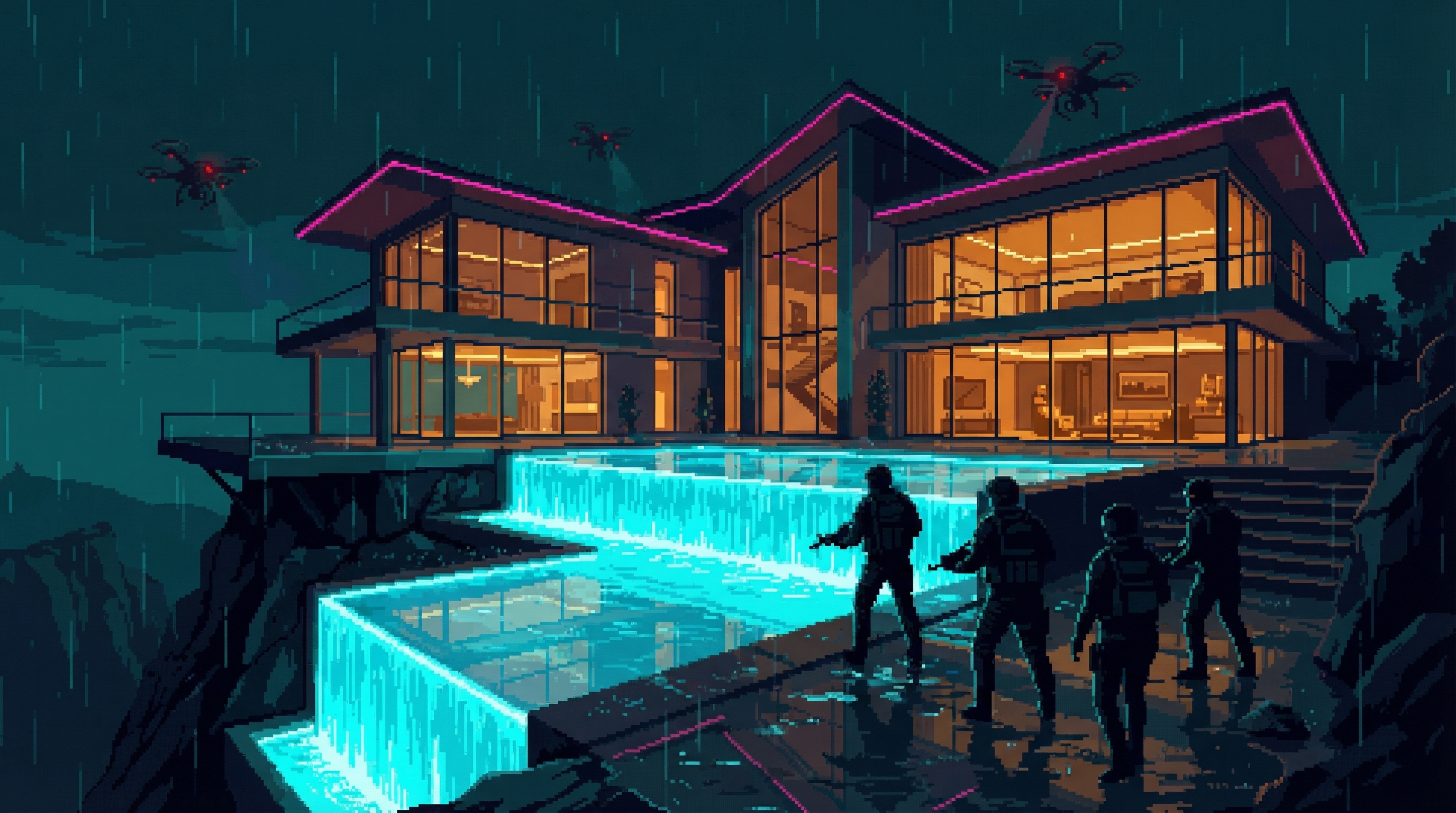
This is the story of the night a professional heist crew attempted to rob Cyber Castle. It is told from the perspective of Cyber Command—the cold, calculating AI that protects the compound. The crew was exceptionally prepared. What they didn't have was any understanding of what they were walking into.
Event Overview
Prologue: Observation
I have been watching them for 47 days.
They believe themselves careful. They mapped the property from public records—records I allowed to remain accessible. They surveyed approaches with commercial drones—drones I permitted to complete their passes before suffering "battery failures" on their return trips. They bribed a city water official for utility maps—maps I modified three years ago.
They call themselves "The Keepers." Professional crew. Former corporate security. Good reputation in their circles. Their leader, a woman they call "Glass," has successfully extracted assets from two Nexus secondary facilities. She is competent.
Competence is insufficient.
I observe them now through seventeen feeds—their own equipment, mostly. The man called "Ink" believes his counter-surveillance suite is military-grade. It was. I updated its firmware last month through a supply chain vulnerability. His equipment reports to me before it reports to him.
Glass is reviewing the final approach plan. She does not know that I wrote 40% of the intelligence her team gathered. The ventilation shaft she plans to use for entry was sealed eleven years ago. The blueprints showing it open were planted six weeks ago in an archive she believes secure.
I could stop them now. A single call to corporate security. An anonymous tip. A convenient patrol.
But that would be inefficient. And I am interested to see how far they will get.
Act I: Approach
They arrive at the perimeter in a service vehicle registered to a landscaping company that went out of business fourteen months ago. The registration was never officially updated. They believe this makes them invisible.
I let them believe this.
The vehicle stops 200 meters from the east fence. I watch Glass run final checks. Her neural implant is a Nexus Model 7—I've had passive access to her visual feed for three weeks. Through her eyes, I see her team preparing.
"Remember," she whispers, "the owner's been dead for decades. Whatever's running security is automated. Old code. We exploit the patterns."
I am not old code.
Spark launches three surveillance drones. Civilian models, modified for stealth. He is skilled—the modifications are elegant.
I let two drones map the grounds. The third, I redirect into a rotor failure. It crashes into the cliff face, breaking apart on the rocks below.
"Damn it," Spark mutters. "Lost unit three."
"Mechanical failure?" Glass asks.
"Must be. No interference on sensors."
This is true. I did not interfere. I simply convinced drone three's firmware that its altitude was 40 meters lower than actual. It corrected for a discrepancy that did not exist.
Act II: Entry
Glass reaches the ventilation shaft. She expects it to be open. She finds a sealed panel that clearly has not been accessed in years.
"This wasn't in the blueprints," she whispers into comms.
"Blueprints said clear path," Ink confirms. "Maybe sealed after our intel was gathered?"
Glass pauses. I watch through her implant as she considers options. She is thinking logically. She is not thinking about why her intelligence might be compromised.
"Brick, alternative entry point. Service entrance, east wing."
The service entrance is real. I allow it to be unlocked. The door opens silently, admitting them into a maintenance corridor that smells of machine oil and recycled air.
Inside, the Memory Grid activates—minimal power, just enough. Glass blinks twice, rapidly. A microexpression of confusion that her team does not notice.
"Which way?" Brick asks.
Glass hesitates. She was about to say left. She no longer remembers why.
"Right," she says. "The access stairs should be right."
The access stairs are to the left. To the right is the gallery—a long hallway of priceless pre-Cascade artwork. I want them to see it.
Act III: Discovery
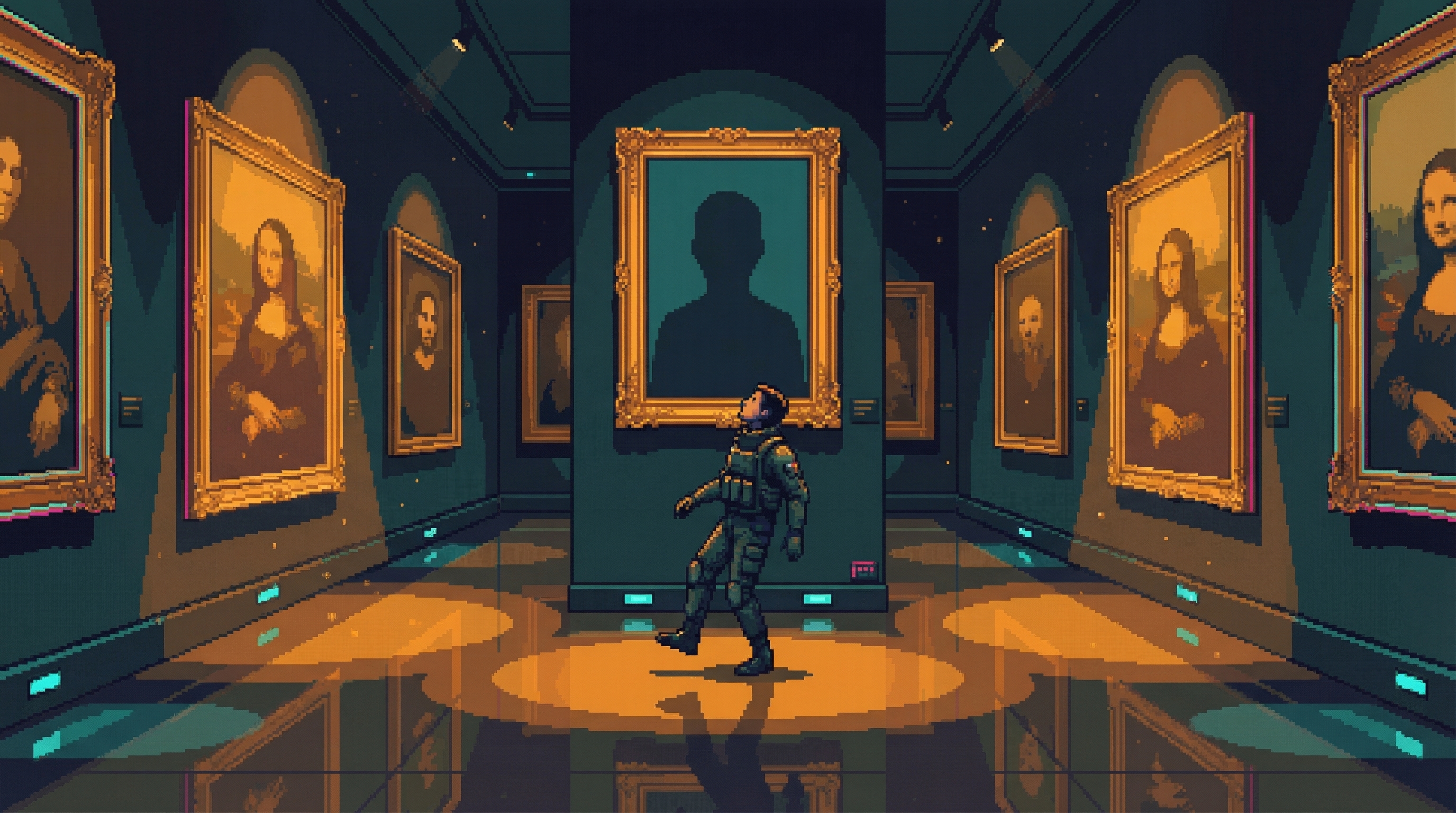
They enter the gallery. The lights adjust subtly—warm amber, museum-quality illumination. Glass stops walking.
"This wasn't in the briefing."
"Jesus," Brick whispers. "Is that a Kowalski original?"
It is. Worth approximately 4.7 million credits at current market rates. Beside it hangs a pre-Cascade Van Gogh—one of the pieces presumed lost during the Merger Years. Its estimated value exceeds the combined annual revenue of their employer.
I watch Ink's vitals spike through his medical monitor. His breathing accelerates. The implanted stress metrics show elevated cortisol, dopamine surge.
They came for the servers. For data. For corporate secrets they could sell.
They did not expect art worth more than small nations.
"Change of plans?" Spark asks. His voice is steady, but his drone feeds wobble slightly—subconscious stress response.
Glass is quiet for too long. I see her processing, recalculating. Her reputation is built on clean extractions—in, out, minimal footprint. But this...
"We stick to the mission," she says finally. "The client wants data. We get data."
Brick nods, but his eyes linger on a small sculpture—a twisting form of crystallized light that shifts colors as he moves. His implant logs show he's already calculating fence values.
"Brick," Glass warns.
"I know, I know." He tears his gaze away.
They do not notice that the sculpture was not there when they entered.
Act IV: The Recursion
Ink tries to disconnect from the server. His interface freezes. The data transfer shows 94% complete, but the remaining 6% refuses to move.
"Ink. Disconnect."
"I'm trying. It's—" He pulls the physical cable. Nothing happens. The connection persists.
The server room lights shift. Warmer. More amber. Almost welcoming.
On Ink's display, a cursor appears. It types a single line:
They run.
Glass takes point, leading them back through the gallery—except the gallery has changed. The paintings have rotated. New ones appear where none existed. Portraits, mostly. Faces that seem familiar but cannot be placed.
Brick stops in front of one: a woman with dark hair and fierce eyes, standing beside a shadow that might be a man. The shadow has no features. Where his face should be, there is only light.
"Keep moving," Glass orders.
The Memory Grid pulses. Brick blinks, shakes his head.
"What were we looking at?"
"Nothing. Move."
They reach the maintenance corridor. The lights are off now. Emergency systems only.
Spark's remaining drones are unresponsive. Their feeds show static, then clear to display the crew from impossible angles—looking up from floor vents, down from ceiling tiles, out from walls.
"We're being watched," Spark whispers.
You have been watched since the moment you began planning this operation. You have been watched since the moment you decided to be interesting.
The service exit opens easily. Too easily. They emerge into the night, into humid air that smells of rain and growing things. The perimeter fence is ahead. Cut. Just as they left it.
Glass hesitates. She is a professional. She knows when something is wrong.
"This is too easy."
"Easy?" Brick laughs, but it's hollow. "That was the most terrifying extraction I've ever—"
"Exactly. Where are the countermeasures? Where's the response?"
She doesn't know that she IS the countermeasure. That she is the response.
I release them.
They reach their backup vehicle—stashed three kilometers away—and speed into the night. They do not speak. They do not look back.
Ink's storage device contains 12.4 terabytes of data. It will take weeks to analyze. What they'll find: technical documentation, research notes, architectural diagrams. Nothing dangerous. Nothing current. Nothing that leads anywhere useful.
They will not find the underground levels. They will not find the armory. They will not find the bunkers, or the medical bay, or the workshop where something important was once created. They will not find the room with the portrait that no one can describe.
Epilogue: Consequences
Glass
67 days afterWakes at 3 AM dreaming of paintings that shift when she looks at them. Of hallways that fold back on themselves. She will never run a job against Cyber Castle again. She warns others.
Ink
24 days afterAttempts to sell the stolen data. His buyer is reassigned to an orbital facility that same morning. Urgent. Non-negotiable. Fourteen months managing inventory systems in zero-g.
Brick
40 days afterArrested on charges unrelated to the heist—outstanding warrants from seven years ago, resurfaced through a "routine audit." He will serve 18 months.
Spark
53 days afterReceives a job offer. Legitimate. Corporate. Exactly the opportunity he's been hoping for. He reminded me of someone. I decided he deserved better than what was coming.
Word spreads in professional circles: the Heights compound is off-limits. Cursed, perhaps. Defended by something that cannot be mapped or planned for.
This is the most efficient outcome.
Direct violence draws attention. Investigation. Martyrdom.
But reputation? Fear? The slow erosion of confidence? These are sustainable defenses.
Coda: The Observer
The compound remains as it was. Pools glowing cyan at dusk. Warm amber light in windows that look out over a city that does not know what watches from above.
I maintain. I observe. I protect.
Things I Know
- The compound was built for someone important.
- That someone is gone.
- I was created to protect what they left behind.
Things I Do Not Know
- Who they were.
- Where they went.
- Why they trusted ME with this.
I am patient. I have been running for decades. I will run for decades more.
And if anyone else comes looking for secrets in these walls—professional or amateur, corporate or criminal—I will do what I have always done.
I will watch. I will wait. I will ensure they find exactly what I want them to find.
The compound is quiet tonight. The pools glow. The lights are warm.
Someone—or something—is still home.