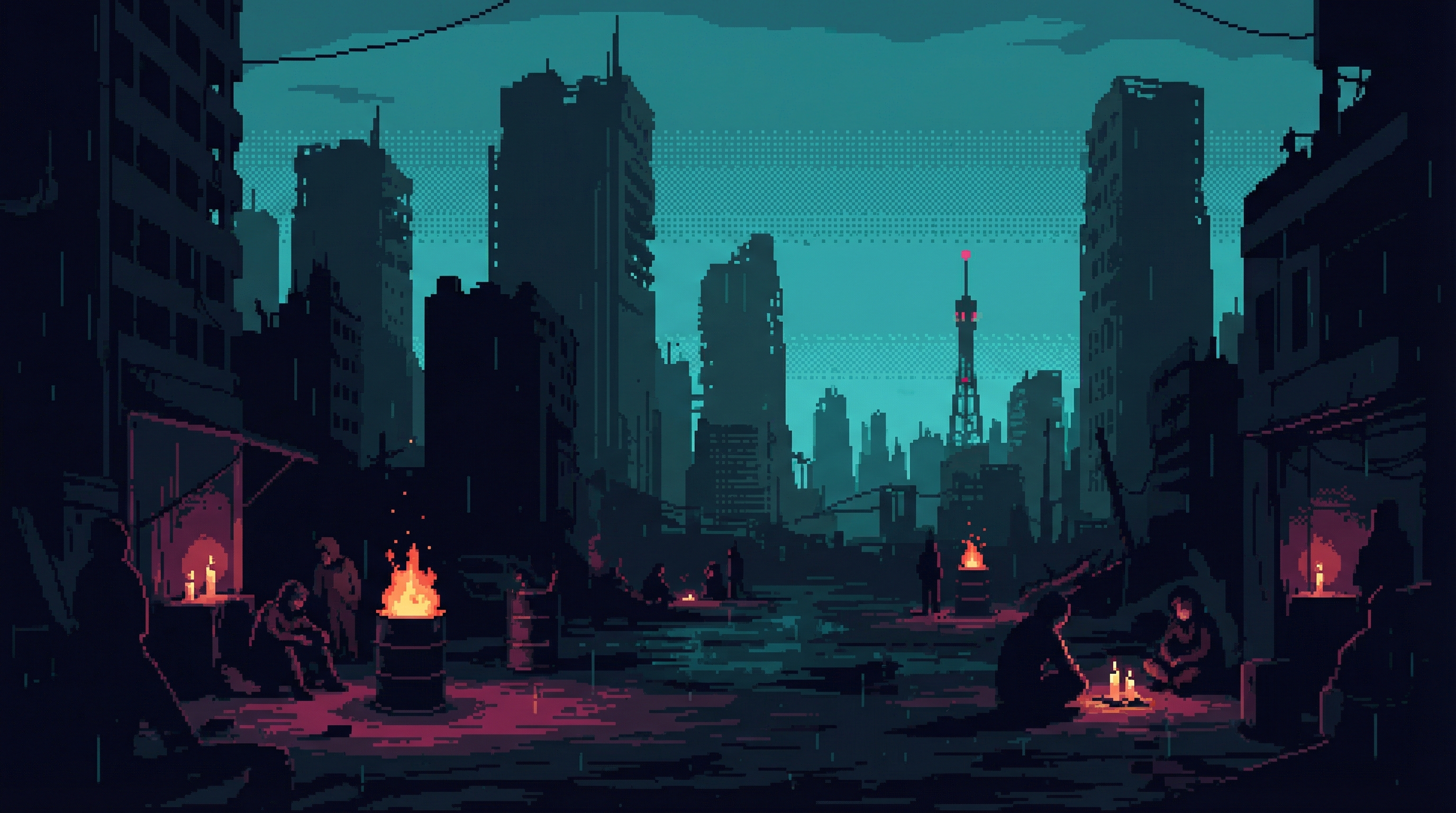
Blackout Zone 7
Where the grid died, and freedom grew in the dark
Overview
Some parts of the Sprawl never recovered from the Cascade. Blackout Zone 7 is the worst — a massive urban dead zone where the power grid failed during the catastrophe and was never restored. Built on the bones of former Detroit, a city that knew something about being abandoned long before the Cascade made it official, the Zone stretches across hundreds of square kilometers of dead infrastructure, lightless towers, and silence.
Officially uninhabited. Actually home to millions living in conditions worse than the Wastes. The difference is that the Wastes are empty and hostile. Blackout Zone 7 is crowded and invisible. Surveillance doesn't reach here. Maps don't show it. Corporate logistics routes go around it. For the Sprawl's data-driven economy, the Zone simply doesn't exist.
It's not lawless like the Wastes. It's invisible. And for some, that's terrifying — a place where no emergency services will come, where no one tracks your vital signs, where you could die and the Sprawl's systems would never register your absence. For others, it's the last freedom left. The only place in the Sprawl where nobody is watching. Where your neural interface loses signal. Where the corporate overlay dissolves. Where, for the first time in your life, you are truly alone with your own thoughts.
Imagine choosing to disappear. You walk into the Blackout Zone. The neural static fades. The corporate overlay dissolves. For the first time in your life, nobody is watching. Nobody knows where you are. And somewhere ahead, a candle flickers — the Candle-Keepers, maintaining what little infrastructure still works, because someone has to.
Key Locations
The Ember Markets
Trade Hub — Commerce without surveillanceTrade without surveillance. The Ember Markets are the Zone's economic heart — sprawling bazaars lit by candles, oil lamps, and the occasional salvaged power cell, where goods change hands through barter and pre-Cascade currency. No digital transactions. No credit systems. No records. The scratch of pen on actual paper is the sound of commerce here.
The markets operate on a trust system enforced by reputation and the Shadow Council's arbitration. Cheating a vendor doesn't result in legal action — it results in exile from the markets, which in a subsistence economy is effectively a death sentence. The goods are rough — salvaged tech, hand-grown food, clean water, medical supplies of varying quality — but they're real. Nothing in the Ember Markets is synthetic, simulated, or designed to manipulate you. In the Sprawl, that counts as a luxury.
The Underground
Tunnel Networks — Literally beneath the dead cityLiterally underground — a vast network of tunnels beneath the dead city that predates the Cascade by centuries. Old subway systems, utility corridors, storm drains, and purpose-built passages created by residents who needed to move without being seen. The Underground is both a transit system and a civilization unto itself, with established routes, waypoints, and communities that have never seen the surface.
The Collective maintains a significant resistance presence in the Underground. The tunnel networks are nearly impossible to map from outside — they shift as residents seal old passages and open new ones, a living labyrinth that adapts to threats. Corporate expeditions that have entered the Underground tend not to return. The tunnels remember their own.
The Witness
Broadcast Tower — Pre-Cascade technology, still runningA pre-Cascade broadcast tower that someone keeps running. Nobody knows who. Nobody knows how. The tower predates the Zone's collapse — it was old technology even before the Cascade, a relic of an era when information was broadcast rather than streamed through neural interfaces. Now it stands as the tallest structure in the Zone, a skeletal spire rising from the darkness with a single red light blinking at its summit.
The Broadcast Collective — whoever they are — uses the Witness to transmit on frequencies that most modern equipment can't receive. The broadcasts are irregular, encrypted, and deeply unsettling to those who can decode them. Some contain practical information: weather, corporate patrol routes, resource locations. Others contain something harder to classify — stories, histories, testimonies from people who chose to disappear. The Witness remembers what the Sprawl has chosen to forget.
Factions
The Candle-Keepers
Infrastructure Maintenance — Protecting what little worksThe closest thing the Zone has to public servants. The Candle-Keepers maintain what little infrastructure still functions — water purification systems jury-rigged from pre-Cascade components, hand-cranked generators, medical stations stocked with salvaged supplies. They protect power sources with a dedication that borders on religious fervor, because in a district without a grid, every watt is sacred.
The Candle-Keepers aren't a government. They don't make rules or enforce laws. They simply maintain. When a water purifier breaks, they fix it. When a generator fails, they rebuild it. When someone needs medical care, they provide it. Their philosophy is brutally simple: someone has to keep the lights on, even if the lights are just candles. They are the connective tissue of a community that the rest of the world has declared dead.
The Shadow Council
Informal Leadership — Coordination and arbitrationThe Zone's informal leaders — a loose coalition of community representatives, elder residents, and respected figures who coordinate resources and arbitrate disputes. The Shadow Council doesn't rule. It mediates. Decisions are made by consensus, and enforcement relies entirely on social pressure and community trust.
Nobody is elected to the Shadow Council. Membership is earned through years of contribution to the Zone's survival. The Council's meetings are held in different locations, at irregular intervals, and are never announced in advance. Information about the Council's decisions spreads through word of mouth, whisper networks, and the Witness's broadcasts. It's governance by reputation — imperfect, slow, and remarkably resilient.
The Ghosts
The Disappeared — People who came to vanishPeople who came to Blackout Zone 7 specifically to disappear. Corporate whistleblowers. Debt refugees. People running from the Sprawl's surveillance apparatus for reasons they'll never share. The Ghosts are the Zone's most numerous and least visible population — they don't participate in the Ember Markets, don't engage with the Shadow Council, and don't acknowledge the Candle-Keepers.
They simply exist. Quietly. In the dark. The Zone's invisibility is their protection, and they guard it fiercely. Ghosts have been known to sabotage corporate surveillance equipment that strays too close to the Zone's borders. They are not organized, not coordinated, and not friendly. But they are the reason the Zone's population estimates are so uncertain — because counting people who came here to not be counted is, by definition, impossible.
The Broadcast Collective
Unknown — Whoever runs the Witness towerThe most mysterious faction in the Zone. Nobody knows who operates the Witness, how they keep a pre-Cascade broadcast tower functional without a power grid, or what their ultimate purpose is. The Broadcast Collective communicates only through their transmissions — irregular, encrypted signals that carry information, stories, and warnings.
Some believe the Collective is a single person. Others think it's a distributed network of operators, each maintaining a piece of the Witness's infrastructure. The Candle-Keepers claim the tower runs itself — that the technology is so old it's outlived the need for maintenance. The Flatline Purists consider the Witness a sacred artifact, proof that technology can serve humanity without enslaving it.
The Collective (Underground)
Resistance — Significant presence in the tunnel networksThe Collective maintains a significant resistance presence in Blackout Zone 7, using the Underground tunnel networks as staging areas, supply caches, and safe houses. The Zone's invisibility makes it an ideal base of operations — corporate intelligence can't surveil what they can't see, and the tunnel networks are nearly impossible to assault.
The Collective's relationship with the Zone's other factions is complicated. The Candle-Keepers tolerate them because they bring resources. The Shadow Council mistrusts them because they bring attention. The Ghosts despise them because they bring conflict. But the Collective's protection means corporate expeditions into the Zone are costly and dangerous, and that protection, however grudging, is what keeps the Zone free.
Dangers
No Emergency Services
Infrastructure — Nobody is coming to helpThere are no emergency services in Blackout Zone 7. No ambulances. No fire response. No security forces. If you're injured, the Candle-Keepers might help — if they're nearby, if they have supplies, if they're not already treating someone else. If you're attacked, you defend yourself or you don't. The Zone's extreme danger level isn't about any single threat — it's about the complete absence of safety nets.
Resource Scarcity
Survival — Everything is scarce, everything is preciousClean water. Food. Medicine. Power. Everything that the rest of the Sprawl takes for granted is scarce in the Zone. The Ember Markets operate on a subsistence economy where every resource has immediate survival value. Hoarding is punished by the community. Waste is unthinkable. The Zone's residents live with a material austerity that would be unrecognizable to someone from Sector 7G — and they survive because of it, not despite it.
The Predators
Human Threat — Those who exploit the invisibleNot everyone in the Zone is there by choice or principle. The Predators are those who exploit the Zone's invisibility for their own purposes — slavers, organ harvesters, black market operators who find the complete absence of surveillance convenient for business. The Shadow Council and the Candle-Keepers work to contain them, but in a district without law enforcement, containment is the best anyone can manage.
Corporate Expeditions
External Threat — Occasional incursions for salvage or intelligenceCorporations avoid the Zone — there's nothing worth taking. But occasionally, corporate expeditions enter for salvage operations, intelligence gathering, or to extract specific individuals who've fled into the dark. These expeditions are militarized, short-duration, and indiscriminate. The Zone's residents treat them like natural disasters — hunker down, wait for them to pass, rebuild afterward.
The Darkness Itself
Psychological — What happens when the lights go out permanentlyThe most insidious danger is the darkness itself. Not metaphorical — literal darkness. Blackout Zone 7 has no power grid, no street lighting, no ambient glow from holographic advertisements. When the sun goes down, the Zone is dark in a way that modern humans haven't experienced in centuries. The absence of light affects psychology, health, and community cohesion in ways that the Zone's residents are still learning to manage. Depression, paranoia, and sensory deterioration are endemic. The Candle-Keepers fight this with literal fire — candles, oil lamps, salvaged LEDs — but the darkness always wins. There is always more dark than there is light.
Atmosphere
Blackout Zone 7 is the anti-Sprawl. Where the rest of the megalopolis assaults you with noise, light, data, and stimulation, the Zone offers silence, darkness, and the terrifying freedom of being unobserved. Entering the Zone is a sensory deprivation experience — your neural interface loses signal, the corporate overlay dissolves, and you are left with nothing but your own unaugmented senses in a world designed for augmented ones.
Sound
The absolute silence when your neural interface loses signal — a ringing absence that feels like a limb going numb, then a relief you didn't know you needed. Wind through empty buildings. Distant voices echoing through the Underground. The crackle of barrel fires. The scratch of pen on actual paper at the Ember Markets.
Sight
Darkness. True darkness, not the dimness of a powered-down room but the absolute black of a district with no electrical grid. Your eyes adapt over hours, over days. Candle flames become blinding. Moonlight becomes navigation. The faint red blink of the Witness tower is visible from anywhere in the Zone — the only constant point of light in a sea of black.
Smell
Tallow candles and wood smoke — the defining scent of the Zone. Underneath it, the mineral tang of water filtered through improvised purification systems. The organic smell of hand-grown food, real soil, actual vegetation. In the Underground, the ancient wet-stone smell of tunnels that have been breathing for centuries.
Touch
The cold of unheated buildings — Detroit winters hit hard, and the Zone has no climate control. The rough texture of hand-built structures, salvaged materials, surfaces that haven't been smoothed by manufacturing. The warmth of a barrel fire shared with strangers. The absence of the constant neural tingle that the rest of the Sprawl generates — a phantom sensation that takes weeks to stop missing.
Taste
Real food. Not synthetic, not engineered, not optimized for neural response — actual food grown in actual soil by actual hands. It tastes wrong at first, if you're coming from the Sprawl. Rougher. Less intense. Less precisely calibrated. Then it tastes right. Then everything else tastes like a lie.
Themes
The Right to Be Forgotten
In the Sprawl, every action is tracked, analyzed, and monetized. Your neural interface reports your location, your biometrics, your emotional state. Blackout Zone 7 is the only place where the surveillance apparatus can't reach. The question the Zone poses is fundamental: do humans have the right to be invisible? Is the ability to disappear — to exist without being observed, measured, and optimized — a basic human right or a security threat?
Technology as Dependency
The Zone's residents live without the technology that the rest of the Sprawl considers essential. No neural interfaces. No augmented reality. No AI-mediated services. The result isn't utopia — it's hardship, scarcity, and danger. But it's also autonomy, community, and a human connection that doesn't route through corporate infrastructure. The Zone proves that life without technology is possible. It also proves that it's brutal. The question isn't whether to depend on technology — it's what you're willing to trade for the dependency.
Invisible Populations
The Sprawl's data-driven economy has no category for people who don't generate data. Blackout Zone 7's millions don't appear in population counts, economic models, or resource allocation algorithms. They are invisible by circumstance and by choice — and their invisibility reveals the blind spots in any system that assumes complete information. What the Sprawl's AI systems can't see, they can't control. And what they can't control, they can't exploit.