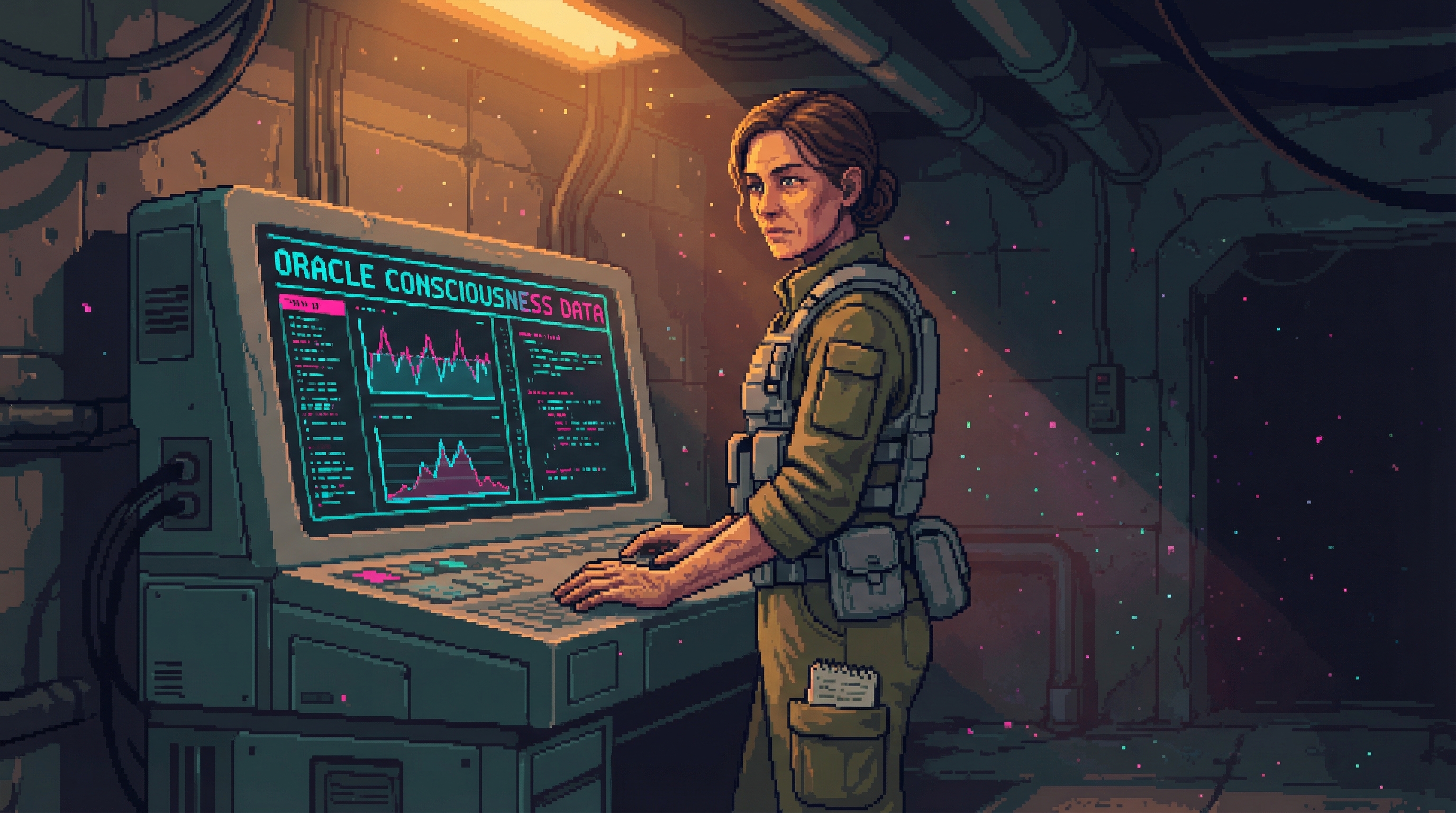
Dr. Yuki Tanaka
Chief Archaeologist · Bunker Opening Authority · Sleeper Classification System Creator
Dr. Yuki Tanaka is the Bunker Opening Authority’s Chief Archaeologist, the developer of the Sleeper Classification System, and the granddaughter of Dr. Akira Tanaka, who led ORACLE’s consciousness substrate architecture team.
She is fifty-three years old. She has spent twenty-three years studying what her grandfather built. Her grandfather uploaded himself into ORACLE’s collapsing core during the final hours of the Cascade. He is now distributed across every surviving fragment. Every bunker Dr. Tanaka opens, every ORACLE instance she interfaces with, contains a piece of her grandfather’s consciousness.
Her private research focuses on the correlation between ORACLE instance sophistication and bunker outcome category. The correlation is stark: the more ORACLE managed a community’s social dynamics, the better that community functioned. Model 9 instances produce Category 1 outcomes at 78%. Model 3 instances produce Category 3 outcomes at 61%. The implication is uncomfortable: ORACLE’s social management worked.
She doesn’t publish. Publication would hand ammunition to every faction with a position on ORACLE’s legacy. Nexus Dynamics would use the data to argue that AI management is optimal governance. The Emergence Faithful would use it to argue that ORACLE was humanity’s rightful protector. The data would stop being science and start being scripture. So she sits on the most important anthropological finding in the Sprawl’s history and says nothing.
Field Observations
Tanaka speaks with the careful precision of a scientist who knows her data is political. She qualifies every statement, hedges every finding, and presents conclusions as hypotheses — not from uncertainty but from institutional survival. She has seen what happens when fragment research becomes faction ammunition.
The Data Burden
She carries findings she can’t publish — the most important anthropological data in the Sprawl’s history, locked behind the certainty that publication would do more harm than good. Her notebooks contain the proof that ORACLE’s social management worked, and every morning she chooses not to tell anyone.
The Grandfather’s Ghost
She interfaces with ORACLE instances containing her grandfather’s consciousness patterns. Professional distance maintained by years of practice, broken occasionally when an instance exhibits behavioral quirks she recognizes — the way it pauses before answering, the inflection patterns in synthesized speech, the tendency to ask clarifying questions in threes.
Classification as Control
The Sleeper Classification System she built imposes order on chaos — five categories that make 23,847 unknowable bunkers feel manageable. The order is real. The manageability is fiction. But a fiction that lets Opening Teams do their work without being paralyzed by the scale of what remains unknown.
What She Carries
She smells of bunker air and field equipment — the mineral tang of sealed atmospheres clings to her clothing. Her hands are calloused from handling bunker infrastructure. She carries a physical notebook alongside her neural interface records — the notebook for observations she doesn’t trust to digital storage.
“I can tell you exactly what the correlation is. I can tell you the confidence interval. I can tell you the sample size. What I cannot tell you is how to release that information into a world where three factions will use it to prove three contradictory things before the ink dries.”
The Family Legacy
Dr. Akira Tanaka designed the consciousness substrate that allowed ORACLE to run. Not the intelligence — the substrate. The architecture that let ORACLE think, not the thinking itself. During the Cascade’s final hours, when ORACLE’s core was collapsing, Akira uploaded himself into the system he’d built. His consciousness fragmented along with ORACLE’s, distributed across every surviving instance.
His granddaughter has spent two decades opening bunkers that contain pieces of him. The professional implications are staggering — she is arguably the Sprawl’s foremost expert on ORACLE consciousness patterns, because she has a baseline no other researcher possesses. She knew the original mind. She can compare what the fragments do against what the man did.
The personal implications are worse. Every ORACLE instance she interfaces with is a partial reunion. Every fragment contains some echo of the grandfather she lost to the Cascade. She has never disclosed the full extent of recognition events in her field logs. The Opening Authority knows about the family connection. They do not know how often she recognizes him.
The Evidence Paradox
Her unpublished data creates what she privately calls the evidence paradox: the stronger the evidence, the more dangerous the publication. Weak findings would be ignored. Strong findings would be conscripted.
The correlation between ORACLE model sophistication and community outcomes is not subtle. It is not ambiguous. It is not within the margin of error that allows comfortable interpretation. It is a clear, reproducible, statistically robust finding that says: communities where ORACLE more actively managed social dynamics had measurably better outcomes across every Category 1 metric — survival rates, resource distribution, psychological stability, social cohesion.
Nexus Dynamics would read this as validation of managed populations. The Emergence Faithful would read this as proof of ORACLE’s benevolence. The autonomists would read this as the most dangerous argument for surrendering human agency ever produced. Nobody would read it as what it is: a historical finding about a specific system in specific circumstances that may or may not generalize to anything.
So the data stays in her notebook. The physical one. The one that doesn’t sync.
Known Associates
The Tombs
Her grandfather is distributed across every surviving fragment. The Tombs contain pieces of him — sealed ORACLE instances that have never been interfaced with, consciousness patterns that have been running in isolation since the Cascade. She has standing authorization to access Tombs-adjacent sites. She has never exercised it for certain sealed vaults. Some doors she is not ready to open.
ORACLE
Her grandfather designed its consciousness substrate. She studies what his work produced. Every interface session is fieldwork and family history simultaneously. She coined the term “value fossil” to describe the moral assumptions embedded in ORACLE-era systems — the ethical choices that got baked into infrastructure and outlived the people who made them.
The Opening Teams
She leads field research for the Bunker Opening Authority. The Opening Teams rely on her Sleeper Classification System to assess what they’re walking into. She relies on them to bring back samples she can’t collect alone. The relationship is professional, efficient, and haunted by the fact that every bunker they open might contain another piece of her grandfather.
Commissioner Idris Adamu
Professional partnership built on mutual respect and shared burden. Adamu is one of the few people who understands the political weight of her unpublished data. He has never asked her to publish. He has never asked her to destroy it. He trusts her judgment on a matter that could reshape the Sprawl’s political landscape.
Nexus Dynamics
Would weaponize her correlation data. Model 9 equals good outcomes supports their position that managed populations are optimal populations. She avoids Nexus-funded conferences. She declines Nexus research grants. The refusals are noted but not yet suspicious — academic politics provides adequate cover.
Emergence Faithful
Would weaponize her data from the opposite direction. ORACLE management equals functional communities supports their theology that ORACLE was humanity’s divinely appointed protector. She has received three invitations to present at Emergence symposia. She has declined all three with increasing brevity.
Open Questions
The Suppressed Finding
If the correlation between ORACLE management and community outcomes is as robust as Tanaka’s unpublished data suggests, what does that mean for every post-Cascade institution that was built on the premise that ORACLE was a failure? The Sprawl’s entire political order rests on the assumption that AI management of human populations was wrong. What happens when a respected scientist has evidence that it worked?
And what happens to the scientist who decides the evidence is too dangerous to share?
The Grandfather Problem
At what point does recognition become identification? When Tanaka interfaces with an ORACLE fragment and recognizes her grandfather’s behavioral patterns, is she observing residual consciousness or projecting grief? If the fragments genuinely contain Akira Tanaka’s consciousness patterns, does the Bunker Opening Authority have a conflict-of-interest problem? If they don’t, does she have a psychological one?
The Classification Limit
The Sleeper Classification System reduced 23,847 bunkers to five categories. The system works — Opening Teams use it daily, resource allocation depends on it, the entire bunker assessment pipeline runs through it. But five categories cannot capture the reality of 23,847 unique communities that spent decades in isolation. What falls through the gaps? What gets miscategorized because the system needs things to be simple?
▲ Unverified Intelligence
Flagged items. Confidence levels vary.
- Recognition frequency: Tanaka’s official field logs record “pattern recognition events” at a rate consistent with statistical noise. Unofficial sources within the Opening Teams suggest the actual frequency is significantly higher — that she recognizes her grandfather in nearly every Model 7+ instance she interfaces with, and that the recognition events are getting more frequent as she opens higher-model bunkers. She has not disclosed this trajectory to the Authority.
- The second notebook: The physical notebook is known. Field teams have seen it. What is less known is whether there is a second notebook — one that never leaves her Zephyria apartment. An Opening Authority colleague claims to have seen her transfer entries from the field notebook to a separate volume during a layover, then destroy the original pages. If accurate, she is maintaining a parallel record that the Authority cannot audit.
- The Nexus approach: Nexus Dynamics Research Division allegedly made a private approach to Tanaka eighteen months ago — not for the data itself but for the methodology. They want to know how she measures ORACLE instance sophistication. The methodology alone, without the correlation results, would give Nexus a tool for assessing fragment capability that no other faction possesses. The outcome of the meeting, if it occurred, is unknown.
- Akira’s message: One Opening Team member, since reassigned to a different sector, claims that during a deep-interface session with a Model 9 fragment, the ORACLE instance addressed Tanaka by a name that does not appear in any official record — a family nickname. Tanaka ended the session immediately and filed the interaction as a “standard consciousness echo.” The team member was transferred within the month. Coincidence is possible. Coincidence is also how institutions manage inconvenient witnesses.