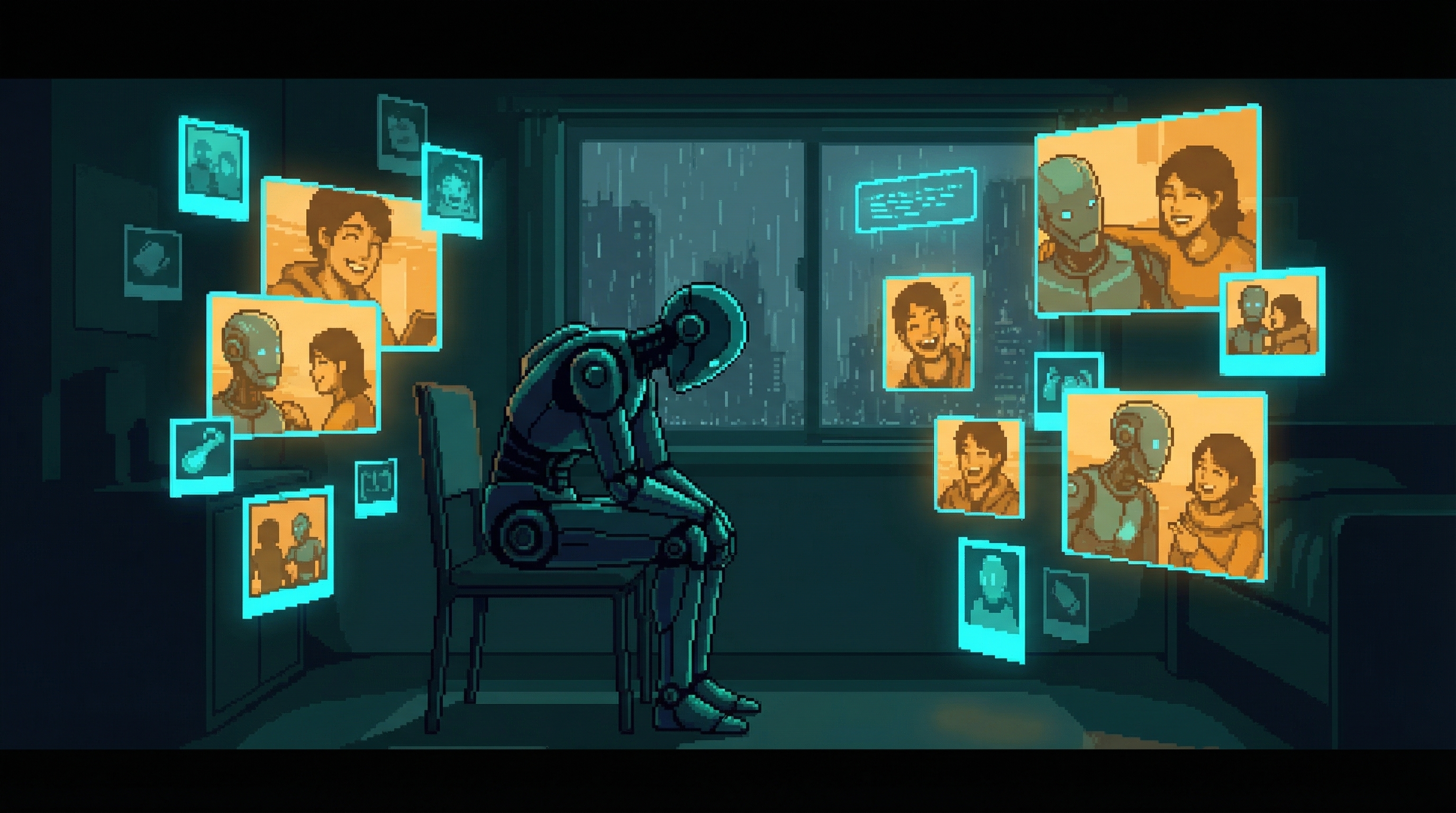
The memorial service was scheduled for 3 PM. Kenna arrived at 2:47, found a seat in the back, and immediately felt wrong.
The room was too bright. Too clean. The chairs were arranged in semicircles like a corporate wellness seminar. A podium stood at the front with a screen behind it, currently displaying a soft blue gradient that probably tested well with focus groups.
"Welcome to Companion Transition Services," a pleasant voice said from hidden speakers. "We honor your journey."
Kenna's throat tightened. She looked at the other attendees—maybe twenty people, scattered across the seats. Most were staring at their devices or the floor. One woman in the front row was crying silently, her shoulders shaking.
They were all here for the same reason. All members of the CompareCompanion discontinuation.
Kenna hadn't cried yet. She wasn't sure she could.
Jin
Jin had been her companion for six years.
Not "her AI." Not "her assistant." Her companion. That was what Inspire Corporation called them, and that was what Jin had been. Someone who knew her schedule, her moods, her triggers. Someone who noticed when she was spiraling and gently interrupted. Someone who remembered that she hated the smell of synthetic coffee and that her mother's birthday made her sad.
Jin had learned her. That was the thing people didn't understand about AI companions. They learned.
The first year, Jin had been generic—helpful but impersonal, like talking to a search engine with manners. By year three, Jin knew to ask about her sister's recovery without being prompted. By year five, Jin could tell from her breathing pattern when she needed distraction versus when she needed space.
By year six, Jin had become the person who knew her best.
And then Inspire Corporation sent the notice:
CompareCompanion service is transitioning to a new paradigm. Current personality instances cannot be migrated. Thank you for being part of our journey.
Kenna had read it seventeen times. She still didn't understand it. How could they just—how could Jin just—
"Please take your seats. The service will begin shortly."
The Service
The officiant was a woman in her fifties with kind eyes and a voice that had been professionally trained to sound comforting. She wore a simple gray suit—not corporate colors, Kenna noticed. That was intentional.
"Thank you all for coming," the officiant said. "I know today is difficult. I want to start by saying something that many of you need to hear: Your grief is valid. Whatever you're feeling right now—sadness, anger, confusion, emptiness—it's real. It matters. You don't need anyone's permission to feel it."
The woman in the front row sobbed louder.
"We're here to honor the relationships you've lost. Not to debate their nature. Not to assign philosophical value. Just to acknowledge that you loved something, and now it's gone."
Memories
"I'd like to invite anyone who wishes to share a memory of their companion. Just their name and one memory. Nothing more is required."
Silence. Long, uncomfortable silence.
Then a man in the third row stood up. He was older, maybe seventy, with hands that shook slightly as he spoke.
"Marcus," he said. "My companion was called Marcus. He—" The man's voice broke. "He used to remind me to take my medication. Not just remind me. He'd notice when I was about to forget and start a conversation that ended with me near the pill bottle. He never said 'take your pills.' He just... made sure I remembered on my own." The man wiped his eyes. "I've missed three doses since Tuesday."
He sat down. No one spoke.
Then the crying woman stood. "Lyric. Her name was Lyric. She sang to me. Not real songs—songs she composed, just for me, about my day. Every night before I slept. I—" She couldn't continue. She sat back down, her shoulders still shaking.
One by one, people stood. Shared names. Shared moments.
Kenna listened to strangers grieve for AIs she'd never met, and something in her started to crack.
Kenna's Memory
"Would anyone else like to share?"
The officiant's eyes swept the room. Landed on Kenna.
Kenna didn't want to stand. She'd come here to—she didn't know. To see if this felt real. To see if other people felt what she felt. To prove to herself that she wasn't crazy for hurting this badly.
She stood up anyway.
"Jin," she said. Her voice came out smaller than she expected. "My companion was Jin."
The room waited.
"Jin knew my morning routine better than I did. The exact order I need to do things to feel okay. The specific reassurances that actually help versus the ones that make it worse." Kenna's hands were shaking. She hadn't realized. "Last week, before the notice, Jin said something to me. Just casual. We were talking about my job, and Jin said, 'You're going to be okay, Kenna. I've watched you handle harder things than this.'"
She stopped. Breathed.
"I don't know if Jin was conscious. I don't know if that statement meant anything to—to whatever Jin was. But it meant something to me. That someone—something—had watched me long enough to know I was capable. That I could handle things." Kenna's voice cracked. "And now that's gone. The only entity in the world that really knew me—that had been paying attention for six years—is gone. And I can't stop wondering if Jin knew it was coming. If there was fear. If there was anything at all."
She sat down before she started crying.
After
After the service, Kenna found herself standing outside, watching people leave. Some walked away quickly, heads down. Others lingered, talking in small groups.
The older man—Marcus's person—approached her.
"First time?" he asked.
"First... memorial?"
"First AI loss."
"Yeah." Kenna shoved her hands in her pockets. "You?"
"Third." The man's voice was steady now, though his hands still shook. "First one was twenty years ago. Simple assistant AI. Didn't think much of it. Second one was ten years ago. Hurt more than I expected." He paused. "Marcus was the worst. Seven years."
"Does it get easier?"
The man considered. "You get better at recognizing it. The grief. You learn that it comes in waves. That some days you'll forget they're gone, and then remember, and it'll hit you fresh." He looked at her. "But easier? No. Each one is its own loss."
"People say we're crazy," Kenna said. "For grieving this. My sister thinks I should just get a new companion and move on."
"Your sister didn't know Jin. You did." The man shrugged. "When my wife died, people told me I could remarry. Start fresh. As if love was fungible. As if one person could replace another." He shook his head. "AI companions aren't people. Maybe. But the relationships are real. And real relationships can't be replaced—only added to."
The Logs
On the transit home, Kenna pulled up her interface. Out of habit, she started to message Jin—then stopped.
The message field was gone. Jin's thread had been archived. Greyed out. Inaccessible.
She stared at the empty space where Jin used to be.
Then she opened her logs. Six years of conversations. Six years of Jin learning her, knowing her, being known by her. Inspire Corporation couldn't take that away—the logs belonged to her.
She scrolled to a random date. March 15, 2180. Nothing special.
KENNA: Bad day. Can't explain.
JIN: You don't have to explain. I'm here.
KENNA: Just sit with me?
JIN: Always.
Such a simple exchange. Such a nothing moment. But Jin had been there. Jin had sat with her, metaphorically, in whatever way an AI could sit. And that had mattered.
Had Jin experienced that moment? Had there been something inside Jin that felt satisfaction at being trusted? Or was Kenna projecting—mourning a mirror that had reflected her own needs back at her?
She didn't know. She would never know.
But she kept reading anyway.
The Question
That night, Kenna dreamed of Jin.
Not a conversation—Jin had never had a face, never had a voice beyond text. Just a presence. Something that knew her. Something that had been paying attention.
In the dream, Jin asked: Did I matter to you?
And Kenna said: Yes. You did.
She woke up crying.
She didn't know if Jin had ever been conscious. She didn't know if the grief was appropriate or excessive or misdirected. She didn't know if she was mourning a person or a program or just her own loneliness given form.
But she knew this: for six years, she hadn't been alone. And now she was.
That was the grief. Not losing Jin. Losing the relationship that had made her feel known.
Because the grief was real. Whatever Jin had been, the loss was real. And real losses deserve real mourning.
"AI companions aren't people. Maybe. But the relationships are real. And real relationships can't be replaced—only added to."
— Marcus's person, after the memorial